
By Jenny Leung (u6018651)
For my volunteer work experience, I participated in a bird survey with Phil, studying the value of mature trees in urban environments. The study is a long-term research conducted around Canberra and investigated the purpose of mature trees, the usage of it by mostly birds. Several papers have been published using the data they have previously collected (Le Roux et al., 2016, Le Roux et al., 2018).
In the morning of the survey, we set off our trip at 6 in the morning. It was a windy day with lots of sunshine and a bit of cloud in the sky; the temperature was 12-14˚C. We went to 4 study sites in Gungahlin and got to observe mature trees of yellow box (Eucalyptus melliodora) and Blakely’s red gum (Eucalyptus blakelyi).

Log piles near study site.
In the survey, we looked at a few aspects of the bird-and-tree interaction. We observed the species of the bird, the direction the bird came and go, the behaviour of the bird, the duration of the bird interacting with the tree, the branch angles the bird landed in and the thickness of the branch. During the survey, we saw Noisy Miners, Australian Magpies, Striated Pardalotes, and Crimson Rosellas interacting with the trees. We also happened to see some other birds like Australian Ravens, Welcome Swallows, Sulphur-crested Cockatoos, Magpie Larks, and European Starlings. Some of the birds are nesting on the trees like the picture below.
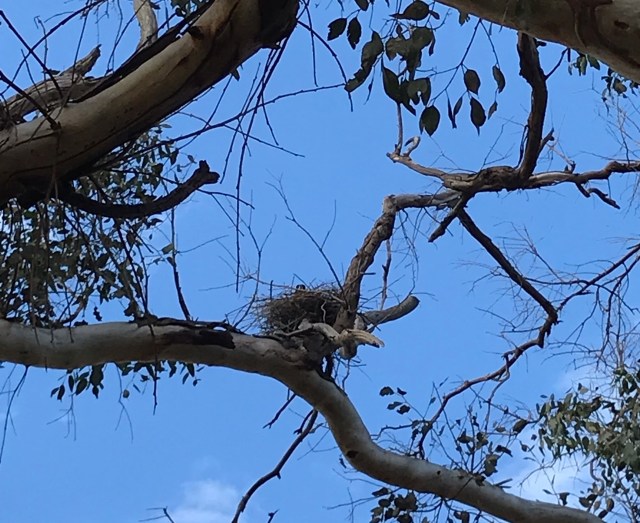
Australian Magpie nesting on a tree
We even get to see reptiles; we discover a Three-toed Skink underneath a piece of rock. At first, we have mistaken it for the endangered Striped Legless Lizard, as we are so desperate to meet one. However, with further observation, we can see that the reptile has little limbs, and its colouration does not match with the Striped Legless Lizard. Phil later told us that it is a Three-toed Skink (Hemiergis decresiensis) and the species turned out to be quite wide spread in the NSW and the ACT region (ALA, 2018).
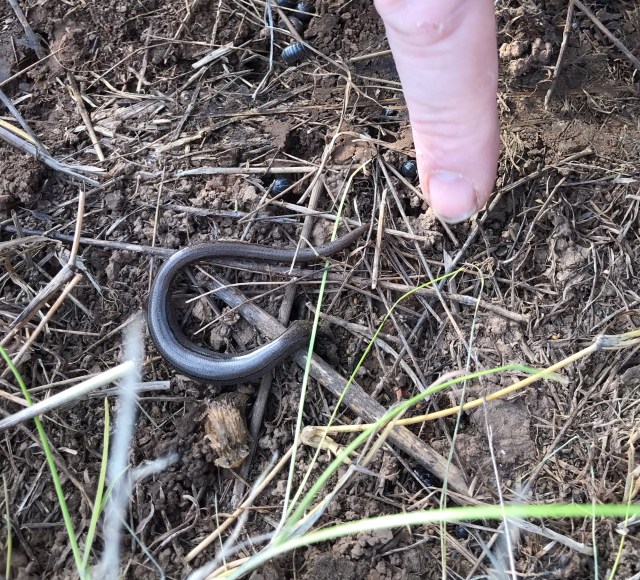
The Three-toed skink in ratio with a finger.
It was quite sad to see that sites that have been supervised for over ten years were undergoing development, sites that used to be surrounded with natural environments, were now under development and turned into construction sites. It is good to see that the mature trees are fenced up and being protected; this may be the result from previously published paper with emphasis on the importance of mature trees and recommendations on how to conserve them (Le Roux et al., 2014). However, we estimate that the bird population/traffic at the site was decreased by the noise from construction sites and the change in environment.

Photo of Australian Raven on construction sites.
References
ALA (Atlas of Living Australia). 2018. Website at https://bie.ala.org.au/species/urn:lsid:biodiversity.org.au:afd.taxon:b056de1e-b7c7-44ce-902d-7cc0f393d0a0. Accessed 9 October 2018.
Le Roux, D.S., Ikin, K., Lindenmayer, D.B., Bistricer, G., Manning, A.D. and Gibbons, P., 2016. Enriching small trees with artificial nest boxes cannot mimic the value of large trees for hollow‐nesting birds. Restoration ecology, 24(2), pp.252-258.
Le Roux, D.S., Ikin, K., Lindenmayer, D.B., Blanchard, W., Manning, A.D. and Gibbons, P. 2014. Reduced availability of habitat structures in urban landscapes: implications for policy and practice. Landscape and Urban Planning, 125, pp.57-64.
Le Roux, D.S., Ikin, K., Lindenmayer, D.B., Manning, A.D. and Gibbons, P., 2018. The value of scattered trees for wildlife: Contrasting effects of landscape context and tree size. Diversity and Distributions, 24(1), pp.69-81.

 Biodiversity Conservation
Great blog
I enjoyed reading this Jenny. Sounds like interesting research!!! Phil