
By Emily Jones (u5714668)
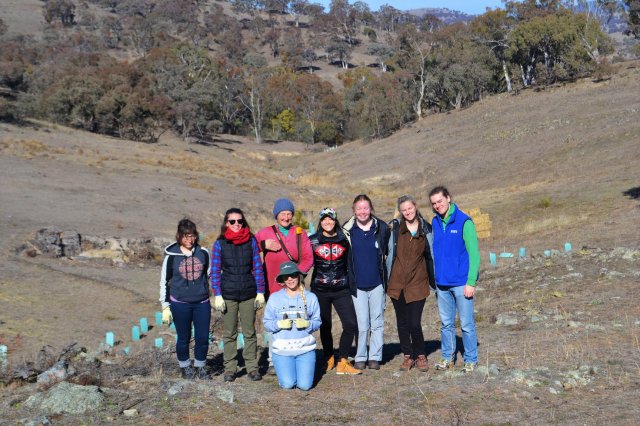
ANU Intrepid Landcare with Carolyn Larcombe at Grasshopper Gully. Photograph: David Stock (2018)
On a chilly August morning, myself and others from ANU Intrepid Landcare headed to a private property near Queanbeyan to undertake some restoration work. Upon arrival, I looked out of the minibus at the landscape around me. The property looked like many I had worked on before, with large tracts of native grassland, beautiful patches of remnant bushland and native seedlings dotted about the place.
However, there was one important difference, which made Carolyn Larcombe’s private property unlike any I had ever visited: There were no commercial activities in sight.
As it turns out, Carolyn had removed cattle from her property about ten years ago. She has been managing her property exclusively for conservation ever since.
Video (with fantastic footage of the Wandiyali-Environa Conservation Area) explaining Carolyn’s story and projects being carried out within the Wandiyali-Environa Conservation Area. Source: Carolyn Larcombe
Carolyn’s property, now named the Wandiyali-Environa Conservation Area, is certainly worth restoring. The site provides vital connectivity between areas like the Molonglo Ranges and the Murrumbidgee River Corridor (Wandiyali Restoration Trust, 2018). It also contains more than 400ha of remnant Box Gum Grassy Woodland, an endangered ecological community (Australian Government, n.d.).
It was a small area of this Box Gum Grassy Woodland, dubbed ‘Grasshopper Gully’, that ANU Intrepid Landcare had been tasked with restoring.
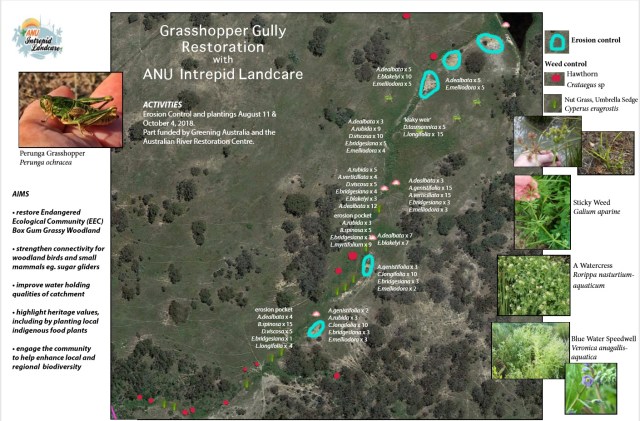
Restoration activities undertaken by ANU Intrepid Landcare at Grasshopper Gully on August 11 and October 4th. The graphic depicts the both the species and number of seedlings (as well as their location) planted at Grasshopper Gully, as well as sites where erosion and weed control have been undertaken. Source: Carolyn Larcombe (2018)
After setting up a photopoint for long-term monitoring of the site, we spent the morning controlling erosion in a small tributary, which flows into Jerrabomberra Wetlands.
We then spent the remainder of the day planting native seedlings, with the dual aims of restoring Box Gum Grassy Woodland at the site, as well as improving connectivity between remnant patches of vegetation.
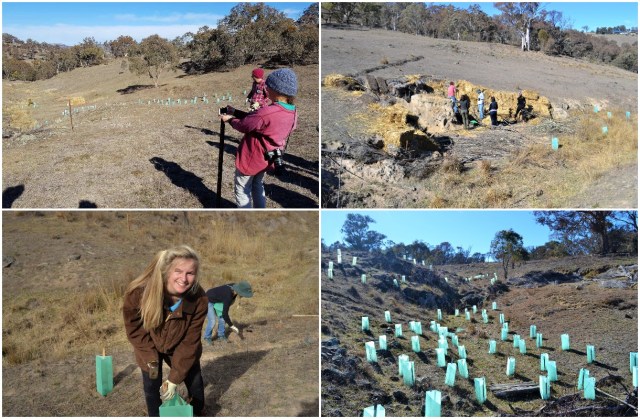
Top Left: Carolyn Larcombe setting up a photopoint for monitoring of Grasshopper Gully. Photograph: Emily Jones (2018). Top Right: Intrepid Landcarers undertaking erosion control in Grasshopper Gully. Photograph: Renee Gonlag (2018). Bottom Left: Planting seedlings in Grasshopper Gully. Photograph: Michael Malone (2018). Bottom Right: Some of the seedlings planted in Grasshopper Gully, both by ANU Intrepid Landcare and previously by Carolyn Larcombe. Photograph: Renee Gonlag (2018)
My time at Grasshopper Gully really emphasised to me just how valuable conservation activities on private land can be for biodiversity.
Unfortunately, Australia’s National Reserve System is not large enough to protect biodiversity on its own. The reserve system only covers around 19% (at most) of Australia’s land area, yet we need at least 30% of habitat to remain if we are to slow the accelerated decline of species richness in a given landscape (DOEE, 2018; Andren, 1994).
Further, many of Australia’s bioregions are poorly represented in the National Reserve System (Neville & Arthington, 2009). This is because it’s largely only commercially unviable land that receives reserve status, whilst many ecological communities and threatened species largely occur on land suited to agriculture (Pressey et al., 2000).
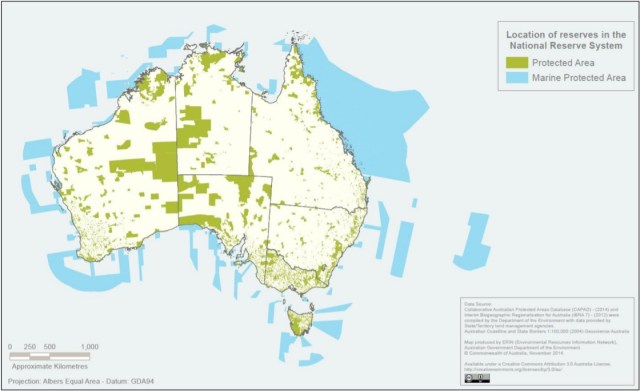
The location and size of reserves in the National Reserve System. Source: Collaborative Australian Protected Areas Database (2014)
Alternatively, private land covers around 70% of Australia’s land area, and harbours many threatened species and ecological communities (Figgis, Humann & Looker, 2005). Like the Wandiyali-Environa Conservation Area, private land can also be vitally important in providing connectivity between patches of remnant vegetation (Figgis et al., 2005).
“Private land covers around 70% of Australia’s land area, and harbours many threatened species and ecological communities”
Consequently, the importance of conservation on private land is significant. As such, many landholders, like Carolyn, are actively conserving habitat on their properties, often doing so with the help of volunteer-driven organisations and government programs (CoA, 2007).
Unfortunately, however, Carolyn’s work is not representative of broader trends at play on Australia’s private land.
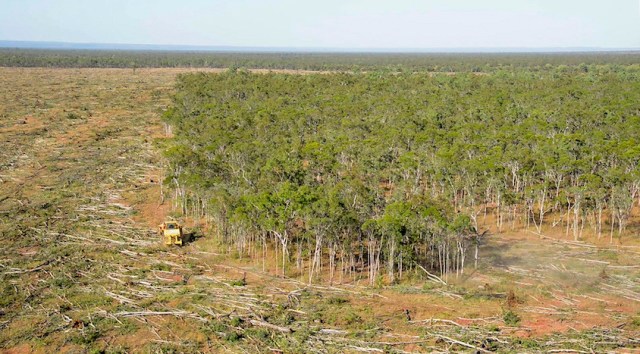
The clearing of tropical forest on Cape York Peninsula. Photograph: Photograph: Kerry Trapnell/The Wilderness Society.
Instead, evidence suggests habitat destruction on private land is increasing (Hannam, 2018). For instance, clearing of native vegetation in NSW increased by 800% from 2014 to 2016, associated with the relaxation of land clearing laws for private landholders (Davies 2018).
As such, it seems strong policy is needed to turn these trends around, to see more landholders preserving and restoring, rather than destroying, important habitat on private land (Bekessy & Wintle, 2017).
If this work sounds like something you might like to get involved with, get in contact with ANU Intrepid Landcare here.
If you’d like to support Carolyn’s work financially, please donate to the Wandiyali Restoration Trust here.
References
Andren, H. (1994). Effects of habitat fragmentation on birds and mammals in landscapes with different proportions of suitable habitat: a review. Oikos, 355-366.
Arthington, A. H., & Nevill, J. (2009). Australia’s Biodiversity Conservation Strategy 2010–2020: scientists’ letter of concern. Ecological Management & Restoration, 10(2), 78-83.
Australian Government (n.d.). Approved Threatened Species Recovery Fund Open Round Projects. [PDF] Available at: http://www.nrm.gov.au/system/files/pages/9d130a47-9239-4694-9392 -9fee1d57cd76/files/tsrf-approved-projects.pdf [Accessed 02 Oct. 2018].
Commonwealth of Australia (CoA) (2007). Conserving Australia: Australia’s national parks, conservation reserves and marine protected areas. [online] Parliament of Australia. Available at: https://www.aph.gov.au/parliamentary_business/committees/senate/ environment_and_communications/completed_inquiries/2004-07/nationalparks/report/index [Accessed 6 Oct. 2018].
Davies, A. (2018). Clearing of native vegetation in NSW jumps 800% in three years. The Guardian Australia. [online] Available at: https://www.theguardian.com/australia-news/2018/aug/04/clearing-of-native-vegetation-in-nsw-jumps-800-in-three-years [Accessed 5 Oct. 2018].
Department of the Environment and Energy (DOEE) (2018). National Reserve System protected area requirements. [online] Available at: http://www.environment.gov.au/land/nrs/about-nrs/requirements [Accessed 2 Oct. 2018].
Figgis, P., Humann, D., & Looker, M. (2005). Conservation on private land in Australia. Parks, 15(2), 19-29.
Hannam, P. (2018). ‘Really scary’: NSW environment minister warned of land-clearing leap. Sydney Morning Herald. [online] Available at: https://www.smh.com.au/environment/conservation/nsw-environment-minister-land-clearing-upton-20180302-p4z2ji.html [Accessed 3 Oct. 2018].
Pressey, R. L., Hager, T. C., Ryan, K. M., Schwarz, J., Wall, S., Ferrier, S., & Creaser, P. M. (2000). Using abiotic data for conservation assessments over extensive regions: quantitative methods applied across New South Wales, Australia. Biological Conservation, 96(1), 55-82.
Wandiyali Restoration Trust (2018). Wandiyali Restoration Trust – Biodiversity Restoration and Resilience.
Wintle, B. and Bekessy, S. (2018). Let’s get this straight, habitat loss is the number-one threat to Australia’s species. The Conversation. [online] Available at: https://theconversation.com/lets-get-this-straight-habitat-loss-is-the-number-one-threat-to-australias-species-85674 [Accessed 6 Oct. 2018].


I love the way you linked your work experience to the bigger picture Emily. Phil