
Over the last couple of months, I’ve been involved in organising the establishment of a native bee pollinator garden at the Acton Community Garden. Leading the project, my roles thus far include researching suitable plant species, weeding, landscaping and planting out the area, garden design, meeting and collaborating with others involved, securing funding for the project and sourcing plants. While the project is still very much in its fledgling stages, in a few more months, what was previously an unused patch of weeds will soon be a gorgeous, diverse garden utilised both as an educational resource and as habitat to encourage native pollinator biodiversity on campus and in surrounding areas.
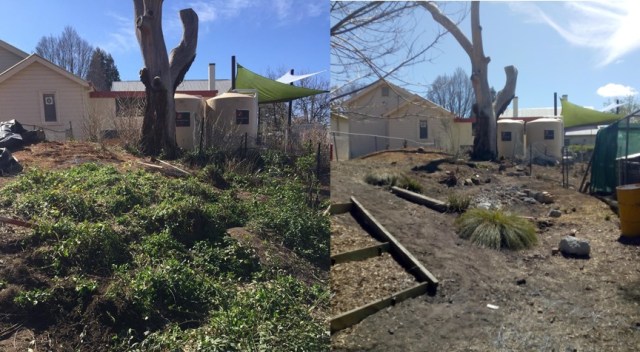
Before (overrun with periwinkle) & After (Weeds cleared, landscaping and planting underway)
Collaboration!
One of the most exciting elements of this project thus far are the diverse range of individuals that have come together to help bring it to life. Being located at the Acton Community Garden, this project is indeed all about community. It will exist for the community (both bee and human) and is being established by the community. Key players in this network thus far include the amazing staff at the Canberra Environment Centre (special shout out to Karina!), their generous volunteers, the wonderful ANU Environment Collective for allocating funding to the project, and those much more knowledgeable than myself who have helped to advise on garden design, appropriate plant species etc.
Education!
While the garden itself will help to encourage native bee visitation to the area, it will prove most valuable by acting as an educational tool for the broader community. The garden will include signage on things such as the aims of the garden, the incredible diversity of Australian bees, and how individuals can go about making their own gardens at home more bee friendly, with a QR code at the bottom of the sign linking them to more information about the project on the Canberra Environment Centre website. Indeed, the webpage itself will likely see more traffic than the garden itself, however the garden will still prove valuable as it will act as a palpable example of what a native pollinator backyard might look like. The garden is also located right alongside a day care centre, and so will help to foster biophilia, through environmental education, by helping to connect the little critters at the day care centre to the little critters in the garden.
Corridors!
It is hoped that by establishing this tiny slice of habitat, an increase in habitat connectivity will allow native pollinators to move across ANU’s fragmented landscape, helping to “play an important role in pollinator conservation”. But more importantly, it is my hope that the public will be inspired to plant their own native pollinator gardens, thereby creating corridors and enhancing the habitat connectivity for native pollinators across Canberra. These urban gardens can act as a vital resource for native bee fitness.
Watch this space!
While the garden to date is mostly just a (now weed free) patch of dirt, with a few sparse plantings and the beginnings of some landscaping, it is leaps and bounds ahead of where it was a few short weeks ago, and it continues to grow. So, watch this space, and if you’re interested in getting involved, come along to the volunteer working bee this Saturday the 13th from 10-12am to check it out and lend a hand!
Written by u5799681

 Biodiversity Conservation
It’s great to hear that this is happening on campus. Phil