
Accompanying the wildlife rangers in their daily rounds struck me as a similar system to a commercial farm. I found myself performing familiar tasks such as when I’m helping out Dad on our sheep and crop farm in Inverleigh; feeding out hay, jumping out the ute to get the gates, feeding animals, cleaning water troughs and checking the electric fences. Since moving from rural Victoria to Canberra to study at ANU, its outdoor experiences like these that I’ve missed. After escaping the concrete jungle of ugly new apartments along cotter road, the landscape changed into familiar farmland passing cattle and sheep properties. This then changed into pine forests and then eventually the marvellous hills encompassing Tidbinbilla Nature Reserve. However, unlike a commercial farm I grew up on which manages the land and raises introduced species to derive profit, Tidbinbilla has been managed since 1971 for conservation and native species are recognised for their intrinsic value, which I saw many visitors appreciating during the day (Neuve 1989).

The wildlife rangers sweet ride to do the rounds, a step up from the quad bikes we ride on the farm
Conservation of species has become a major focus of the reserve, especially for three species. These are the Corroboree Frog, Brush-tale Wallaby and the Bettong, which were critically endangered before a successful breeding program was conducted (ACT Government 2017a). The captive populations have now been able to release and transport species to other locations around Australia. For example, one of the Brush-tale’s which I helped catch will be flying to its new home at Wildlife HQ, a zoo in Queensland. However, my discussions with the rangers raised concerns that our conservation efforts are bitter-sweet. They expressed their confliction that in order to save the species the breeding program requires captive populations, such as the wallabies to be kept in enclosures when really they would love to see them hopping free in the wild.

A Brush-tailed Rock-wallaby in her enclosure
This provoked me to think about at what point species are worth saving and when it is better for nature to take its course? Without addressing the drivers of their extinction will these species simply become extinct in 50 years time? But the delight I felt later in the afternoon when I saw a long-nosed potoroo for the first time, challenged the thought of ever giving up on species. I was surprised that I had never heard of this species, however further research explained that the endangered population has suffered since European settlement especially due to predation by introduced species (Norton et. al. 2010).
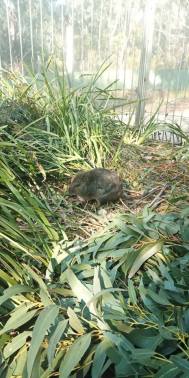
My first sighting of a long-nosed native potoroo
I also couldn’t help adoring over the Koala’s, especially the little joey which allowed us to discover he was a male while I visited. This meant he can now be given a name from a list of indigenous names the wildlife rangers have been provided with. This is a contemporary way to maintain links to indigenous heritage and educate visitors of its significance. Maintaining this cultural connection to the Ngunnawal people of the Canberra region is another important purpose of the reserve, reflected in its name as Tidbinbinbilla is derived from Jedbinbilla meaning ‘where boys were made men’ (ACT Government 2017b). Reflected in its name Tidbinbilla – which is derived from Jedbinbilla, meaning ‘where boys were made men.’

The little male joey I met peaking out from between the gum leaves while clinging onto his mother
Reflecting on my day at Tidbinbilla, I’ve developed a greater understanding of diverse values the park can hold for both people and nature, and the pivotal management role of rangers to ensure its perpetuity. While governments focus on development to improve humans living standards, it seems much more value can be restored by funding conservation and the maintenance of heritage in our remaining natural landscapes. This notion is supported by Wilson’s (1984) biophilia hypothesis and studies since which have found experiences with nature enhance human wellbeing (Molsher & Townsend 2016; Sandifer et. al. 2015). Whilst land clearing and degradation continues to threaten biodiversity, simultaneously the increasing number of protected areas now reaching 15% of total land mass provides a sense of hope (Protected Planet 2017).
References:
ACT Government 2017a, Tidbinbilla, available at https://www.tidbinbilla.act.gov.au/learn/tidbinbilla (accessed 17 Sept. 2018)
ACT Government 2017b, Aboriginal connections to Tidbinbilla, available at https://www.tidbinbilla.act.gov.au/learn/tidbinbilla/aboriginal-connections-to-tidbinbilla (accessed 17 Sept, 2018)
Molsher, R. & Townsend, M. 2016, “Improving wellbeing and environmental stewardship through volunteering in nature”, EcoHealth, vol. 13, no. 1, pp. 151-155.
Neuve, H.M., Neave, H.M. & Tanton, M.T. 1989, “The effects of grazing by kangaroos and rabbits on the vegetation and the habitat of other fauna in the Tidbinbilla Nature Reserve, Australian Capital Territory”, Australian Wildlife Research, vol. 16, no. 3, pp. 337-351.
Norton, M.A., Claridge, A.W., French, K. & Prentice, A. 2010, “Population biology of the long-nosed potoroo (Potorous tridactylus) in the Southern Highlands of New South Wales”, Australian Journal of Zoology, vol. 58, no. 6, pp. 362-368.
Protected Planet 2017, Increased Growth of protected areas in 2017, available at https://www.protectedplanet.net/c/increased-growth-of-protected-areas-in-2017 (accessed 17 Sept. 2018)
Sandifer, P.A., Sutton-Grier, A.E. and Ward, B.P., 2015. Exploring connections among nature, biodiversity, ecosystem services, and human health and well-being: Opportunities to enhance health and biodiversity conservation. Ecosystem Services, 12, pp.1-15.
Wilson, E. 1984, Biophilia. Cambridge: Harvard University Press. ISBN 0-674-07442-4.

 Biodiversity Conservation
Thanks for sharing your experience, although you haven’t provided a name or u-number so we don’t know who you are! Phil