
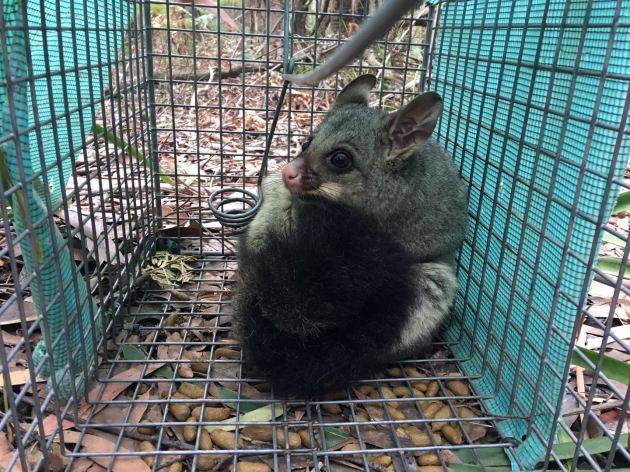
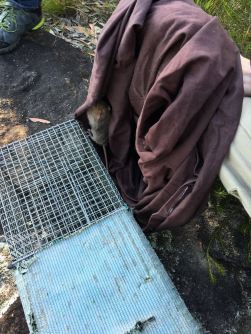
From 25 August to 27 August this year, I joined a field trip to Booderee National Park, Jervis Bay (around 35°07ˈ45ˈˈS, 150°41ˈ13ˈˈE). I’ve learned and practised how to use two mammal survey methods, live-trapping and camera traps to detect and monitor terrestrial mammals within that place. Research study and working experience during the three-day survey, really inspire me that I can design many biodiversity conservation researches of many other places depends on these methods and the data they collect.
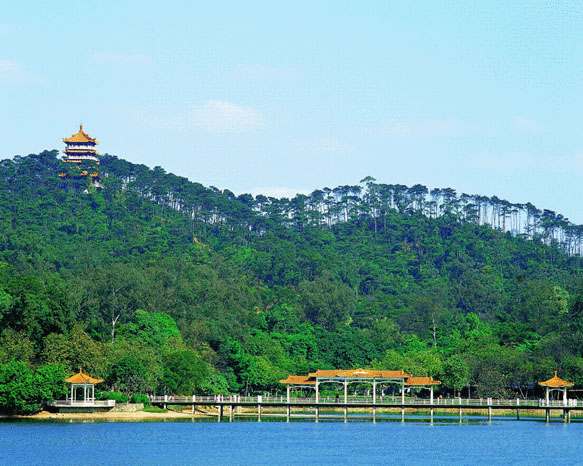
I’m an international student who comes from Guangzhou, south of China. Bai Yun Mountain in Guangzhou is very famous for its beautiful natural scenery. As I’m an environmental science student, I really hope I can help my hometown to protect and improve this one of the most beautiful natural parks in China. I start curious about how well Bai Yun Mountain can protect the wildlife within it, especially terrestrial mammals. There are lots of terrestrial mammals in Bai Yun Mountain, like wild boar, Paguma larvata, Manis pentadactyla, Arvicolinae and Cuon alpinus. However, Bai Yun Mountain is more like a tourist attraction than a national park, there are hundreds and thousands of tourists everyday, so I really worried about whether our tourists will have a great impact on terrestrial mammals inside the park. Before making an appropriate biodiversity conservation plan, the most important thing we should do is to detect species and collect their data of abundance and richness. Linking to the methods I’ve learned and practised, I decide to introduce a combination method of live-trapping and camera traps to my hometown.
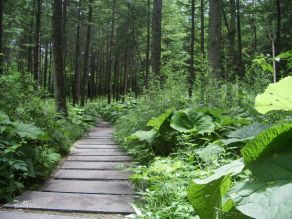
If I have a chance to design a biodiversity conservation research at Bai Yun Mountain in my hometown, I will design a study to find out how serious the impact due by human activities on terrestrial mammals is within this park, and where we should put more attention to set up conservation areas. To achieve my goal, I will set up total 12 sites. 1-3 sites are in an area with high altitude and far away from tourists active area, 4-6 sites are in an area with high altitude and closed to tourists active area, 7-9 sites are in an area with low altitude and far away from tourists active area, 10-12 sites are in an area with low altitude and closed to tourists active area (see Table 1.). And one site will have two 200m transects which are at least 1km away from each other, then I will set up live-trapping and camera traps along those transects, collect data for at least one week. As Bai Yun Mountain will be closed at night, so it is feasible for my research to get into practice. I will check the live-trapping once a day, to clean up the traps, renew the bait, recognize and record the species I’ve got, however the camera traps will no be turn off until I download the data after one week. Also, as the diet of mammal species in Guangzhou maybe quite different from mammal species in Australia, I will check up and find out the most effective bait before my traps get set.
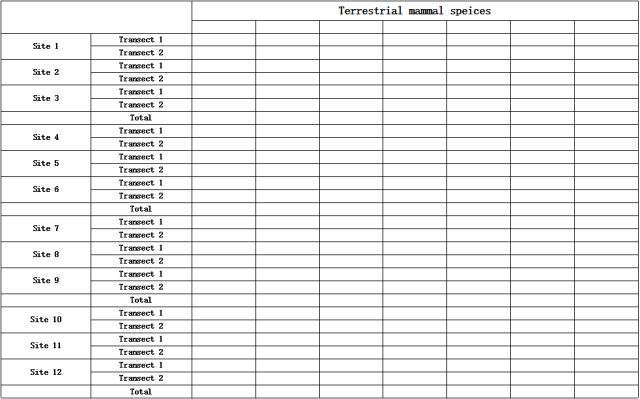
Table 1. Example of data collecting sheet.
By collecting and comparing the data of mammal abundance and richness at different sites in Bai Yun Mountain, I can test out four questions of my study: 1. Whether there is a correlation between terrestrial mammals abundance and altitude in Bai Yun Mountain. 2. Whether there is a correlation between terrestrial mammals richness and altitude in Bai Yun Mountain. 3. Whether there is a correlation between terrestrial mammals abundance and distance from tourists active area. 4. Whether there is a correlation between terrestrial mammals richness and distance from tourists active area.
I have been to Bai Yun Mountain for many times, but it is too difficult to see a wild animal around tourists active area, I can only see animals in the zoo which is managed by government in Bai Yun Mountain. However, there are still lots of areas that are forbidden to tourists, it is very necessary for us to detect, monitor and protect the species in those areas. Better management plan is definitely needed, I hope I can learn more about biodiversity conservation, and someday I will do a real research on my homeland, and contribute my effort to the natural environmental protection business in Guangzhou.
Kangxu Wu (Raven)
Student ID: u6158339


