
Last month I spent five days at ‘Bowra’ an Australian Wildlife Conservancy property located near Cunnamulla in south west Queensland. This property was recently purchased from a family who had been on the property for five generations. I assisted with a bird banding project led by Dr Jon Coleman with the help of many banders and researchers from Brisbane and a few from Canberra. The objective of the project is to determine the survival rate, longevity, site fidelity and movements of a range of birds at Bowra. My role was to help choose suitable net sites, open and close mist nets, extract birds from the nets and band the captured birds.
Due to good rain in the previous months the surface water and grass on the property was quite abundant. This provided favourable conditions for seed eating birds such as Zebra Finch (Taeniopygia guttata), Plum-headed Finch (Neochmia modesta) and Diamond Dove (Geopelia cuneata). The Zebra Finch is a “boom and bust” species. Their population dynamics are primarily driven by rainfall and associated seed supply which is highly temporally variable in this region.

From left to right: A male Zebra Finch, a Double-barred Finch and a male and female Plum-headed Finch. Over the four days banding we captured 171, 72 and 40 individuals of these species respectively.
At Bowra there are a few ‘mulga specialist’ species which are typically only found in areas where Mulga (Acacia aneura) is present. One of these is the Hall’s Babbler (Pomatostomus halli), a species that inhabits the mulga of SW QLD and NW NSW. It is a cooperative breeder which means that individual offspring are raised by a group of up to 15 babblers collectively.

Hall’s Babbler
Another species that is often found in Mulga but not restricted to it is the Crested Bellbird (Oreoica gutturalis). This species is a formidable looking bird up-close and possesses a rich call – hence its name. It is not an easy bird to catch in a mist net as they are pretty wary but on one morning I found this individual and 6 other species caught in a single net.

A male Crested Bellbird. This individual was caught in an area of Mulga.
We banded a total of three fairy-wren species one of which is the Splendid Fairy-wren (Malurus splendens). We caught a number of males which were at various stages of their breeding plumage.

A male Splendid Fairy-wren in full breeding plumage.
It was nice to see both Brolga (Grus rubicunda) and Australian Bustard (Ardeotis australia) on the trip -the latter being a species I’ve never seen before. The bustard was once relatively common in SE Australia (including the Canberra region) but its range has now retracted to northern and western Australia due to hunting and habitat modification.

This Brolga did a dance as we pulled up on the side of the road.
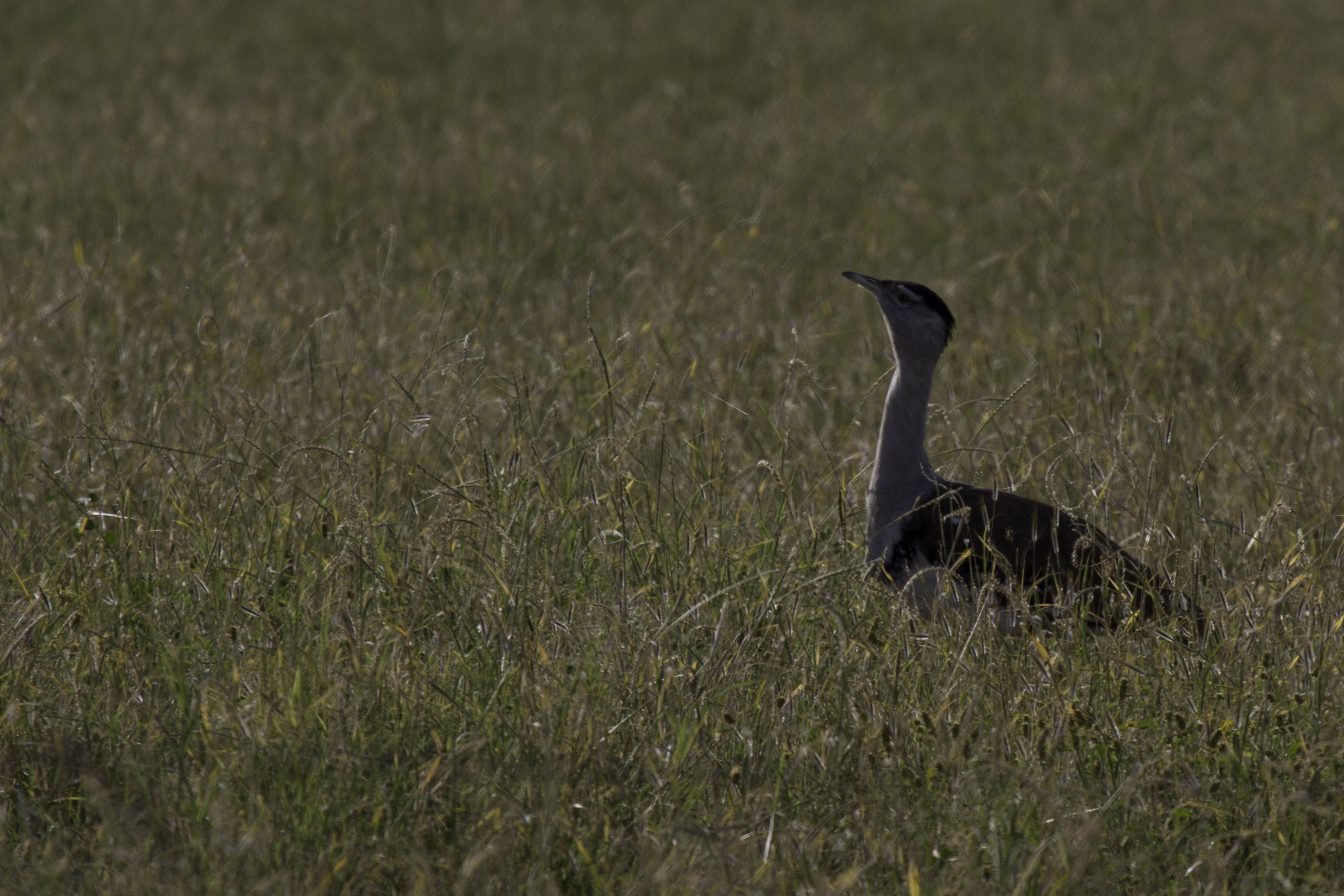
This Australian Bustard was one of three seen in the extensive grasslands south of Cunnamulla.
The trip was a fantastic opportunity to see the biodiversity of the mulga, open woodlands and grasslands of south west Queensland. In total we banded 452 individual birds consisting of 42 species.

Sunrise over the lagoon
Mark Allen
Photography: Brett Allen

 Biodiversity Conservation
Pingback: Creatures of south west Queensland | Biodiversity Conservation
Fantastic blog Mark. You provide a great insight to the work of the Aust Wildlife Conservancy and some sense of what occurs inland. Phil
Pingback: Bowra Station: April 2015 | ausnature