
By Divya LaBrooy (u7243494)
My work experience involved partaking in an annual Echidna sweep which took place at Mulligan’s Flat Nature Reserve.
An Outdoor Laboratory:
Mulligan’s Flat is a crucial area for wildlife and ecological monitoring. Spanning over 1200 hectares, it is the largest intact assemblage of critically endangered Yellow Box–Blakely’s Red Gum Grassy Woodland. This area is surrounded by a fence, which allows researchers to monitor environmental conditions without the impact of pests and predators, like feral cats, foxes, rabbits, over abundant native species like the Eastern Grey Kangaroo (Macropus giganteus). Enjoying a decrease in competition and predation from pest species, the wildlife at Mulligan’s Flat has thrived. This has enabled experiments for the reintroduction of locally extinct species, like the Eastern Bettong (Bettongia gaimardi). Additionally, researchers have used the opportunity to establish baseline data conditions for other species, like the short-beaked Echidna (Tachyglossus aculeatus), which suffered from knowledge gaps regarding average population dynamics prior to European Settlement

Figure 1: A puggle found near the predator-proof fence at Mulligan’s Flat. Source: Divya LaBrooy original photography.
Puggles and puddles:
This year saw uncharacteristic amounts of rainfall for August, and as a result, the grass at Mulligan’s Fat was in abundance. This created literal obstacles for volunteers like me, who needed to search through tall vegetation and avoid puddles simultaneously – not to mention the isolated hailstorm!

Figure 2: An isolated hailstorm at Mulligan’s Flat during the Echidna sweep. Source: Divya LaBrooy original photography.
After a debrief and assembling into enclosure sections, volunteers wading through thickets in groups of approximately 8 – 10. Forming lines about 10m apart, we searched for Echidnas at different locations across the sanctuary. When an Echidna was spotted, it was marked with nail polish to identify individuals. Additional data, like size, location, time, and enclosure was also recorded. The same process was then repeated the next week to generate a statistical analysis of population demographics for 2022.
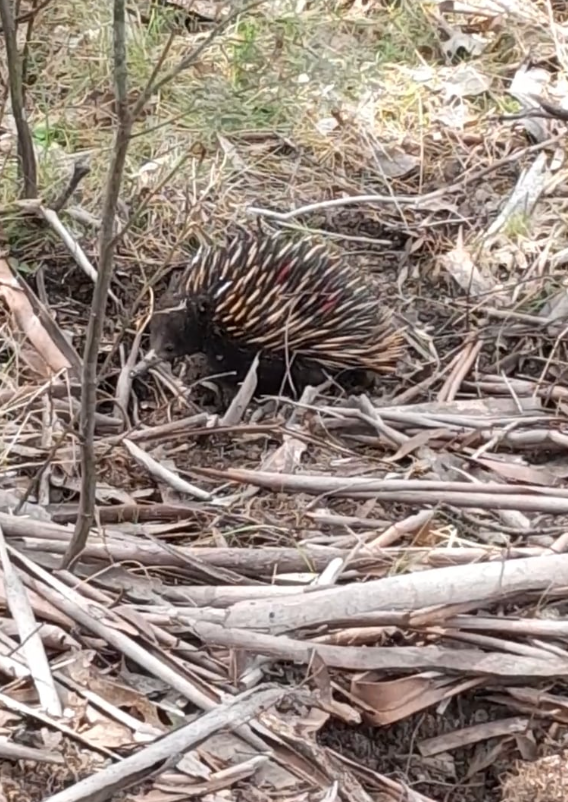
Figure 3: A puggle walking through leaf litter at Mulligan’s Flat, red nail polish indicates the individual. Source: Divya LaBrooy original photography.
Monitoring viable populations is crucial to informing conservation efforts in areas where populations may be struggling. Furthermore, long-term monitoring of the population at Mulligan’s Flat allows scientists to identify any potential risks to numbers if a large increase or decrease is found from the yearly audit. This can then inform adaptive management to stabilise the impact.
Stoics in disguise:
Citizen scientists are integral aspects of wildlife monitoring at Mulligan’s Flat. Given limited resources and funding, community drives like the Echidna sweep inform, include, and utilise the public for conservation. Volunteers are invaluable to large scale monitoring events, without them giving their time and effort, results like this would be impossible. The altruistic values from community members ensures that scientists have the best data available to inform their adaptive management and monitoring efforts. To get involved with volunteering opportunities, visit ParkCare ACT and check out new opportunity listings!
References
Batson, W., Fletcher, D., Portas, T., Crisp, H., Ryan, S., Wimpenny, C., Gordon, I. and Manning, A., 2016. Re-introduction of eastern bettong to a critically endangered woodland habitat in the Australian Capital Territory, Australia. Global Re-introduction Perspectives, pp.172-177.
ParkCare ACT [Online]. 2022. Parks and Conservation Service Available: https://app.betterimpact.com/PublicOrganization/7baf50be-3b65-4dd3-
Parsons, A.W., Goforth, C., Costello, R. and Kays, R., 2018. The value of citizen science for ecological monitoring of mammals. PeerJ, 6, p.e4536.
RISMILLER, P. D. & MCKELVEY, M. W. 2000. Frequency of Breeding and Recruitment in the Short-Beaked Echidna, Tachyglossus Aculeatus. Journal of Mammalogy, 81, 1-17.
SHORTHOUSE, D. J., IGLESIAS, D., JEFFRESS, S., LANE, S., MILLS, P., WOODBRIDGE, G., MCINTYRE, S. & MANNING, A. D. 2012. The ‘making of’the Mulligans Flat–Goorooyarroo experimental restoration project. Ecological Management & Restoration, 13, 112-125.
STENHOUSE, A., PERRY, T., GRÜTZNER, F., LEWIS, M. & KOH, L. P. 2021. EchidnaCSI–improving monitoring of a cryptic species at continental scale using citizen science. Global Ecology and Conservation, 28, e01626.

 Biodiversity Conservation