
u6949325
It is not often you get the opportunity to see rare animals long gone from your local landscape beyond the confines of a local zoo, or walk amongst undisturbed woods in proximity to suburbia. Luckily, I had the chance to combine both while surveying reintroduced curlews within Mulligans Flat Woodland Sanctuary (MFWS).

Bush-stone curlew in flight. Photo credit: David Cunningham
No branches in the bush! Australia’s woodland crisis
Eucalyptus woodlands of south-eastern Australia are some of the most highly modified ecosystems, due to their fertile and flat landscapes. Box-gum grassy woodland has had over 90% of its original extent destroyed, and remaining patches are isolated and damaged. Even unassuming components, such as wood, are essential for woodland health, but are overexploited and damaged by us. Coarse woody debris (CWD) provides habitat and resources for many organisms, and its removal drives declines of biodiversity.
The loss of grassy woodlands impacts the quirky bush-stone curlew (Burhinus grallarius). This enigmatic bird is quite unlike any other. With cryptic plumage and motionless behavior mimicking a branch, curlews rely on CWD to forage, roost, and avoid detection by predators.

Curlew laying down in stiff position to mimic a branch. Photo provided by author.
Once widespread across the mainland, the loss of grassy woodlands in the south-eastern states have caused declines in curlew numbers and range. The last sighting of a wild curlew in the ACT occurred in 1970, and they are classified as locally extinct. The removal of CWD has increased predation of the birds by introduced predators, particularly the red fox (Vulpes vulpes), which easily detect and find their vulnerable eggs and chicks.
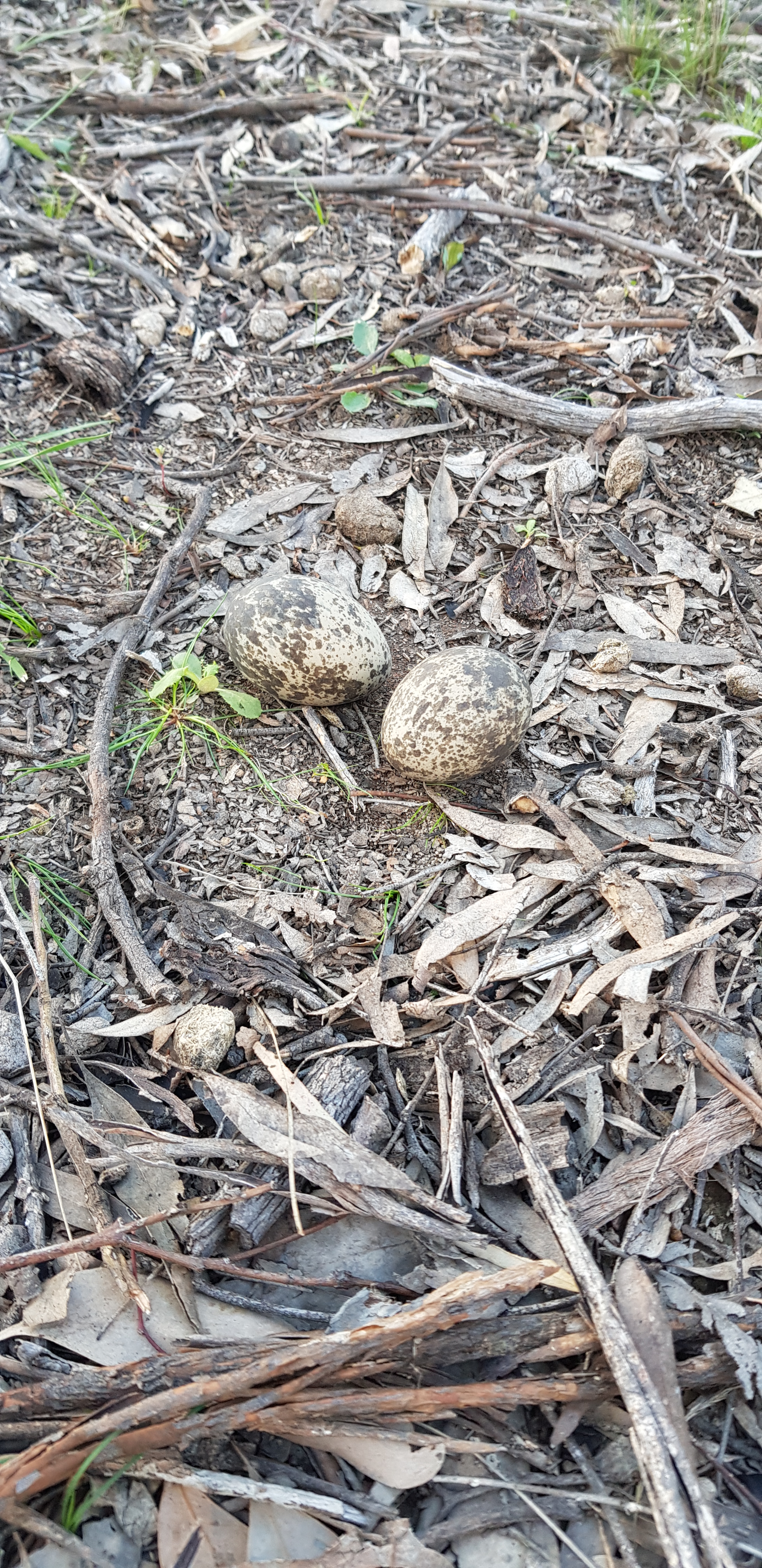
curlew nest with cryptic eggs. Photo credit: Shoshana Rapley
Caged conservation?
With 22.8km of predator-proof fencing, MFWS is a safe-haven for a critically endangered ecological community, as well as a research forefront for the reintroduction of locally extinct critters. Several other successful species reintroductions have occurred here, including the eastern bettong (Bettongia giamardi) and eastern quoll (Dasyurus viverrinus).
Over half of all reintroduction attempts fail to establish populations, largely due to lack of knowledge about threatened animals. Of 8 curlew translocation attempts, the sole successful project occurred here at MFWS, from 2014 to the current day. This species is cryptic and highly mobile, so determining curlew presence and continued breeding within MFWS continued is essential for continued success of this project.
The survey
The main goal of this survey was to determine a robust population estimate of the curlews, and find any new arrivals. Pairs of volunteers set off in the morning, when the curlews are roosting, to survey distinct polygons within the sanctuary using the map below. The curlews are identified by leg tags, flags, radio packs, or in the case of those recently born within the sanctuary, no artificial markers. Survey efforts were focused around wooded areas with plenty of CWD. GPS coordinates and curlew sightings were made using the Avenza Maps app.
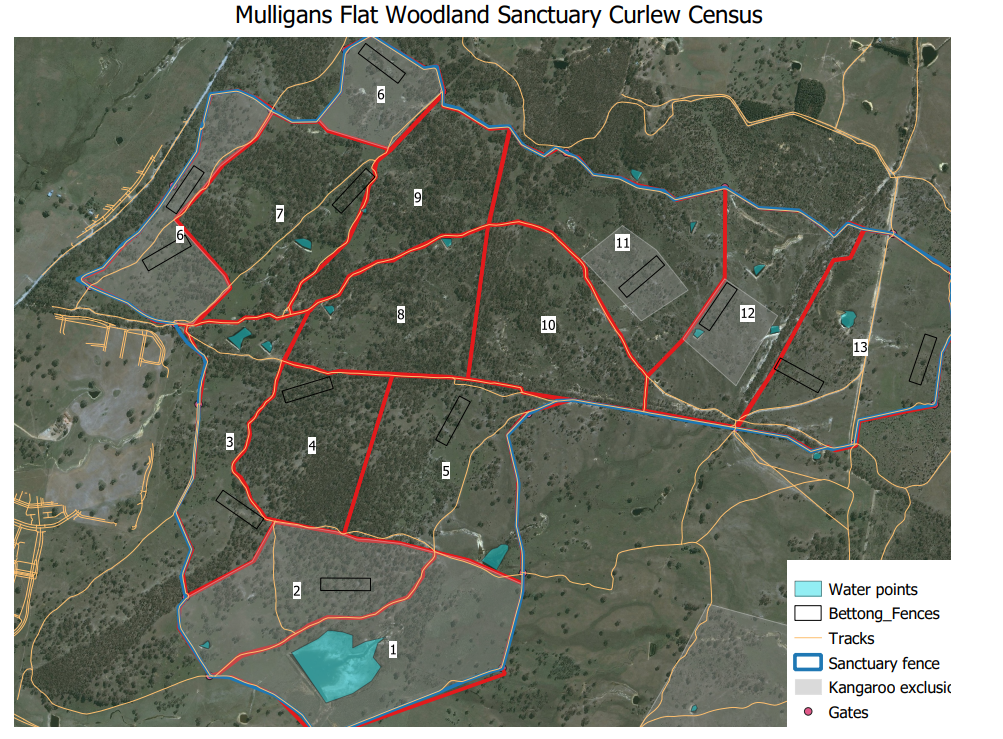

Curlew survey polygons of MFWS. Map provided by Shoshana Rapley. Tracks and curlew locations in zones 7 & 9 by Author.
Once a curlew was spotted, the ID, GPS coordinates and time were recorded. While I struggled to identify reintroduced individuals, I found a branch-posing individual with no leg tags, indicating that the curlews continue breeding successfully within the sanctuary! The population estimate obtained by this experience show the success of this reintroduction, and inform other projects how curlew reintroductions can succeed.
I would like to thank Shoshana Rapley for facilitating this work experience, and for detailing her charge in reintroducing curlews.
Word count: 568

Curlew with leg tag. Photo credit: Julie Clark
References
Anson, J.R., 2018. Predator proofing for conservation: an AWC perspective. Australian Zoologist, 39(2), pp.352-358.
Department of Environment and Conservation NSW. 2006. ‘NSW Recovery Plan for the Bush Stone-curlew Burhinus grallarius’. DEC, Sydney.
Bennett, V.A., Doerr, V.A., Doerr, E.D., Manning, A.D., Lindenmayer, D.B. and Yoon, H.J., 2013. ‘Causes of reintroduction failure of the brown treecreeper: Implications for ecosystem restoration’. Austral Ecology, 38(6), pp.700-712.
Kemp, L. Roshier, D., 2016. ‘A trial of release protocols for re-introduction of the bush stone-curlew to southern Australia’. Global re-introduction perspectives, pp.117-122.
Killey, P., Mcelhinny, C., Rayner, I.A.N. and Wood, J., 2010. Modelling fallen branch volumes in a temperate eucalypt woodland: implications for large senescent trees and benchmark loads of coarse woody debris. Austral Ecology, 35(8), pp.956-968.
Rapely, S. 2020. ‘Spatial ecology informs reintroduction tactics for warabin (Burhinus grallarius; bush stone-curlew)’. [Honours thesis]. Australian National University, Canberra. Accessed with author permission.

 Biodiversity Conservation