
By taking part in the removal of weeds and planting of native shrubs in the new Ginninderry development, we helped to conserve habitat in the green spaces of a suburban community.
By Luke Gordon (u6390583)
An accelerating problem worldwide
The growth of urban land globally can’t stop, won’t stop. Worldwide, urban space has increased from approximately 1.84 percent in 1985, to 3 percent in 2014. In Australia, our urban footprint is increasing at double the average rate of other developed nations, and 30 percent of listed threatened species overlap with urban land. Although this expansion has meant more homes, businesses and infrastructure to support them, it has also meant the decline of threatened ecological communities and the species that call them home.
In Canberra, new urban development tends to have negative impacts on threatened ecological communities such as the Box-Gum Grassy Woodland and Natural Temperate Grassland, and threatened species such as the Golden Sun Moth, and Superb Parrot.

Urban expansion doesn’t just threaten native ecological communities by replacing them, it also threatens them by bringing them into contact with the invasive vegetation of exotic grass mixes used by local governments. These exotic weeds stifle the growth of natives by outcompeting them for space, water, nutrients and sunlight.
Considering that population growth is unlikely to subside, and that subsequent urban expansion is not halting any time soon either, developers and government need to find a way to conserve habitat and build better for biodiversity. The new Ginninderry development west of Belconnen ACT by Riverview Projects Pty Ltd, may hold part of the answer.
Habitat conservation in Ginninderry’s urban green space
Preserving green space with high levels of biodiversity in our urban areas has been shown to have a plethora of co-benefits for human health. Physically, they decrease air, noise and water pollution. And mentally, they reduce stress, anxiety and depression. Furthermore, by conserving native habitat in our urban green spaces, we can reduce the fragmentation of native ecological communities and species populations. It’s truly a win-win scenario.
In Ginninderry, there has been an active effort to preserve the local ecological community. For example, 80 percent of existing mature trees were retained in Strathnairn, Ginninderry’s first suburb, as opposed to the usual 25-50 percent of similar sized developments.
Riverview’s landscapers, Cia Landscape and Colour, collaborated with researchers of the ANU in establishing two alternative treatments to traditional “park-like” management for their green spaces. The first alternative comprised of mulching under a large eucalypt with organised planting of native, non-endemic ground cover. The second alternative comprised of restoring the local Box-Gum Grassy Woodland by scraping the nutrient rich topsoil, and planting endemic ground cover. This was done to evaluate the potential benefits differing conservation park management could have on biodiversity, society, and the economy.
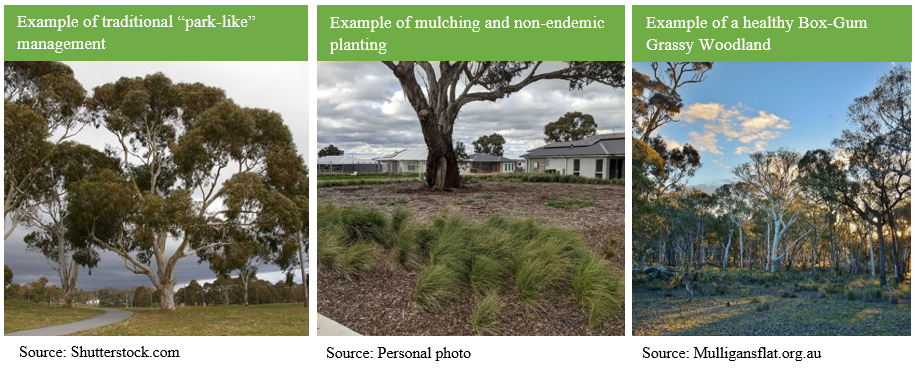
Our role was to remove weeds established from the urban vegetation matrix, and subsequently plant native shrubs in a site undergoing treatment three. With the time available, I think we were quite successful!

It takes a strong will and ongoing learning to reconcile urban development and biodiversity conservation, and Ginninderry is shining a light for others to follow.
WC = 530

 Biodiversity Conservation