
Australia’s housing crisis has left many renters spending over 40% of their income on rent. In Namadgi National Park, 80 new rent-free homes have been set up with the support of the Bushfire Recovery for Wildlife and Habitat Community Grants Program specifically for hollow-dependent avian species. Despite the free accommodation and modern designs, some are questioning whether avian hollow-dependent species are actually using these homes. Now scientists are investigating nest-box use and the impact of the 2019/2020 bushfire on natural tree hollow availability.
It was a sunny spring morning in late September of 2022 when I followed the two scientists and master students at the ANU, Nicole and Diego, into Namadgi National Park to investigate the situation. Our freshly hosed 4wd wound through Old Boboyan Road, the transect we would be collecting data on that day. We were met by a thick acacia and eucalypt understory, and clear evidence of fire in the remnants of a scorched overstorey (see image 1). Whilst as a protected area Namadgi National Park is able to minimise land-use and protect threatened flora and fauna by limiting pressures such as agriculture, forestry and hunting, some threats, such a fire, cannot be mitigated.

Image 1: Thick understorey regrowth and bare treetops indicate the high intensity of the fire that passed through this area. Photo author’s own.
80% of Namadgi National Park was scorched by the Orroral Valley Fire in 2020, having detrimental impacts on biodiversity of the protected area, according to the ACT/NSW Rapid Risk Assessment Team (2020). To support biodiversity in the post-fire landscape, 160 nest boxes were constructed, 80 of which have since been hung in the protected area. The nest-boxes are a variety of shapes and sized to suit different species of birds and bats.
To investigate the uptake of nest-boxes by avian species, we collected data on the nest box, such as habitation style (small, large, suitable for birds or bats) and presence or absence. We used a long stick with a camera on the end of it to peer into the nest boxes from the ground and evaluate evidence of nest-box uptake. We also collected site data such as aspect and vegetation type.
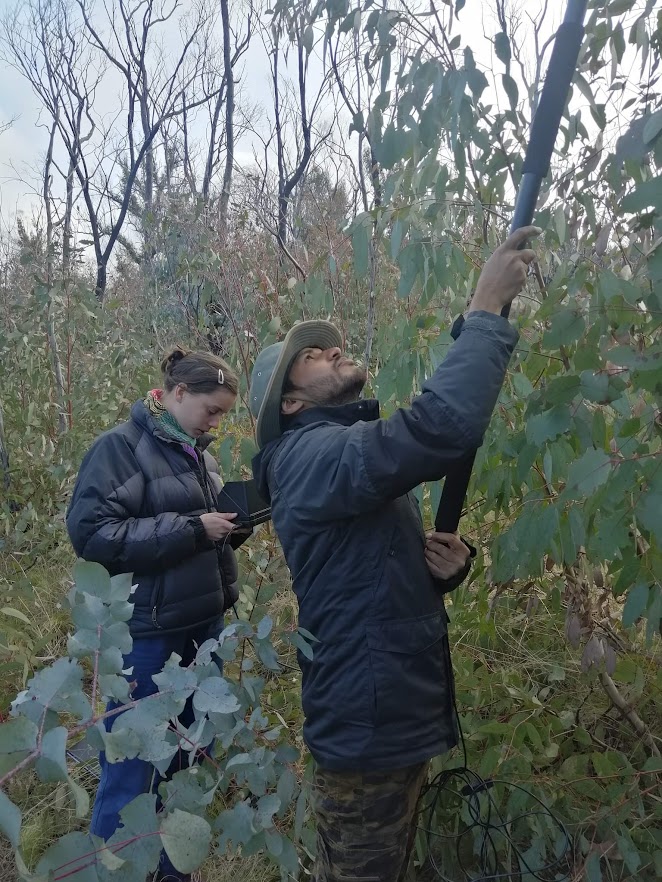

Image 2 and 3: Another student, Rao, and myself, observing nest box occupancy using a monitor attached to a videoscope which can reach into the canopy. Image 2 by Nicole Damaggio and Diego Avi, image 3 author’s own.
Whilst the cost of rent might be influencing our choice of where to live, a lag in formation of hollows can influence where cavity-dependent species chose to breed. Natural tree hollows are estimated to take more than 120 years to form (Gibbons and Lindenmayer 1997) and furthermore, different species have different needs and preferences for hollows (Higgins, 1999). Even more concerning under increased future fire risk, research suggests that fire negatively impacts the abundance of hollow-bearing trees (Salmona et al. 2018).
To investigate the effect of fire on natural tree-hollow availability, we also collected in radial transects around a given artificial nest box tree. This is extrapolated to understand the effect of fire on tree hollow occurrence.
So, are our avian renters enjoying their stays in the artificial nest boxes? On this day, it didn’t seem so. But it’s early in the season so more families might move in with the warmer weather. Overall, this research can help us to understand not only the preference of species for artificial nest-boxes, if we are using conservation funding effectively and also for reporting the status of the project and it’s outcomes (Stem et al. 2005). In future years, natural nest hollow availability is only expected to decline (Manning et al. 2013), so it’s tough times ahead for our picky avian inhabitants.
W:540 u6984759
References:
ACT/NSW Rapid Risk Assessment Team 2020, Orroral Valley Fire Rapid Risk Assessment Namadgi National Park. Unpublished report. Canberra. https://www.environment.act.gov.au/ACT-parks-conservation/bushfire_management/orroral-valley-fire-impact-report.
Dickman, CR 2021, ‘Ecological consequences of Australia’s “Black Summer” bushfires: Managing for recovery’, Integrated Environmental Assessment Management, vol. 17, pp.1162-1167.
Higgins, PJ 1999, Handbook of Australian, New Zealand and Antarctic birds. Oxford University Press, Melbourne, Vic.
Manning, AD Gibbons, P Fischer, J Oliver, DL Lindenmayer, DB 2013, ‘Hollow futures? Tree decline, lag effects and hollow-dependent species’, Animal Conservation, vol. 16, pp.395-403.
Salmona, J Dixon, KM Banks, SC 2018 ‘The effects of fire history on hollow-bearing tree abundance in montane and subalpine eucalypt forests in southeastern Australia’, Forest Ecology and Management, vol. 428, pp.93–103.
Stem, C Margoulis, R Salafsky, N Brown, M 2005, ‘Monitoring and Evaluation in Conservation: a Review of Trends and Approaches’, Conservation Biology, pp.295 – 309.

 Biodiversity Conservation