
By Alice Kelly – U7287600. Word Count: 540
Agricultural lands across Australia play a crucial role in the economy, food security, and health of our nation. But so does healthy ecosystems and biodiversity. Agricultural productivity and environmental conservation have been considered independently for hundreds of years, but it’s about dam time that we put the two together!

Going, going… gone: habitat loss on agricultural landscapes
The extent of land clearing in Australia puts us amongst the top 10 worst countries for land clearing in the world, and as one of seven countries that contribute to over half of biodiversity loss globally. Since European invasion, over 40% of our country’s woodlands and forests have been cleared, making leftover habitats fragmented or degraded. Much of this land has been cleared for agricultural use, resulting in major habitat loss and biodiversity decline. With less than 10% of native vegetation cover remaining in many agricultural regions across Australia, the associated species declines lead to alterations in ecosystem dynamics and services and increased extinction rates. With human population growth and the associated food demand, it is clear that the current ways of agriculture must change.
There is hope: habitat restoration and returning biodiversity
By taking a co-benefits approach, we can improve the productivity and outcome of agriculture, whilst conserving and enhancing Australia’s biodiversity. Consider the role of dams in agricultural landscapes – poor dam quality can reduce livestock and soil health, and favour the spread of disease and exotic species. Further, with lack of vegetation present on agricultural lands, species diversity is heavily reduced. However, by enhancing farm dams, farmers can reduce GHG emissions, strengthen biodiversity, improve water quality, and create better agricultural outcomes, such as increased land, stock, and crop value.
Caring for the land and giving back
Landcare ACT is an organisation that uses the knowledge and experiences of local communities to deliver solutions in addressing issues, building resilience, and achieving outcomes with positive environmental attributes. I worked with Landcare ACT as part of their ACT Dam Restoration series to enhance dams and build resilience across the state, funded by the ACT Natural Resource Management as part of the Australian Government’s Future Drought Fund.
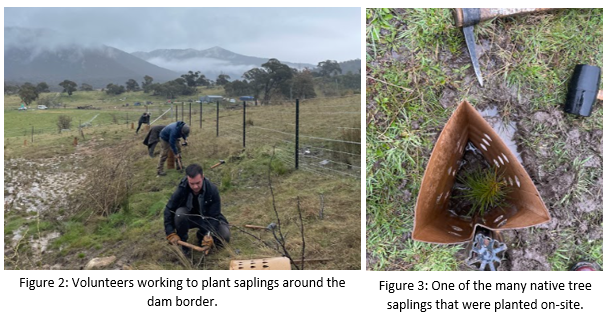
Previous volunteer efforts fenced the dam to exclude cattle. I then joined the team to plant native species around the dam to increase the vegetation cover. This has many benefits, such as water quality improvement, disease reduction, improved stock health, and increased biodiversity. With various native trees and shrubs, we helped to stabilise the landscape, create foliage height diversity, and improve the wet ecosystem to hopefully return many lost species. You can learn more about the project here.
Heading home
In the face of climate change and population growth, it is crucial that we work to create resilient landscapes. We must ensure that the needs of current and future generations can be met without degrading Earth’s precious ecosystems and unique biodiversity. Even in the freezing cold, pouring rain and strong wind, the dedication and hard work of volunteers highlighted just how meaningful biodiversity is to our lives. My work with Landcare ACT showed that we can conserve biodiversity and effectively re-establish ecosystems whilst enhancing agricultural outcomes. Working with nature is critical to our future – it doesn’t have to be difficult or expensive, and we can reap many great benefits!
Thanks to Landcare ACT for offering an insightful and enjoyable work experience opportunity.
*All images are my own, taken in Booth, ACT, September 28, 2022.
References
BELL, K., DRISCOLL, D. A. & DOHERTY, T. S. 2022. Slow loss of a foundation species in agricultural landscapes: Effects of nutrients, land clearing, and other factors. Agriculture, Ecosystems & Environment, 323, 107681.
BRADSHAW, C. J. A. 2012. Little left to lose: deforestation and forest degradation in Australia since European colonization. Journal of Plant Ecology, 5, 109-120.
ELLISON, A. M., BANK, M. S., CLINTON, B. D., COLBURN, E. A., ELLIOTT, K., FORD, C. R., FOSTER, D. R., KLOEPPEL, B. D., KNOEPP, J. D., LOVETT, G. M., MOHAN, J., ORWIG, D. A., RODENHOUSE, N. L., SOBCZAK, W. V., STINSON, K. A., STONE, J. K., SWAN, C. M., THOMPSON, J., VON HOLLE, B. & WEBSTER, J. R. 2005. Loss of foundation species: consequences for the structure and dynamics of forested ecosystems. Frontiers in Ecology and the Environment, 3, 479-486.
FREUDENBERGER, D. & BROOKER, L. 2004. Development of the Focal Species Approach for Biodiversity Conservation in the Temperate Agricultural Zones of Australia. Biodiversity and Conservation, 13, 253-274.
RESIDE, A. E., BEHER, J., COSGROVE, A. J., EVANS, M. C., SEABROOK, L., SILCOCK, J. L., WENGER, A. S. & MARON, M. 2017. Ecological consequences of land clearing and policy reform in Queensland. Pacific Conservation Biology, 23, 219.
STOECKL, N., CHAIECHI, T., FARR, M., JARVIS, D., ÁLVAREZ-ROMERO, J. G., KENNARD, M. J., HERMOSO, V. & PRESSEY, R. L. 2015. Co-benefits and trade-offs between agriculture and conservation: A case study in Northern Australia. Biological Conservation, 191, 478-494.
TAYLOR, R. 2011. WWF Living Forests Report. Chapter.
WALDRON, A., MILLER, D. C., REDDING, D., MOOERS, A., KUHN, T. S., NIBBELINK, N., ROBERTS, J. T., TOBIAS, J. A. & GITTLEMAN, J. L. 2017. Reductions in global biodiversity loss predicted from conservation spending. Nature, 551, 364-367.
WATTS, R. J., RICHTER, B. D., OPPERMAN, J. J. & BOWMER, K. H. 2011. Dam reoperation in an era of climate change. Marine and Freshwater Research, 62, 321-327.
WESTGATE, M. J., CRANE, C., SMITH, D., O’MALLEY, C., SIEGRIST, A., FLORANCE, D., LANG, E., CRANE, M., HINGEE, K., SCHEELE, B. C. & LINDENMAYER, D. B. 2022. Improved management of farm dams increases vegetation cover, water quality, and macroinvertebrate biodiversity. Ecology and Evolution, 12, e8636.
WILLMS, W. D., KENZIE, O. R., MCALLISTER, T. A., COLWELL, D., VEIRA, D., WILMSHURST, J. F., ENTZ, T. & OLSON, M. E. 2002. Effects of water quality on cattle performance. Rangeland Ecology & Management/Journal of Range Management Archives, 55, 452-460.

 Biodiversity Conservation