
Sian Hardy U6951596
Word count: 546
Scottsdale Reserve is located on Ngunawal/Ngunnawal/Ngambri country 75km south of Canberra, in the locality of Bredbo. Previously a sheep-grazing farm, the site was bought by the private conservation organisation Bush Heritage Australia in 2006 with the aim of restoring the riparian and cool temperate grassy woodland ecosystems across the 1328 hectare property.
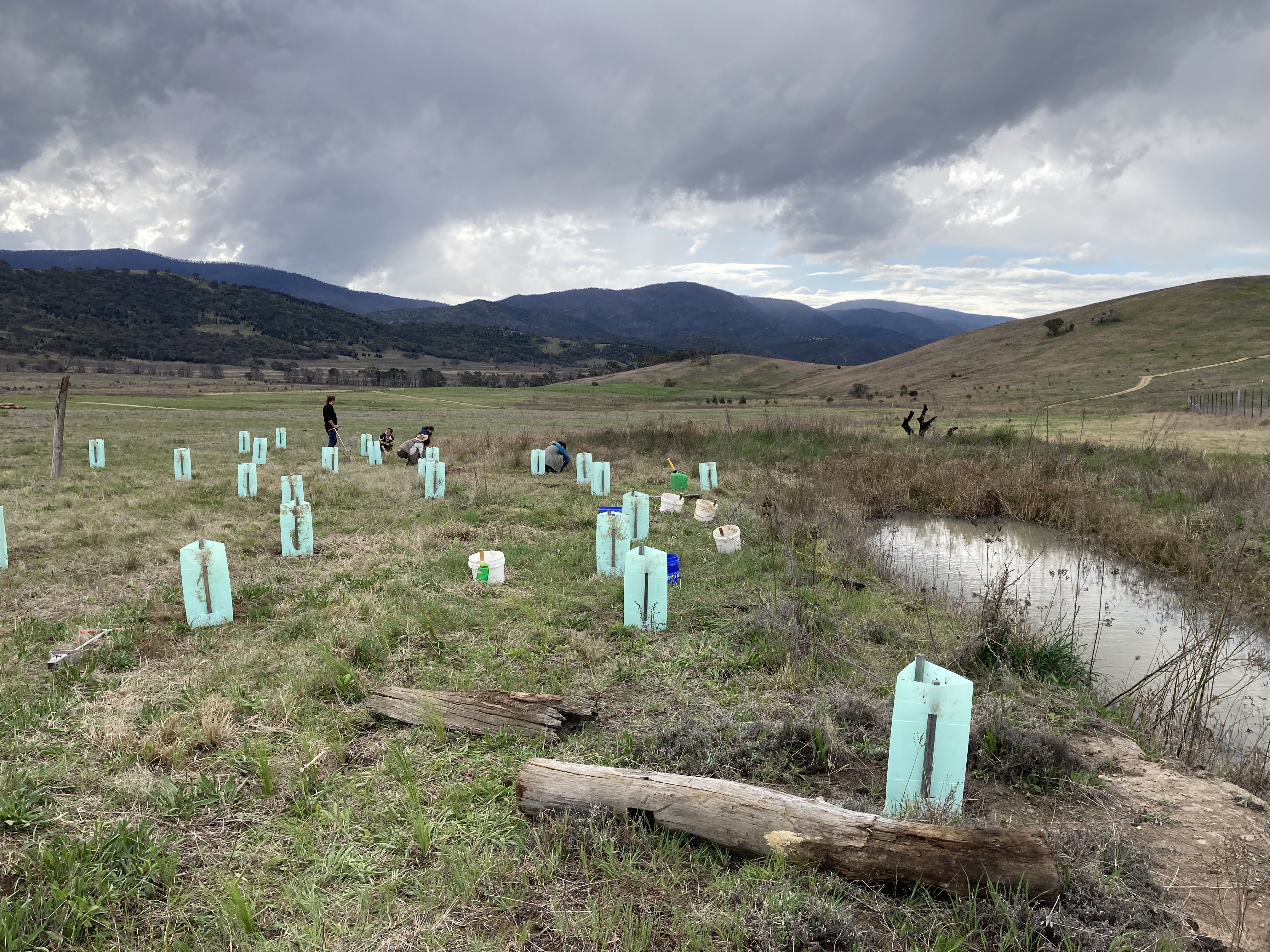
On the 27th of September, 12 ENVS3039 students including myself headed to Scottsdale for a day of work helping to restore a riparian site known as Applebox Creek. This work is part of a larger long-term project to revegetate drainage lines for habitat enhancement and connectivity, as well as water retention and erosion control. Site manager Phil Palmer and field officer Kim Jarvis told us about the history of the site, the work that Bush Heritage does, and some of the major challenges and priorities for the restoration project, before we headed out to Applebox Creek and got our hands dirty.

Kim showing us how to plant the seedlings. Photo credit: Sian Hardy
As a highly degraded site, restoring Scottsdale is a challenging undertaking. Phil told us that he believes effective ecological restoration requires the equivalent of time and energy as was put into its degradation. Given that Scottsdale was an agricultural site for 180 years and very little of the original cool temperate grassy woodlands remain, this statement really puts into perspective the fact that restoration work is an intergenerational task requiring continual commitment, resources, and a holistic and evidence-based approach. Bush Heritage is aiming to achieve this at Scottsdale, through management actions to reestablish healthy ecosystem processes, functions and interactions in the long term.
Planting for ecosystem functions
At Applebox Creek, we planted a variety of flora including grasses and sedges, mid storey shrubs, and eucalypt trees. This species diversity is an important component of grassy woodlands ecosystems. Having a more structurally complex habitat attracts small birds and vertebrates that struggle to find shelter and resources in more open, cleared landscapes. Plants were also chosen for their compatibility with the riparian habitat. For example, water-loving species like Lomandra longifolia and Carex appressa were planted in the creekbed to stabilise sediments and decrease turbidity, and Eucalyptus bridgesiana (applebox) comprised the majority of the overstorey as it is best suited to saturated soils and stream lines (Palmer, pers. comm.).
As well as plantings, our work included placing coarse woody debris around the site. Woody debris has a variety of important ecological functions, including increased habitat complexity and improving soil quality.
The location of our planting site was also carefully chosen, to connect up with the remnant woodland upstream as well as two pre-existing regeneration areas – an eight-year-old planting on the other side of the creek, and a one-year-old planting just upstream (see the map below). Ecosystem connectivity is particularly important for fauna populations, which can become locally extinct due to a lack of resources and genetic diversity in fragmented habitats.
Monitoring for success
The staff at Scottsdale keep track of all the restoration work at Scottsdale through remote sensing and ArcGIS digital mapping. This data is used to monitor the survival rates of plantings and plan future restoration efforts according to what has and hasn’t succeeded. As of 2022, there are over 37,000 plants mapped across Scottsdale, with a survival rate of 87%. Hopefully our plantings down at Applebox Creek are on track to achieve a high distinction as well!

A eucalyptus seedling in its new home. Photo credit: Sian Hardy

 Biodiversity Conservation