
By Jingai Bai (u7542689) Word Count: 499 words
On 6th September 2022, a group of students from ANU participated in the manual removal of Verbascum thapsus in Ginninderry Conservation Corridor (Figure 1), located on the ACT – NSW border, managed by the Ginninderry Conservation Trust, under the guidance of Weed Management Plan – Conservation Corridor.

Figure 1: Picturesque views of the Ginninderry Conservation Corridor. (Image Credit: Jingai Bai)
The reason why it is unwanted and unloved
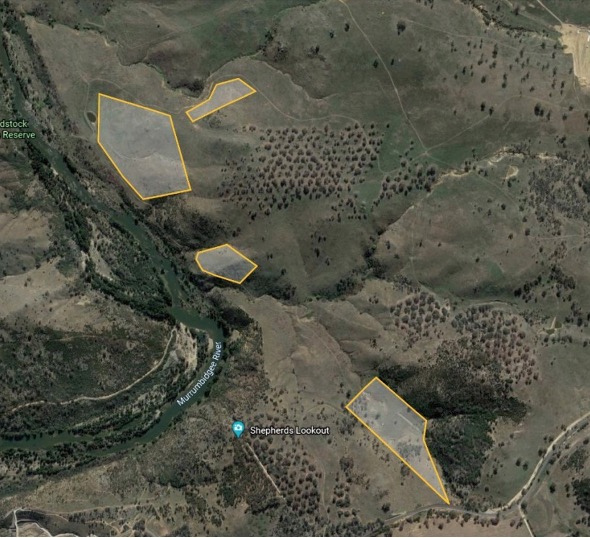
Spreading over the hillside is Verbascum thapsus (Figure 2), an invasive plant native to Europe, North Africa, and Asia, introduced to Australia as a garden plant and listed in the Tasmanian and Victorian seedling catalogues in 1845 and 1855 respectively.
Figure 2: Distribution of Verbascum thapsus in the Ginninderry Conservation Corridor in 2021. (Image Credit: Ginninderry Conservation Trust)

It has a green furry lotus appearance (Figure 3), and dual identity as an invasive plant and a weed. The relationship between invasive plants and weeds is that invasive plants are often weeds because they grow in abundance and their negative characteristics exceed positive ones, but weeds are not always invasive.
Figure 3: The appearance of Verbascum thapsus and its large rosette. (Image Credit: Jingai Bai)
It grows very fast, and each individual can produce between 100,000 and 175,000 seeds that can survive over several hundred years, making the existing population challenging to eradicate. Verbascum thapsus has many characteristics of weeds, such as high reproductive potential, abundant seed production, seeds remain active for a long time, rapid population establishment, and invasiveness outside of its native range. V. thapsus was born with traits that make it an unloved and unwanted weed.
Threats to biodiversity
If not controlled, its large rosette (Figure 3) can shade out, out-compete native vegetation, threaten the diversity of native plants, and influence the degraded indigenous territory’s regeneration. In alpine regions, it will also threaten the degradation of native plant communities and interfere with natural succession processes.
The Ginninderry Conservation Corridor covers the Box-Gum Grassy Woodland, Natural Temperate Grassland, and Pink-tailed Worm Lizard habitat. Under the EPBC Act, Box-Gum Grassy Woodland and Natural Temperate Grassland are listed as critically endangered ecological community, and the Pink-tailed Worm Lizard is listed as vulnerable species. Due to the corridor’s high biological value and distinctiveness, the establishment of V. thapsus inevitably threaten the community structure and biodiversity by displacing native species.

Our action is at the early rosette stage when taproots are shallow, and the seeds have not yet formed. So we need to eradicate the taproots completely to ensure the effectiveness of the removal (Figure 4). However, as our action was in the late stages of control, the prevent and eradicate phases were missed, and this invasive species was already abundantly established and widespread. Thus long-term management and monitoring are necessary.
Figure 4: Our victory – Verbascum thapsus thoroughly removed from the roots. (Image Credit: Jingai Bai)
ANU students are always on the move
In addition to weed removal (Figure 5), ANU students contributed significantly to the ACT koala survey, animal monitoring, and shrub planting through various work experiences.
We are a group of young generations committed to biodiversity conservation and are always on the road to practical action for biodiversity conservation. We recognise, respect, and protect biodiversity’s cultural and environmental values.
May our efforts make a difference in biodiversity’s recovery, and we look forward to more participants joining our group.
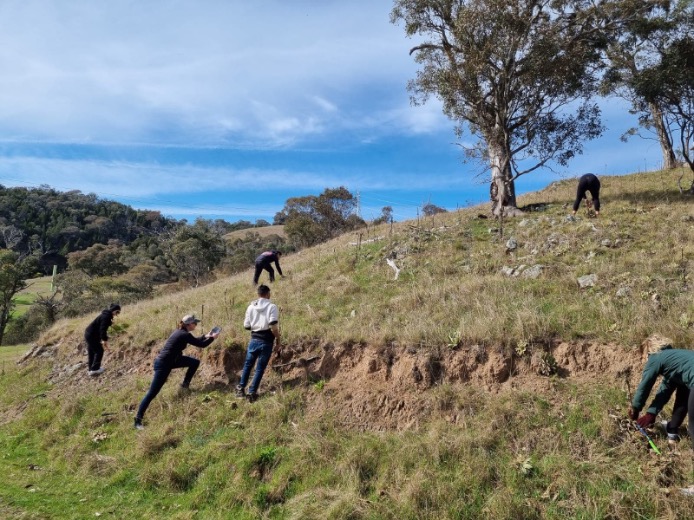
Figure 5: A group of ENVS3039 students were using garden tools to remove weeds manually. (Image Credit: Bridie Noble)
Acknowledgements
Many thanks to Bridie Noble, Riverbank Restoration and Education Officer, for answering our questions and providing working photos.

 Biodiversity Conservation