
By u6963692
While we are busy building more homes for ourselves, we are destroying the homes of many threatened species.
Rapid population growth and poor housing affordability are placing pressures on governments to make more land available for housing leading to the destruction of habitats for many threatened species. Australia’s urban developments are expanding into areas of high species diversity at a rate more than double the average for developed countries. New residential areas around Canberra are threatening ecological species such as the Box Gum Grassy Woodland, the Superb Parrot and the Pink-tailed Worm-lizard.
Globally, urban green spaces (public open space in built-up areas primarily covered by vegetation) have quickly expanded to provide habitat for various threatened species promoting conservation in urban environments. However, not all urban green spaces fulfil this role as some are typically mowed and tidied for aesthetics which prohibits natural regeneration and biodiversity. Famous examples include the Gardens by the Bay in Singapore, the picturesque Central Park in New York and London’s well-visited Hyde Park.
Conserving biodiversity at Ginninderry
Researchers from ANU collaborated with Riverview Projects Pty Ltd and their landscape architects, Cia Landscape and Colour, to devise two alternative treatments for urban green spaces to compare with traditional “park-like” management at Ginninderry, a new sustainable residential area in west Canberra. The project aimed to evaluate the benefits to biodiversity, the economy and society of alternative treatments of urban space.
The first alternative treatment was mulching and mass-planting where landscapers extensively mulched before hand-planting native (but not endemic) ground-cover below a mature tree. The second alternative treatment focussed on restoring Box Gum Grassy Woodland by removing topsoil and scalping near the tree before seeding native endemic species.

I joined a group of fellow ANU students to help contribute to this project by planting mid-storey species at Ginninderry. We initially aimed to assist in early September, however the weather had other plans…
Second time’s a charm (kind of…)
We rescheduled to early October, when yet again it was tipping down. However, we didn’t let the rain stop us from heading out to Ginninderry, but we did let it stop us from planting (and getting all wet and muddy!).
We saw the shrubs we were supposed to be planting and the landscapers from Cia Landscape and Colour that will now have to plant all of those without the help of all of us student volunteers. It was a shame that we missed out on contributing to this project at Ginninderry however I am glad we were still able to visit and see all of the good work!
Matthew Frawley, Ginninderry’s Urban Design and Landscape Manager, explained that the most successful treatment so far has been the mulching and mass-planting. Traditional management caused minimal regeneration and the third treatment suffered as it is challenging to establish native species in an urbanised environment due to warmer microclimates and different soil conditions.
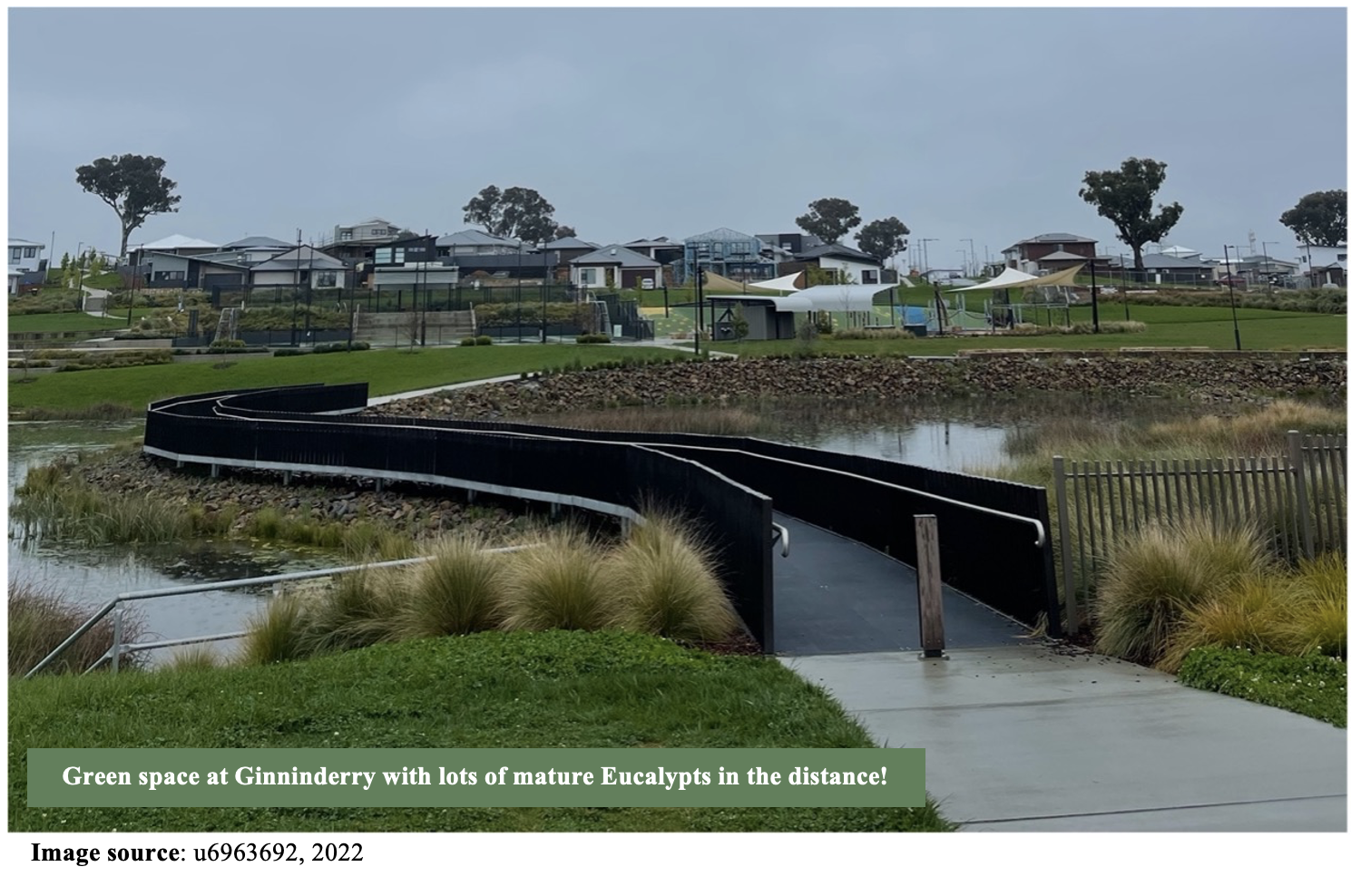
Having the opportunity to visit Ginninderry and speak with the people concerned in this project, made me realise the importance of such sustainable developments in promoting biodiversity and species richness with our continual urbanisation.

 Biodiversity Conservation