
By Bridget Smits – u6953448
Verbascum thapsus, commonly known as Rams Ear is a plant that my Nana has always had in her garden. I used to love rubbing the velvety soft leaves between my fingers as I explored her sensory rich backyard. Until I volunteered with the Ginninderry Conservation Trust, I didn’t realise this nostalgic plant was a highly invasive weed species dominating landscapes across southern and eastern Australia.
Who is the Ginninderry Conservation Trust?
I completed my work experience day at the Ginninderry Conservation Trust (GCT), where we met with Riparian Restoration Officer Bridie Noble and her colleague Violet to get stuck into some weeding in the Ginninderry Conservation Corridor (GCC). The Corridor is made up of 597 hectares of conservation area between the ACT’s northwest suburbs and the Murrumbidgee River, spanning the ACT-NSW border. After extensive historical clearing for grazing and timber, the Corridor now protects and manages Grassy Box-Gum Woodland ecosystems, which now only covers 8% of its original pre-European coverage over large areas of southeast Australia.

The invasive nature of Verbascum
As humans continue to influence and control the natural environment at unprecedented rates, plant species are invading new regions and environmental niches at a rate that poses large threats to ecosystems and human security and wellbeing. Plant or animal species become invasive when they have been displaced due to human activity and now negatively impact the new environment they inhabit.
Verbascum is well adapted species that grows vigorously in a broad range of landscapes and soil types (Invasive Plant Atlas 2018). It is a prolific seeder which can produce 100,000-240,000 seeds from a single flowering stem which grows in dense, often tall clumps. The invasive nature of Verbascum poses threat to the Corridor as it can outcompete native vegetation and species such as the Golden-Sun Moth, Box-Gum Woodlands, and Natural Temperate Grasslands.
How are weeds managed in the GCC?
When identifying which sites to conduct weeding on, priority was given to sites containing highly invasive weeds in significant numbers which pose risk for severe spread or affecting areas of high conservation value, such as Pink-tailed Lizard worm habitat.
With the help of the GCT staff, we spent hours physically removing Verbascum from the targeted area of the Corridor. We used a pickaxe to pull the deep-rooted weeds from the hard soil and made sure to leave them flipped over to avoid reestablishment.
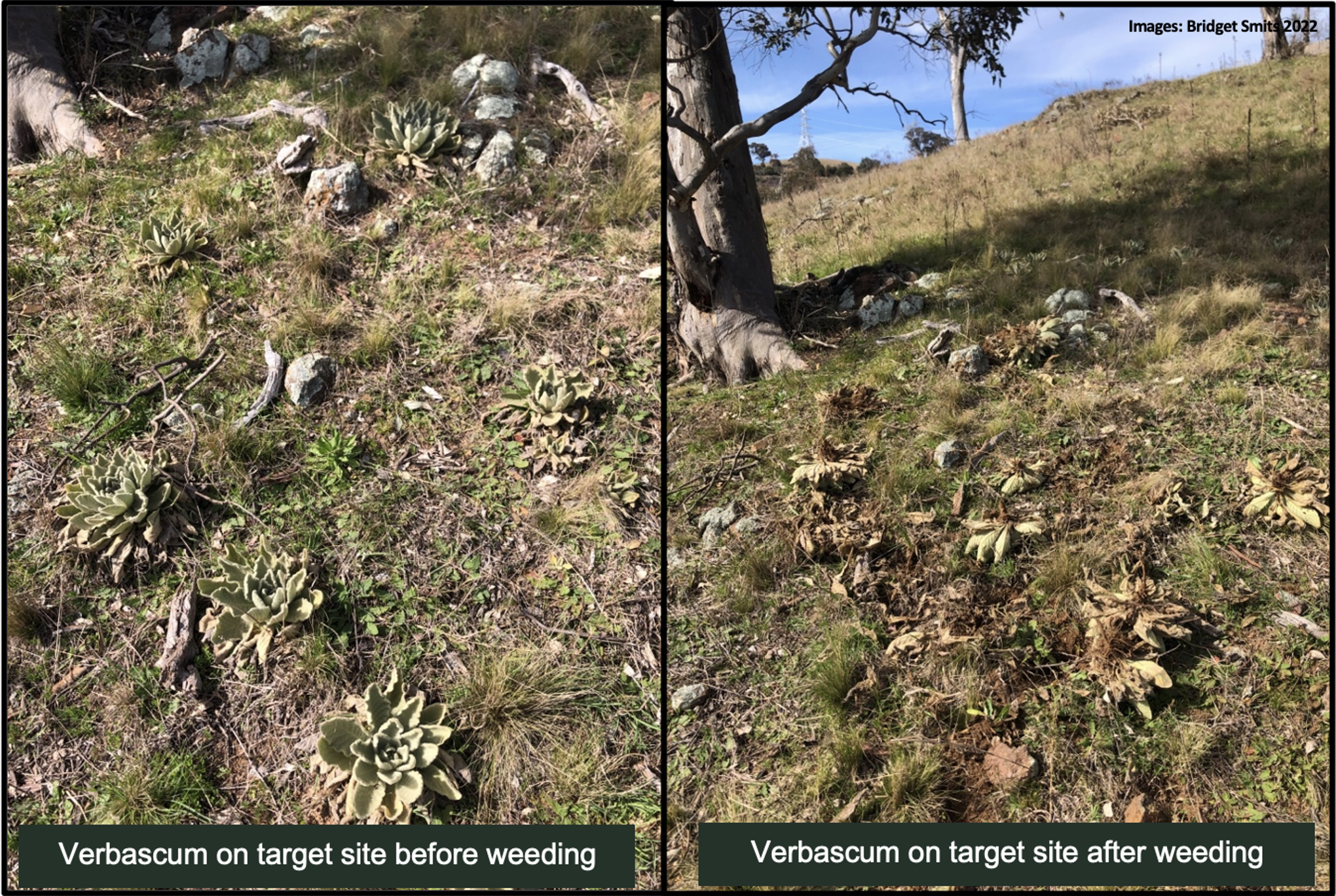
‘Verbascum is easily removed by hand but spreads quickly, having dedicated volunteers to regularly clear the area is crucial in maintaining habitat and control.’ – Bridie Noble, GCT
Staff also conduct herbicide spraying, targeted grazing to maintain groundcover while reducing weed biomass which effective for short term weed prevention and control, but to achieve long-term eradication, techniques such as Indigenous cool burning should be implemented, and education should be developed to avoid future importation of the plant into the community.
References
Ginninderry Conservation Trust (2018) ‘Ginninderry Conservation Corridor 2018-2023 Management Plan’ Ginninderry, http://www.ginninderry.org.
Ginninderry Conservation Trust (2022) ‘Our Mission’ [2022, 1.10.2022, Ginninderry Conservation Trust]
Gupta, A., Atkinson, A., Pandey, A., Bishayee, A. (2022) ‘Health-promoting and disease-mitigating potential of Verbascum thapsus L. (common mullein): A review’, Phytotherapy Reseearch 36:4, 1507-1522.
Westwood, J., Charudattan, R., Duke, S., Fennimore, S., Marrone, P., Slaughter, D., Swanton, C., Zollinger, R. (2018) ‘Weed Management in 2050: Perspectives on the Future of Weed Science’, Weed Science 66:3, 275-285.

 Biodiversity Conservation