
By Imogen Rayner u7138959
Monitoring reptile populations in grasslands is important in understanding and conserving their habitat, as well as understanding threats, dispersal patterns, and morphology. Reptiles are an important indicator of ecosystem health and contribute heavily to the functioning of their habitat. When it comes to making important conservation decisions and managing agricultural development, reptiles provide a good baseline.
A brief introduction:
Striped Legless Lizards (Delma impar) are listed as vulnerable by the EPBC in the Australian Capital Territory. On first appearance they are like snakes, but are easily distinguished by their ear opening, broad tongue, and shedding tail. They each have a unique scale pattern on their head, making them easily identifiable as individuals. The lizard is often found in treeless grasslands, both with native and exotic grasses, they particularly favour tussock grasses.
The grassland habitat favoured by legless lizards is under constant threat, affected by multiple anthropogenic and climate barriers. The biggest of which are caused by agricultural and infrastructure development and poor land management practices.

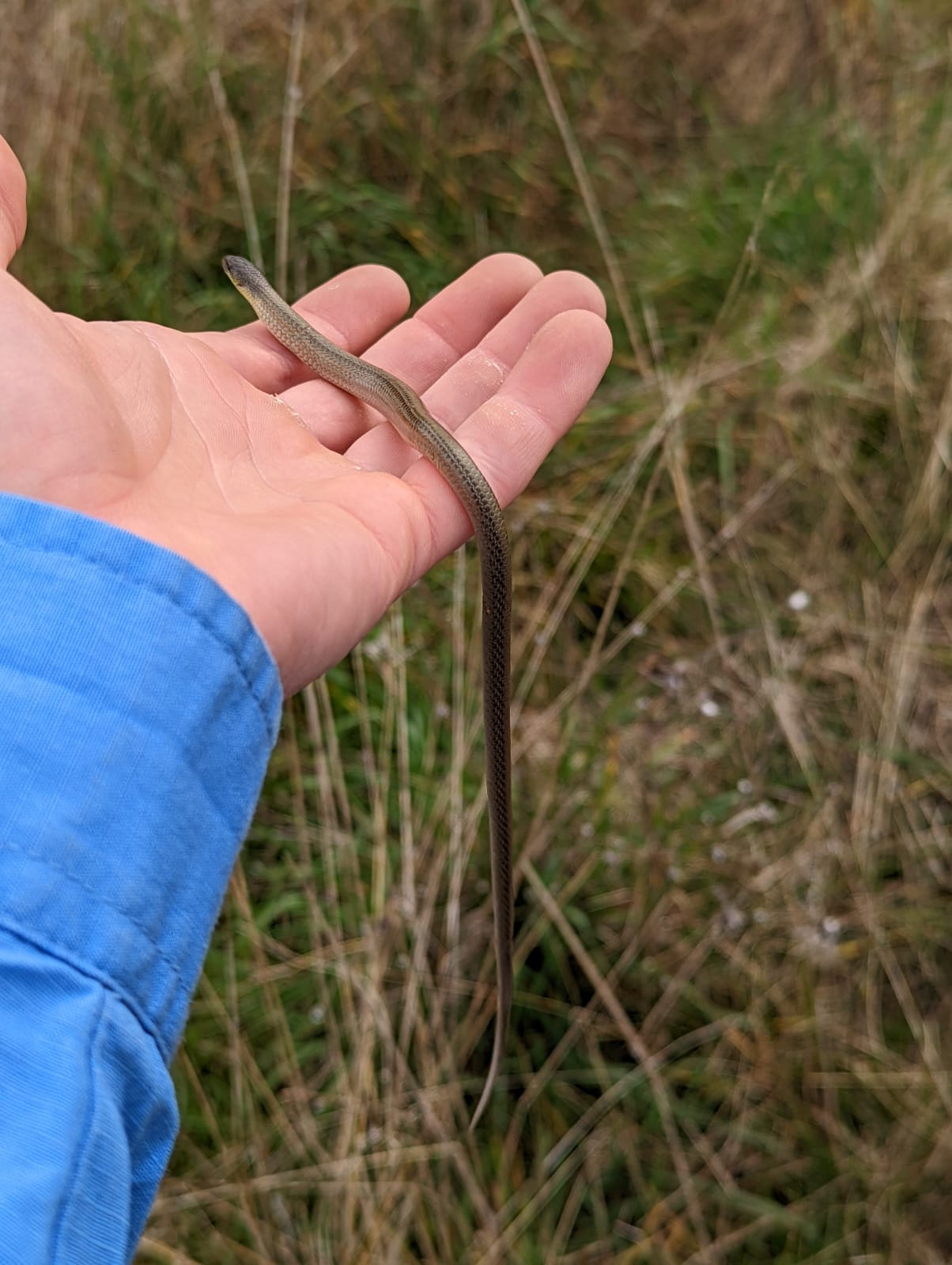
Fig. 1 and 2: Striped Legless Lizard
The project:
The Legless Lizard monitoring program in the ACT are under the direction of the Striped Legless Lizard Action Plan which is part of the broader 2017 Native Grassland Strategy. The aims are to:
- Conserve all large populations in the ACT
- Manage the species and its habitat to maintain the potential for evolutionary development in the wild
- Enhance the long-term viability of populations through management of adjacent grassland to increase habitat area and connect populations, or to establish new populations
- Improved understanding of the species ecology, habitat, and threats
- Promote a greater awareness of, and strengthen the stakeholder and community engagement in the conservation of the species
In the ACT, Legless Lizards are found in Gungahlin, Belconnen, Majura Valley, Yarramundi Grassland, Jerrabomberra Valley, Yass, and Murrumbateman. These sites are on both private and government land. The monitoring program is conducted by Capital Ecology, a privately owned ecological consulting business. Capital Ecology have identified several sites around the ACT and uses roof tile grids as the preferred survey method.
I participated in a field monitoring day with Capital Ecology at their established sites in Hume near the Mugga Lane Recycling Centre and on a private property, Bonshaw. The fieldwork involved turning over the roof tiles to check for Legless Lizards. If found, they are measured, weighed, and photographed. Other species are also recorded. The table used is shown below:

Fig. 3 Monitoring sheet used and created by Capital Ecology
Shannon Thompson, a spatial ecologist with Capital Ecology, said that the weather can be a tough barrier to monitoring. Wet weather causes the lizards to seek dry shelter and if the tiles are cool the lizards are unlikely to seek shelter under the roof tiles. On the contrary, if it is too hot the lizards will also not utilise the roof tiles. Overgrazing can also reduce the available tussocky grass cover that the lizards favour.
Legless Lizards are an important indicator of ecosystem health in the ACT’s threatened grassland. Continuing these monitoring programs will not only ensure survival of the Legless Lizards, but also improve other conservation practices and achieve biodiversity goals in the future.
Acknowledgements:
Thank you to Shannon Thompson, Rob Speirs, Catherine Ross and the rest of the Capital Ecology team for providing this experience and their knowledge of the Striped Legless Lizard.

 Biodiversity Conservation