
Marlon Taylor u6735195
In the summer of 2019-2020, much of Australia’s eastern seaboard was devastated by fire. Scars of this so-called Black Summer linger; affected ecosystems are still in the process of rejuvenation and recovery. The ACT’s Namadgi National Park was particularly hard hit by the Black Summer fires. The majority of the southern portion of the park was burned by the Orroral Valley fire. Developing strategies to help the Namadgi NP recover from the fire has been the subject of a body of research following the Black Summer fires. One such study, by PhD candidate Heather Burns, examines whether artificial shelter structures can be useful tools for the recovery of small mammals and reptiles.
Australia’s Missing Mammals
Australia has the worst record in the world for mammal extinctions since European arrival in the 1700s. The majority of these extinctions consist of small to medium sized mammals, which have been decimated by introduced predators. Conserving Australia’s remaining mammals is of high priority, especially considering many are threatened by predation from introduced species. Previous research indicates that small mammals are more vulnerable to predation after disturbance events, such as bushfire. Bushfire removes shelter structures such as woody debris from landscapes, a habitat element known to be of importance to both mammals and reptiles. Heather’s study addresses this vulnerability, asking whether the introduction of artificial shelters made of woody debris can assist with the recovery of small mammal populations following fire events.
The Road To Recovery
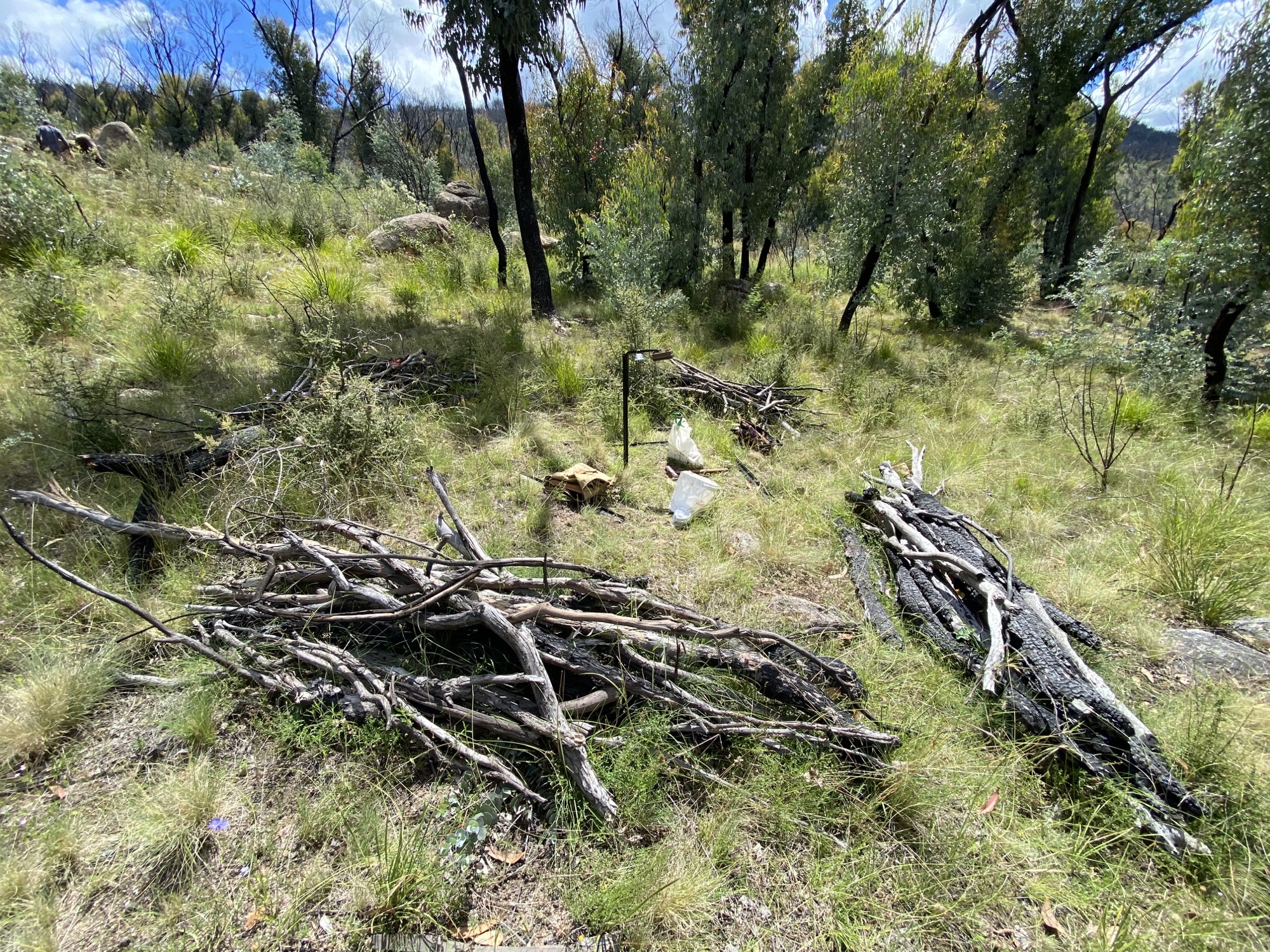
Heather’s study sits in a broader suite of research projects investigating bushfire recovery in Namadgi NP. Her study is examining whether artificial shelters made of wood piles, chicken wire, or a combination of both, attract more mammals and reptiles than elsewhere in the environment. At each site she has a camera trap used to record all the animals that pass through and are using the shelter sites. Although no data has been published just yet, the camera traps have turned up some interesting observations. The camera traps have recorded some mammals that typically avoid burnt areas, such as the long-nosed bandicoot (Perameles nasuta), suggesting perhaps the shelters are working as desired. Unfortunately, the camera traps are also recording a large quantity of introduced rodents such as House Mice (Mus musculus) and Black Rats (Rattus rattus).

A Formidable Frequency of Future Fires
Research into bushfire recovery is more valuable now than ever. Projections continue to indicate that increased frequency and severity of bushfire is likely should global temperatures continue to warm. The Black Summer fires have acted as something of a wakeup call to Australia, the future has arrived. While fire is an important part of many Australian ecosystems, including those in Namadgi NP, many of these systems are not adapted to the kinds of fire regimes that we will likely experience as global warming continues. As a result, the importance of understanding how to adapt, and how to help ecosystems adapt, to these changing conditions cannot be overstated. Studies into strategies for bushfire recovery, such as Heather’s, will provide an essential knowledge base from which to plan future management of bushfire prone areas.
Acknowledgments
Thanks to Heather Burns for providing background to the project and photographs.

 Biodiversity Conservation