
By Xinran Miao u6529022
An interview with Mrs. Ziyou Yang – the Project Director at Spoon-billed Sandpiper in China©
Migratory birds utilize different regions as habitat at different stages across the breeding, passage and staging, and wintering grounds [1,2]. However, a conspicuously low percentage of migratory birds receive adequate protection across their entire habitat ranges. In the past few decades, migratory bird populations are declining rapidly around the world, which emphasizes the urgency for acting migratory birds conservation [1].

To understand better about this issue and learn to how can we contribute to migratory birds conservation, I had a conversation with Mrs. Ziyou Yang, the Project Director at a Chinese NGO (called Spoon-billed Sandpiper in China), who aims to protect migratory birds on the Yellow Sea mudflats along the East Asian-Australasian Flyway.

As one of four globally recognized flyways for migratory waterbirds, the East Asian-Australasian Flyway (EAAF) stretches from the Russian tundra to New Zealand’s coasts, which overlaps with 37 countries [2,3]. The EAAF is used by more migratory species on the IUCN Red List than any other flyway [4].
In this flyway, at least 33 globally threatened or Near Threatened waterbirds have occurred and 24 of them are heavily dependent on the intertidal zone, such as Spoon-billed Sandpiper (Calidris pygmaea), which was classified as Critically Endangered on the Red List of IUCN, and has been considered as one of the most threatened migratory birds in the world [4,5].
Key threats to migratory birds in the East Asian-Australasian flyway in China
“Threats faced by migratory species in the EAAF are complex, and habitat loss remains the most significant driver of decline for many waterbirds, such as the Spoon-billed Sandpiper.” —– Ziyou
The Yellow Sea intertidal flats that span the coasts of China and the Koreas contain critical staging areas used by most of the EAAF shorebird populations [2,5]. “However, almost two-thirds of the Yellow Sea tidal flat area has been lost over the last five decades,” said Ziyou, “These areas are threatened by industrial-scale reclamation in China, especially on the Jiangsu coast.” By the 2010s, over 65% of the tidal flats present in the 1950s had been lost [6], and many shorebird taxa reliant on the Yellow Sea are estimated to have declined an average of 5.2% annually [7].


“It only takes a few years’ time for a bare mudflat to become a ‘grassland’, Spartina has spread rapidly along the east coast of China over the past two decades.” —– Ziyou
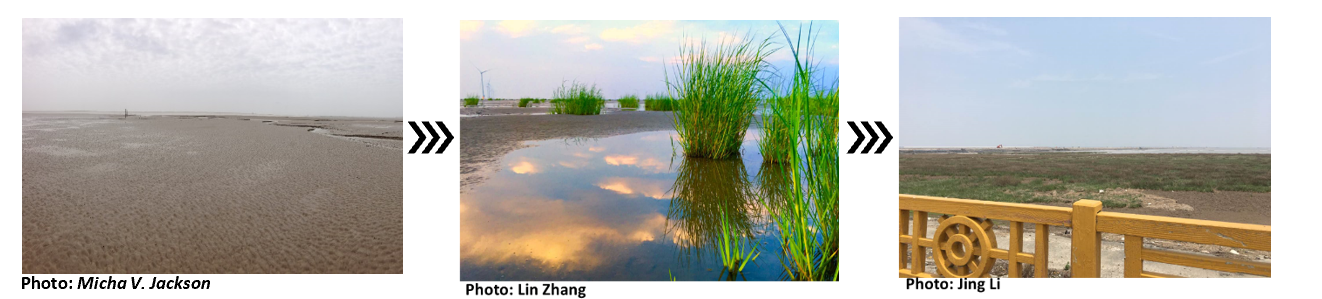
Besides, invasive plant species (e.g., smooth cordgrass [Spartina spp.]) was intentionally introduced to China to accelerate the reclamation, which supports a low abundance of macroinvertebrates and insects and therefore represent poor habitat for migratory birds [2,8].
What to do for the conservation of migratory birds?
Currently, 1.39 million ha (~23.99%) of coastal wetlands in China receive protection, and policies are in place to further strengthen this protection [2]. Many scientific outreaches have been done to improve public awareness of migratory birds’ protection. A wide variety of activities such as lectures, interactive exercises, and birdwatching trips related to migratory birds conservation have been organized for people who lived nearby the south-west coast of the Yellow Sea, especially for students and local fishermen.

However, within the EAAF, international level conservation is also important to protect migratory birds since the foremost challenge in conserving migratory birds is the fact that their annual migration route spatially link sites and habitats across their life circles, and each of these areas contributes to different components of their lives [1,2].
International cooperation and coordinated actions have been implemented as well. The Bonn Convention led a multilateral platform for coordination of conservation across countries, and regional initiatives that link government and civil society organizations can be conducted to strengthen transboundary cooperation [2].
Overall, biodiversity conservation can not be achieved with efforts from a single person, region, or country, it is a global challenge that needs more close transboundary cooperation in the future. Also, as the most severe direct drivers for biodiversity loss, more efforts are encouraged to be made on avoiding habitat loss, therefore to achieve ecologically sustainable development.
Acknowledgment
Appreciation to Mrs. Ziyou Yang for providing this interview opportunity and sharing her knowledge, work experience as well as pretty photos. Thank you to Prof. Philip Gibbons for giving suggestions to write this blog.

 Biodiversity Conservation