
Dorothy Mason (u6019552)
Word count: 506

Dusk is falling over the ANU. The sky is streaked with soft evening light and paddle-pop coloured clouds. It’s a Friday afternoon, and campus is bustling with students spilling out of libraries, gearing up for a night off the books and perhaps a well-earned pint.
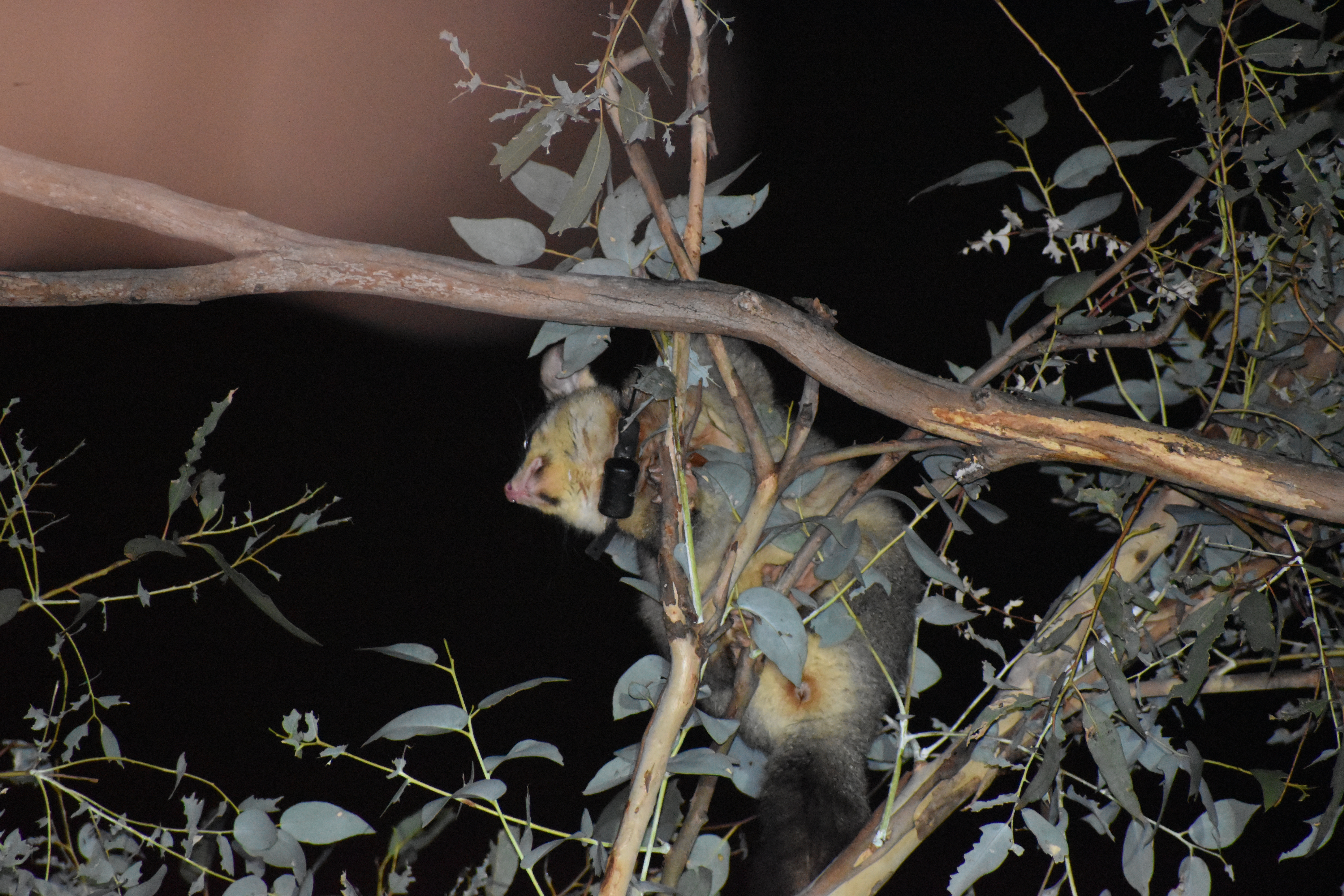
I’ve got weekend plans of a different kind. I’ve arranged to meet up with Tay, an Honours student at the ANU Fenner School conducting research on Canberra’s most ubiquitous marsupial: the common brushtail possum (Trichosurus vulpecula).
Tay has been observing the ANU’s possum population for the past year, tracking their movements across campus in order to learn more about their denning habits and habitat preferences.
He came to the project after he became aware of how much damage possums cause to campus infrastructure. Often, they den in small cavities in ceilings or walls, damaging the building and disturbing its occupants.
“In 2018 alone, the ANU spent 1.4 million [on possum damages],” Tay tells me. “I divided that by the total number of possum issues — that’s 25 grand per possum!”
I spent several evenings walking around campus with Tay, tracking possums he had fitted with GPS collars. Once we had located a possum using the GPS signal, we made a note of the type of habitat we’d found it in: native tree, exotic tree, bare ground, road, urban building or ground cover like grass and shrubs. Tay would later go into ANU Tree Management Systems to try to find out more details about the habitat in question.
The results have been surprising.
“We thought that the possums would have certain selection preferences for exotic trees…but they’ll take whatever when it comes to home range selection,” Tay says.
“But it could be [that] within the home range itself, they selectively feed on exotic trees. That’s what the analysis suggests when we look at habitat preferences on a tree level.”
Tay’s results are important for several reasons. Conducting good fieldwork is essential to improving monitoring practices and exercising adaptive management. Solving the ANU’s possum problem simply isn’t possible without meaningful data on how possums select their habitat.

The research also has broader implications. Understanding how native species adapt to urbanisation remains poorly studied in environmental science. And yet, more systematic research on urban ecology could dramatically improve conservation outside protected areas.
Urbanisation is progressing at a rapid rate, leading to increasingly isolated and fragmented habitat patches. This can have dire consequences for biodiversity. At the same time though, urban environments can play important roles in the protection of local biodiversity, by providing new ecological niches that native species can exploit.
Tay’s preliminary results suggests that brushtail possums in urban environments behave differently to those in the wild.
“In studies of possums in the bush, people reported possums being quite territorial, like fighting for resources and defending territory,” he says. “But within the ANU campus […] their home ranges are not exclusive. They can actually live together, mutually.”
One thing is for certain — there is still much to learn about this familiar creature.
Works cited
Carthew, Susan M., Susan M. Carthew, Beiha-Malen Yáñez, Beiha-Malen Yáñez, Laura Ruykys, and Laura Ruykys. 2015. “Straddling the Divide: Den Use by Brushtail Possums (Trichosurus Vulpecula) in Urban Parklands.” Urban Ecosystems 18 (2): 525-538.
Dixon, Kelly M., Geoffrey J. Cary, Graeme L. Worboys, Sam C. Banks, and Philip Gibbons. 2019. “Features Associated with Effective Biodiversity Monitoring and Evaluation.” Biological Conservation 238: 1-11.
Magle, Seth B., Victoria M. Hunt, Marian Vernon, and Kevin R. Crooks. 2012. “Urban Wildlife Research: Past, Present, and Future.” Biological Conservation 155: 23-32.
McKinney, Michael L. 2002. “Urbanization, Biodiversity, and Conservation: The Impacts of Urbanization on Native Species are Poorly Studied, but Educating a Highly Urbanized Human Population about these Impacts can Greatly Improve Species Conservation in all Ecosystems.” Bioscience 52 (10): 883-890.
Additional acknowledgments
All photos were kindly provided by Divyang Rathod, fellow student in ENVS3039.
All quotes are by Tay and recorded by myself on a field microphone.

 Biodiversity Conservation