
U6051167 – Lara Videnovic
My volunteering project took place in Mulligans Flat Woodland Sanctuary, where I participated in the annual “Echidna Sweep” over two weekends in November.
Importance of the sanctuary
Mulligans Flat spans more than 1200 hectares of protected land in the northern outskirts of Canberra, and has been a hotspot for conservation projects since its establishment. Together with Goorooyarroo Nature Reserve, it forms the largest, most intact area of critically endangered Yellow Box-Blakely’s Red Gum Grassy Woodland in the ACT region. This woodland retains significant ecological values, supporting threatened ecosystems and providing habitat for many native species.
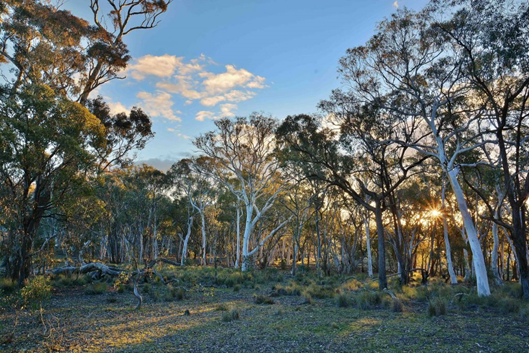
The sanctuary has been an important experiment in restoration and biodiversity conservation. It is enclosed by an extensive predator-proof fence, which removes the threats associated with introduced predators such as foxes and cats, and herbivores such as rabbits. The protection provided by this fence has enabled the successful reintroduction of locally extinct native species within the reserve. As a result, echidna populations in Mulligans Flat have also flourished.
Echidnas!
Foxes pose a major threat to echidnas, as they predate heavily on newborn “puggles”. The purpose of the echidna sweep at Mulligans Flat is to monitor the population size of the native short-beaked echidna (Tachyglossus aculeatus) each year, to assess the proliferation of this species in the absence of predators like foxes. Every spring, about 60 volunteers come together for two weekends to survey the entire sanctuary. They are split into zones, where they walk along transects at 10 metre intervals and scan the area, searching for the spiky creatures.
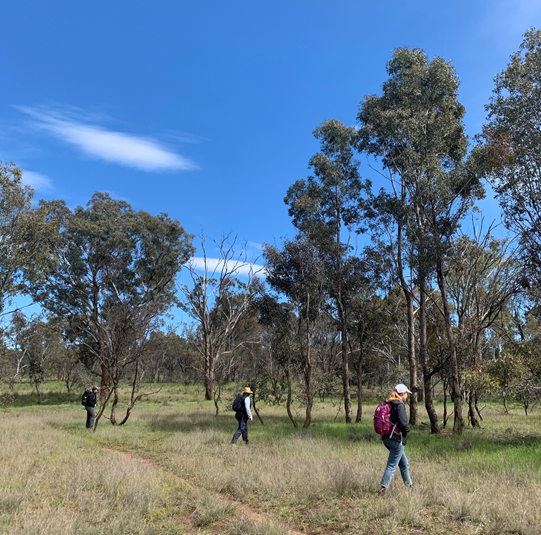
When an echidna is spotted, the Capture-Mark-Recapture method is applied to record the time and place of the sighting. The quills of each echidna are marked with a unique and colourful pattern in nail polish so that at the sweep the following week, marked echidnas can be distinguished from unmarked and the total population can be estimated.
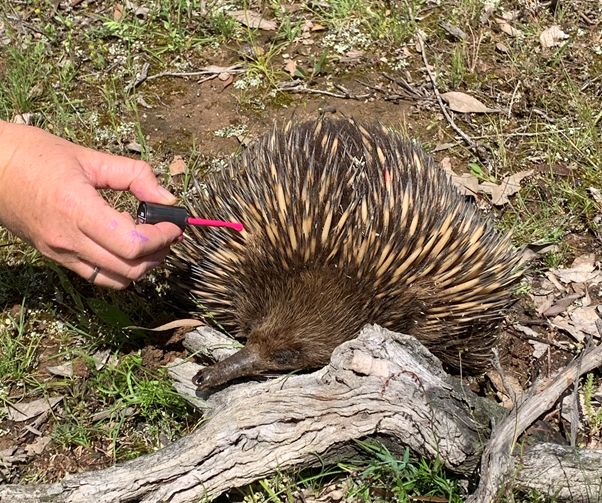
This year, we spotted 40 echidnas – significantly less than was spotted during the sweep last year (70!). The rangers have attributed this to the exponential increase in rainfall that Canberra has experienced this spring. Much of the sanctuary has been flooded over the last few months, so echidnas are seeking shelter in burrows, bushes and thicker tussocks of grass. This makes them much harder for the average volunteer to spot, but further reiterates the importance of effective monitoring in species conservation efforts.
Reflecting on the importance of “citizen science”
Overall, my experience at Mulligans Flat was a lot of fun and emphasised just how much of a difference volunteers make towards progressing conservation initiatives. The limited funding available for conservation science means that projects like the echidna sweep simply would not go ahead if it weren’t for volunteers. Public participation in scientific research (“citizen science”) has thus become a great means for scientists to overcome data and resource limitations. Luckily, there is a great volunteer community in Canberra, with many people giving up some of their free time to get involved and decorate the local echidna populations.
References
ACT Government, 2017. Mulligans Flat to Triple in Size, Our CBR. Available at: https://www.act.gov.au/our-canberra/latest-news/2017/august/mulligans-flat-to-triple-in-size (Accessed 5 November 2020).
Shorthouse, D.J., Iglesias, D., Jeffress, S., Lane, S., Mills, P., Woodbridge, G., McIntyre, S. and Manning, A.D., 2012. The ‘making of’ the Mulligans Flat – Goorooyarroo experimental restoration project, Ecological Management & Restoration, 13(2): 112-125.
Theobald, E.J., Ettinger, A.K., Burgess, H.K., DeBey, L.B., Schmidt, N.R., Froehlich, H.E., Wagner, C., Hille Ris Lambers, J., Tewksbury, J., Harsch, M.A. and Parrish, J.K., 2015. Global change and local solutions: Tapping the unrealised potential of citizen science for biodiversity research, Biological Conservation, 181: 236-244.
TRC Tourism, DSB, ACT Parks and Conservation Service and Woodlands and Wetlands Trust, 2016. Mulligans Flat Woodland Sanctuary Concept Plan, ACT Government. Available at: https://mulligansflat.org.au/wp-content/uploads/2016/12/D.-Draft-Mulligans-Flat-Concept-Plan-Sept-2016.pdf (Accessed 6 November 2020).
Wildlife Victoria, 2017. Short-beaked Echidna, State of Victoria Department of Environment, Land, Water and Planning. Available at: https://www.wildlife.vic.gov.au/__data/assets/pdf_file/0020/92441/Short-Beaked-Echidna.pdf (Accessed 5 November 2020).
Woodlands and Wetlands Trust, 2015. Kids on Country, ACT Government. Available at: https://mulligansflat.org.au/event/kc2/ (Accessed 5 November 2020).

 Biodiversity Conservation