
Lauren Schenk- u6663583
Following a postponement due to rainy weather conditions, we set off for Scottsdale Reserve, Bredbo on Friday October 9th. Our group included Dr David Freudenberger, his team and two fellow students. After a pleasant hour drive, we arrived at Scottsdale where we were greeted by a decked-out volunteer hub. We then set off into the field to start our work on measuring the regeneration of seedlings following fire.
So, what is Scottsdale Reserve?

Scottsdale Reserve was purchased in 2006 by Bush Heritage Australia, a non-profit organisation, to prevent the subdivision of this land for housing. Covering an area of 1,328 hectares, this property had previously been used for agricultural purposes, and as such, around 300 ha had been extensively cleared. Scottsdale Reserve has a strong volunteer community who help in restoration efforts.
What’s being done at Scottsdale Reserve?
Several projects at Scottsdale have been set up to monitor the potential of recovering the endangered box-gum grassy woodlands that once dominated this region. In 2014-15 Dr Freudenberger and several of his students planted thousands of tubestock trees and shrubs native to the site. This included several eucalyptus, acacia and shrub species.

Previous years were spent observing how well the seedlings survive in regards to both: 1) the landscape and, 2) the influence of volunteers maintaining them. However, the Orroral Valley fire that swept through this part of Australia during January 2020 in what is now known as the ‘Black Summer’ presented a new question: to what extent can the seedlings survive and regenerate following fire?
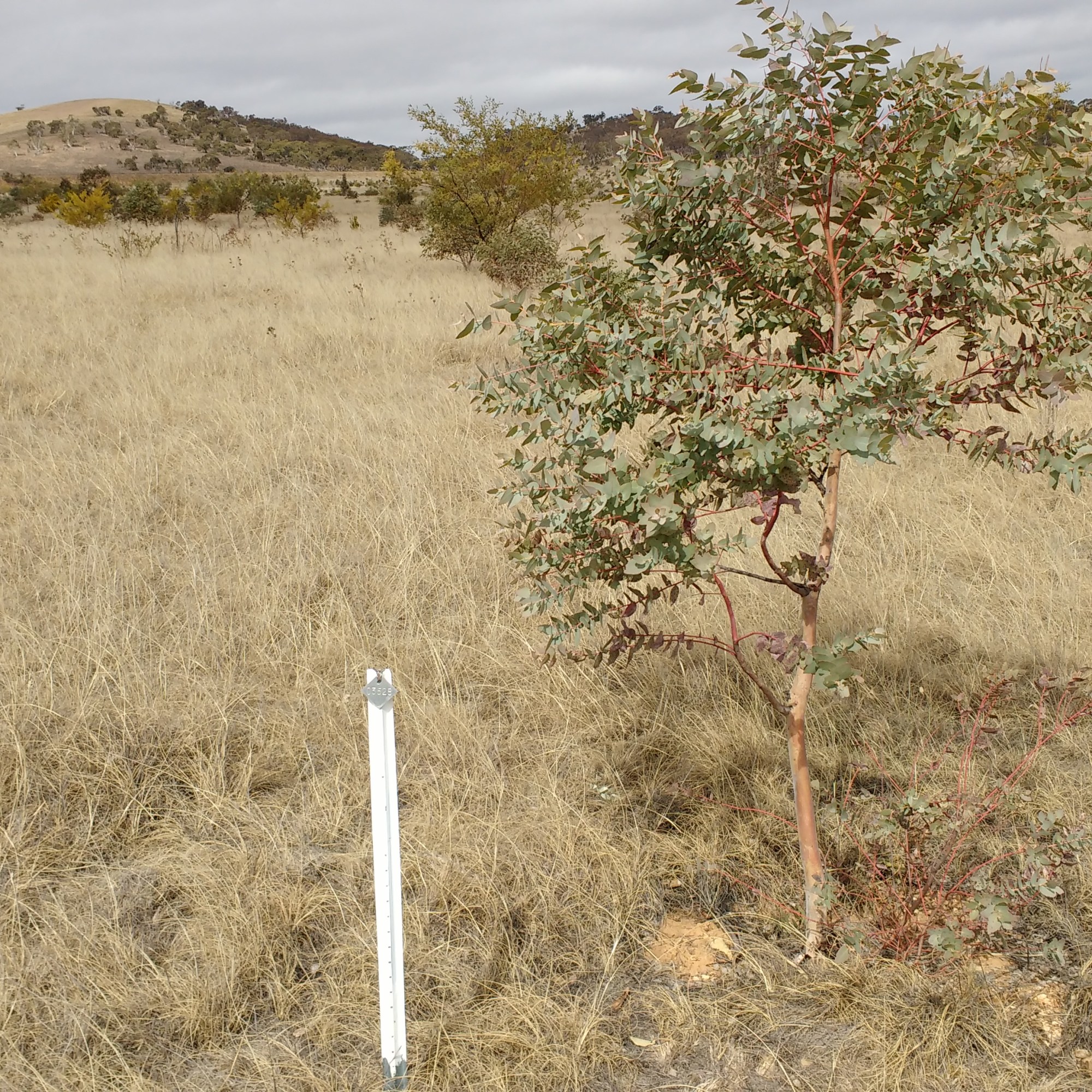
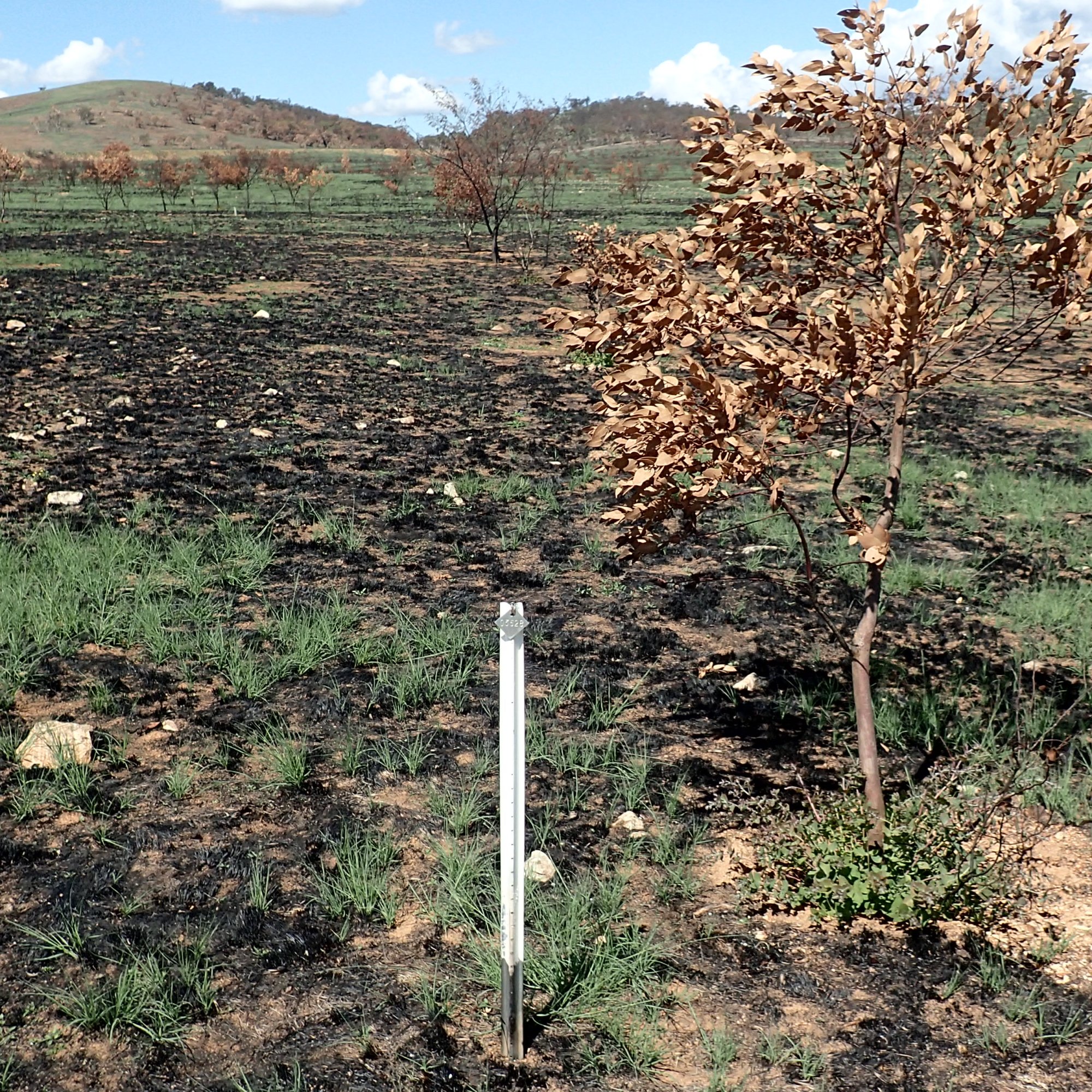
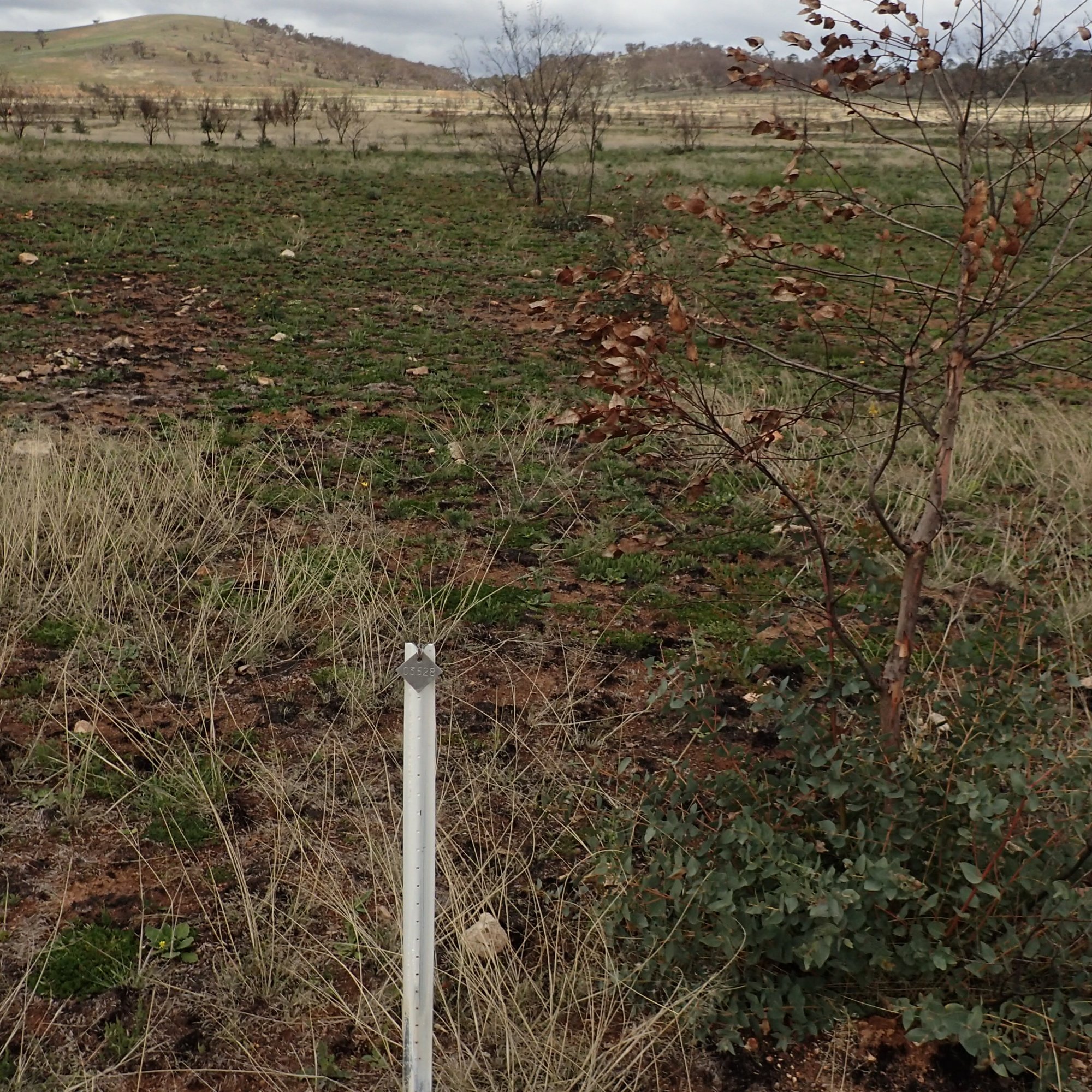
Image depicting the same individual over time. From left to right, Aug 2019, March 2020, and Oct 2020 (Photos by Dr David Freudenberger)
Our Role
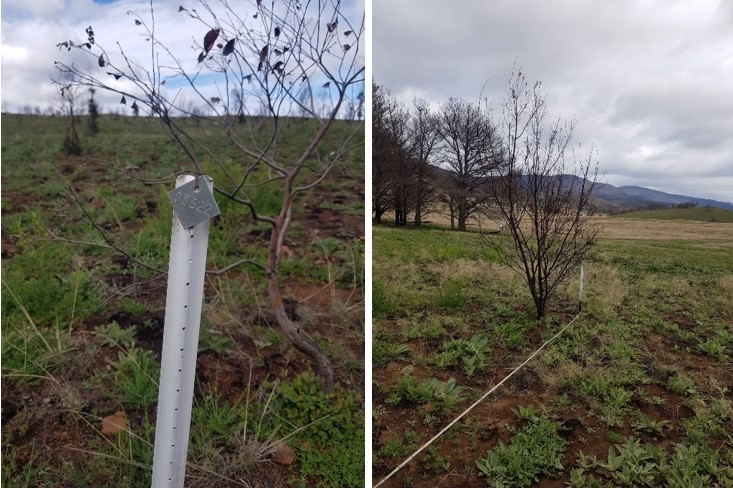
Armed with a trusty 100 m measuring tape and a clip board, we set out along the various transects where the seedlings had been planted. Each 100m-transect had been assigned a number which correlated to a datasheet.

On this datasheet, the specific species and its position was listed. Our role was to observe two components; the health of the individual, and the degree of regrowth/resprouting. For both health and regrowth/resprouting, this was given on a scale of 0 to 2, where 0 is dead/regrowth absent, and 2 is robust health/vigorous regrowth. Regrowth/resprouting was further classified into epicormic, lignotuber, seeding and root plates.
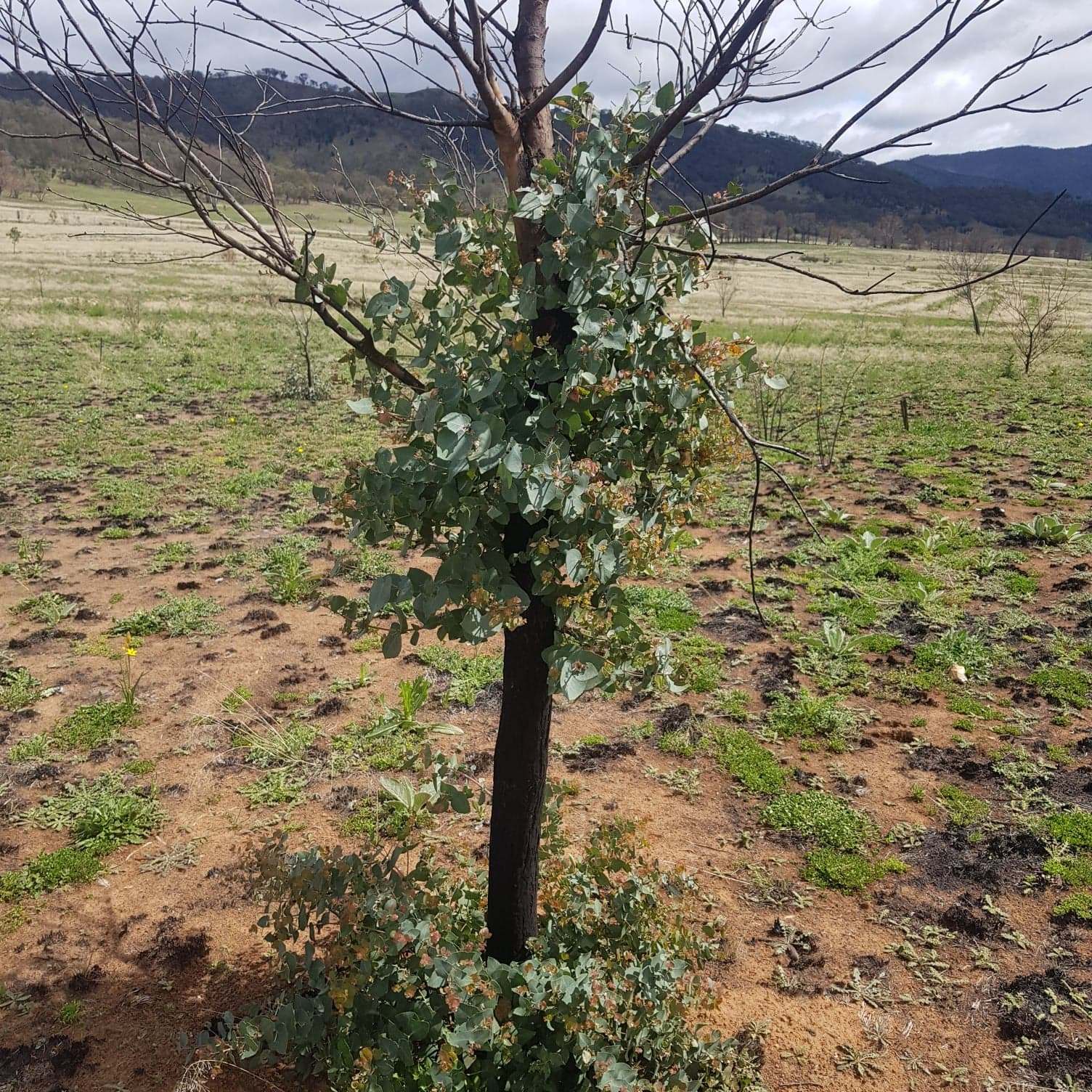

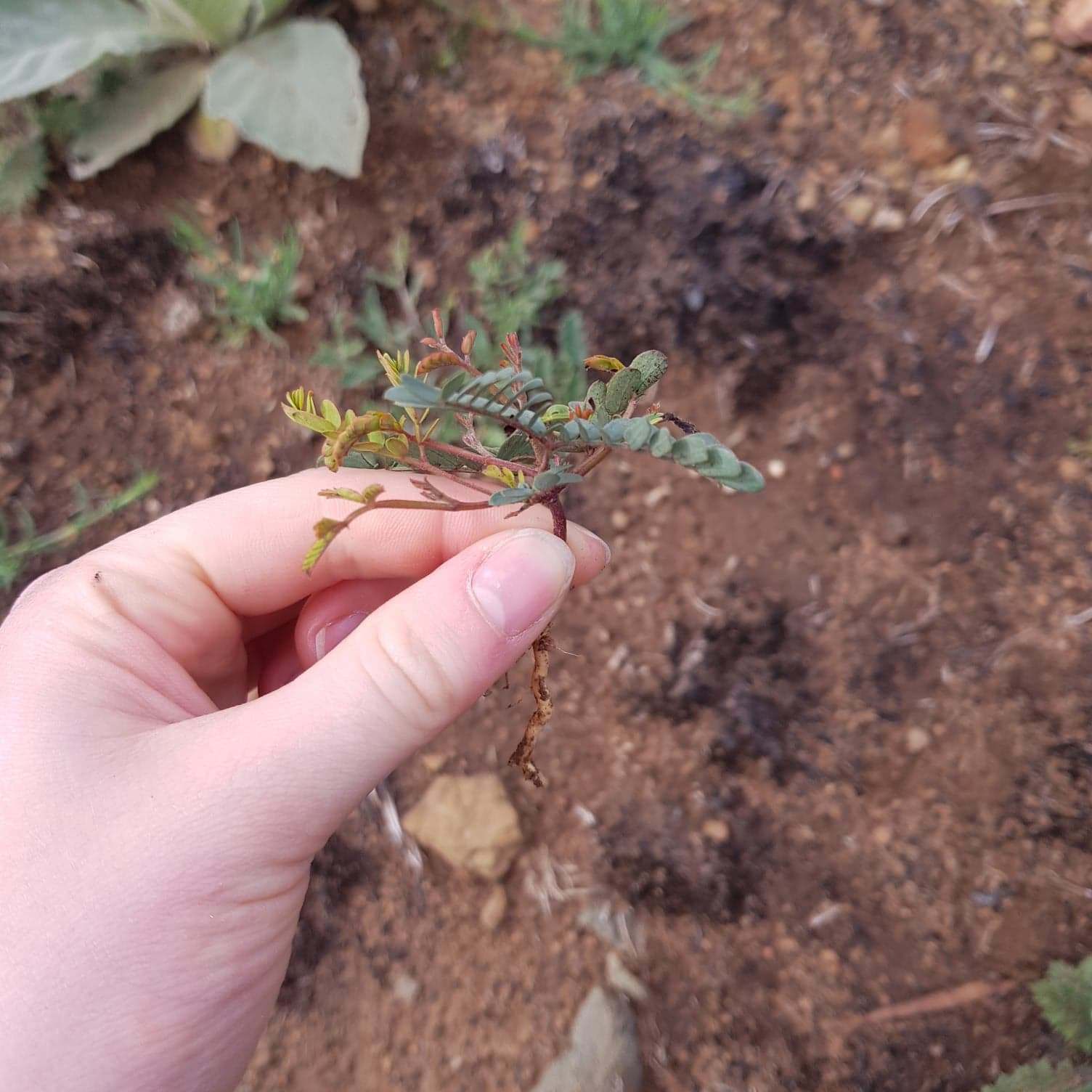
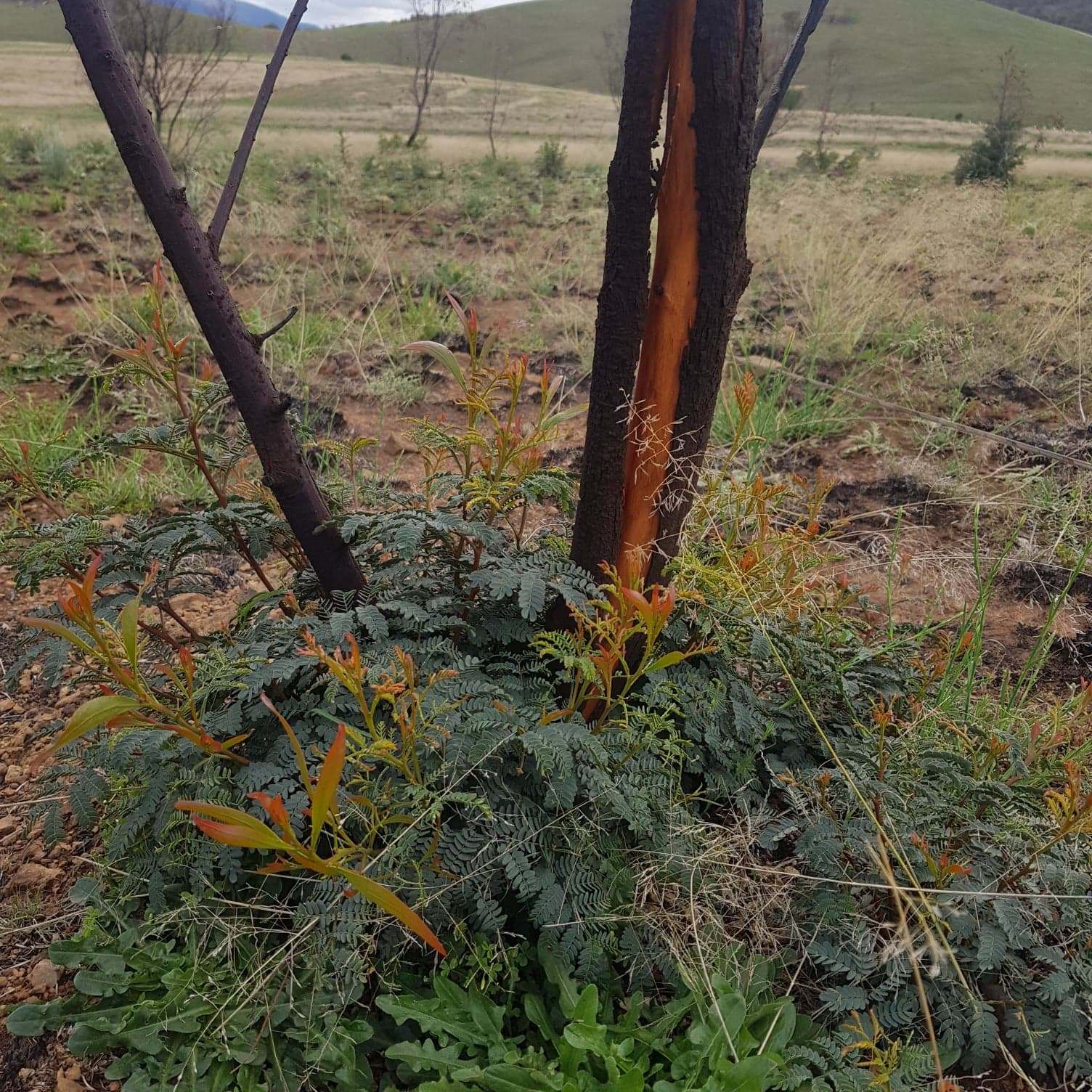
Top left: epicormic growth on a eucalyptus tree. Top right: lignotuber growth on Eucalyptus melliodora. Bottom left: seedling resprout of Acacia rubida. Bottom right: root plate resprouting of Acacia rubida. (Photos by Lauren Schenk 2020)
What’s the verdict?
From the general trends in the data we collected, Dr Freudenberger estimated a survival rate of over 90%! A high proportion of the Eucalyptus and Acacia seedlings were repouting/regrowing. This is incredible considering how damaged and bleak the landscape looked following the fire.
While some natives fared well against the fire others, such as the native shrub Cassinia were not so fortunate. Moving along the transect, cassinia was consistently absent. This shows the variation in survival from species to species following a natural disturbance. As our climate continues to change and frequency of fires increases, this resilience will become more and more important. Therefore, it is vital for us to understand how communities, both native and restored respond to these disturbances. The work done at Scottsdale could be crucial to enabling this understanding.
Scottsdale presents an amazing opportunity to volunteer and make a difference in a community not too far from home. I would highly recommend looking into being a volunteer here.
Word count: 500
Acknowledgements
I would like to thank Dr David Freudenberger for organising this trip and all his amazing insight into the work done at Scottsdale. I would also like to that the other members of his team, Shoshana and Peter, as well as my other fellow students for making this trip so enjoyable.
References
BUSH HERITAGE AUSTRALIA. Scottsdale [Online]. Available: https://www.bushheritage.org.au/places-we-protect/new-south-wales/scottsdale [Accessed].
DEPARTMENT OF ENVIRONMENT CLIMATE CHANGE AND WATER NSW 2011. National Recovery Plan for White Box – Yellow Box – Blakely’s Red Gum Grassy Woodland and Derived Native Grassland. Department of Environment, Climate Change and Water NSW. Available at: https://www.environment.gov.au/system/files/resources/386f395f-b2c6-4e10-8fc3-e937ad277bfe/files/white-and-yellow-box.pdf
HNATIUK, S., RAYNER, I., BROOKHOUSE, M. & FREUDENBERGER, D. 2020. Survival of native seedlings planted by volunteers: The Lower Cotter, ACT case study. Ecological Management & Restoration, 21, 151-154. Available at: https://onlinelibrary.wiley.com/doi/full/10.1111/emr.12410
MAGUIRE, O. & MULVANEY, M. 2011. BOX-GUM WOODLAND IN THE ACT. Conservation Planning and Reserach Policy Division. Available at: https://www.environment.act.gov.au/__data/assets/pdf_file/0011/576848/Box-Gum_Woodland_Technical_Report_25_Cover.pdf
PICKUP, M., WILSON, S., FREUDENBERGER, D., NICHOLLS, N., GOULD, L., HNATIUK, S. & DELANDRE, J. 2013. Post‐fire recovery of revegetated woodland communities in south‐eastern Australia. Austral Ecology, 38. Available at: https://onlinelibrary-wiley-com.virtual.anu.edu.au/doi/epdf/10.1111/j.1442-9993.2012.02404.x

 Biodiversity Conservation