
By Marvin Jin (u6599031)
Behavioural Ecology
White-winged choughs (Corcorax melanorhamphus) are a communal species that congregate together to form social groups. These highly territorial birds carry out obligatory cooperative breeding where a single pair dominates the group and produce offspring, while the others serve as helpers to the brood.
Like a scene straight out of a movie, birds of different groups engage in gang fights and kidnapping, all to strengthen the stability of the social group. They do so by abducting fledgelings and destroying the eggs and nests of rival groups. These complex behaviours do not stop there as even within social groups, deception is commonplace for White-winged Choughs when resources are scarce.
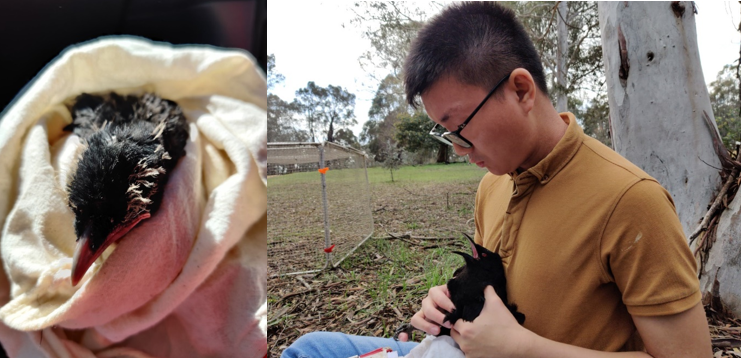
Bird banding work
Studying their complex social behaviour is an ongoing endeavour for Professor Robert Heinsohn from the Fenner School. Assisting on this work is Dr Constanza Leon, who I first heard of this work from over last summer. Professor Heinsohn and his colleagues have refined techniques and methods used to study individual-based social behaviour and cognition in these birds and translate them into approaches in conservation biology.
“Each bird possess a personality unique to the individual”, echoed Dr Constanza, who spent a considerable amount of time during her PhD mapping the relationships of every bird within social groups. This perspective is often important in reintroduction and monitoring projects whereby the study of individuals tell a story about the population dynamics that could inform management strategies.
My role as a scribe was to help with luring, trapping and recording the birds’ measurements while Dr Constanza took measurements and put on identification bands on their tarsus. However, being a professional bander in Australia takes a lot of commitment and skills as required by the Australian Bird and Bat Banding Scheme (ABBBS). You can imagine the state of wonderment I was in when Dr Constanza recognised an individual just by their behaviour.

Climate change and urbanisation
After several banding trips, I sat down with Professor Heinsohn for a casual interview on his perspective on his work. Of which, he shared the consequences of urbanisation on biodiversity. Using White-winged choughs as examples, he noted that as biological invasions into urbanised areas become more prevalent, there is a trade-off between urban and non-urban populations. Urban populations tend to experience lower fledgeling survival but more stable food resources, compared to their non-urban counterparts.
Under climate change, droughts may become more widespread and chough populations may be destabilised, causing a reshuffling of social groups. Individuals may choose to reside in more urbanised settings to secure more stable resources. Perhaps we should consider giving attention somewhere closer to home and think more about ecological planning in cities. The concept of ‘habitecture’ immediately came into my mind as I wonder how cities can integrate ecological values to enhance biodiversity conservation.
Acknowledgements
Thank you Professor Robert Heinsohn and Dr Constanza Leon for providing the opportunity to learn more about this charismatic species.
(490 words)
References
Beck, N.R. and Heinsohn, R., 2006. Group composition and reproductive success of cooperatively breeding white‐winged choughs (Corcorax melanorhamphos) in urban and non‐urban habitat. Austral Ecology, 31(5), pp.588-596.
Heinsohn, R., Dunn, P., Legge, S. and Double, M., 2000. Coalitions of relatives and reproductive skew in cooperatively breeding white-winged choughs. Proceedings of the Royal Society of London. Series B: Biological Sciences, 267(1440), pp.243-249.
Dai, A., 2013. Increasing drought under global warming in observations and models. Nature climate change, 3(1), pp.52-58.
Baker, G.B., Dettmann, E.B., Scotney, B.T., Hardy, L.J. and Drynan, D.A.D., 1997. Report on the Australian bird and bat banding scheme, 1995–96. Environment Australia, Canberra.
Barrueto, C.L., 2019. Social structure, individual fitness and the effect of climate in an obligate cooperatively breeding bird, the white-winged chough (Corcorax melanorhamphos).
Boland, C.R., Heinsohn, R. and Cockburn, A., 1997. Deception by helpers in cooperatively breeding white-winged choughs and its experimental manipulation. Behavioral Ecology and Sociobiology, 41(4), pp.251-256.
Heinsohn, R.G., 1988. Inter-group ovicide and nest destruction in cooperatively breeding White-winged Choughs. Animal behaviour, 36(6), pp.1856-1858.
Heinsohn, R.G., 1991. Kidnapping and reciprocity in cooperatively breeding white-winged choughs. Animal Behaviour.
Heinsohn, R.G., 1992. Cooperative enhancement of reproductive success in white-winged choughs. Evolutionary Ecology, 6(2), pp.97-114.

 Biodiversity Conservation