
U6664609: Greta Owen
It is well known that Australia’s distinct biodiversity is battling threatening processes such as climate change, land use change, invasive species and habitat fragmentation (SOE, 2016). Historically, the effort to conserve biodiversity has been restricted to securing protected areas that could contain large, undisturbed ecosystems (Figgis, 2004). The increasing pressure for land for production and development, it is becoming apparent that new approaches to increase opportunities for biodiversity conservation are vital. That’s where Rivers of Carbon comes in.
On the 3rd of September I had the pleasure of accompanying Lori Gould on a site visit to a landowner who has reached out to her via Rivers of Carbon.
Rivers of Carbon: How they work
Rivers of Carbon (RoC) works to support landholders protect and restore water systems with the long-term goal of stopping erosion, filtering and trapping sediment, providing habitat improving water quality and sheltering stock. The Macquarie Perch project is all about improving a known habitat Macquarie Perch habitat in the Murrumbidgee River. This starts with engaging up-stream landowners.
Supporting landholders through directly funding fencing for overall habitat restoration enables landholders to receive the required help without going the route of directly contacting government for funding, which can be an arduous and overly complicated process.
Go with the flow: The site visit
Lori and I drove to Adaminaby to visit a landholder who had recently reached out to RoC after hearing about the program from a neighbor started working with the program. As we located the property Lori reminded me “You never know what to expect, so it’s always best to assume the worst [with regards to the state of the land and the land-holder’s mindset to the program].”

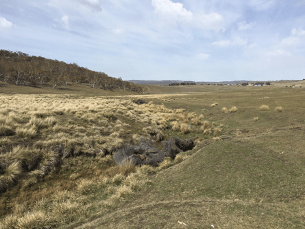
We arrived, engaged in some niceties then set off in a 4WD to check out the property and areas the landholder wanted help with restoring. The main issues faced by this property was livestock causing channel erosion, poor floodplain drainage, and land-use changes since colonization.
Fortunately, the landowner is aware of the issues faced by his property and has tried to remediate the channel erosion through removing livestock from the paddocks and creating temporary leaky-weirs from wire off-cuts (Image 2) in attempt to slow-flow. Lori pointed out the program is more inclined towards developing bank stability than leaky weirs, however it is more important to work with the landowner and what their plan is.
Flow on effects: Personal Conclusion
To me, the most surprising aspect of this field of work is just how social it is. “There are some crucial aspects about the landscape you will never know without engaging with the landowners and digging into historical records of the region… its really equal parts social science and environmental science” said Lori when we were on our way back into town.
In its Summary for Policy Makers, the IPBES (Intergovernmental Science Policy Platform for Biodiversity and Ecosystem Services) recognises the importance of grassroots-level biodiversity conservation focused on community level change (IPBES, section D pp. 18-21). RoC is an extraordinary example of these incentives coming to action, but the battle is not over yet.
Acknowledgements
Thank-you Lori for taking time out of her busy work schedule to fit in time for this work experience. Thank-you Phil for making this work experience a part of our course.
References
Figgis, P., 2004, ‘Conservation on Private lands: The Australian Experience’ IUCN, Gland, Switzerland and Cambridge, UK, available at: https://portals.iucn.org/library/sites/library/files/documents/PAPS-013.pdf
IPBES (2019): Summary for policymakers of the global assessment report on biodiversity and ecosystem services of the Intergovernmental Science-Policy Platform on Biodiversity and Ecosystem Services. S. Díaz, J. Settele, E. S. Brondízio E.S., H. T. Ngo, M. Guèze, J. Agard, A. Arneth, P. Balvanera, K. A. Brauman, S. H. M. Butchart, K. M. A. Chan, L. A. Garibaldi, K. Ichii, J. Liu, S. M. Subramanian, G. F. Midgley, P. Miloslavich, Z. Molnár, D. Obura, A. Pfaff, S. Polasky, A. Purvis, J. Razzaque, B. Reyers, R. Roy Chowdhury, Y. J. Shin, I. J. Visseren-Hamakers, K. J. Willis, and C. N. Zayas (eds.). IPBES secretariat, Bonn, Germany, available at: https://ipbes.net/sites/default/files/2020-02/ipbes_global_assessment_report_summary_for_policymakers_en.pdf
State of Environment (SOE), 2016, ‘Frameworks: Pressures’, available at: https://soe.environment.gov.au/frameworks/pressures

 Biodiversity Conservation