
Not to be confused with their serpent cousins, the stripped legless lizard (Delman impar) is a small grey to light brown lizard that is distinguished by its’ visible ear openings [1]. This species occurs throughout the natural temperature grasslands of southeastern Australia and is listed as vulnerable at both international and national levels, including the ACT in 1996 [2]. My volunteering in early September assisted ACT Parks and Conservation Service field ecologists in their seasonal long-term monitoring of the species using artificial substrates (roof tiles) in the Mullanggari, Gungaderra and Crace grasslands.
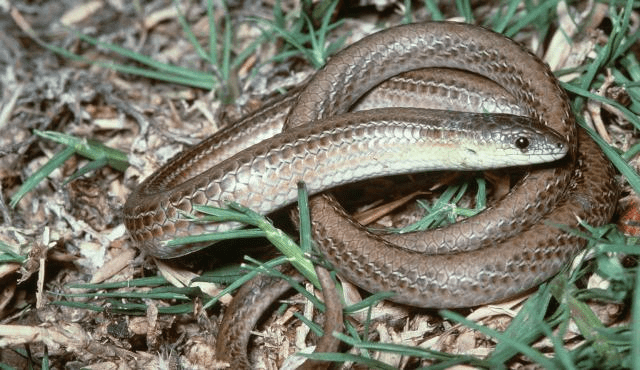
Striped legless lizard. Source: The State of Victoria, Department of Environment and Primary Industries [3]
Why are striped legless lizard vulnerable?
Roughly 99.5% of the natural temperature grasslands that provide habitat for striped legless lizards have been cleared or degraded since European settlement as a result of residential and pasture development [2]. Ongoing clearing for urban development, grassland degradation (e.g. invasive weeds), habitat fragmentation, overgrazing, drought, fire and hotter temperatures associated with climate change remain major threats the species [1],[2]. Overgrazing by kangaroos or cattle is a key issue, with too much or too little grazing degrading the quality of available habitat [5].
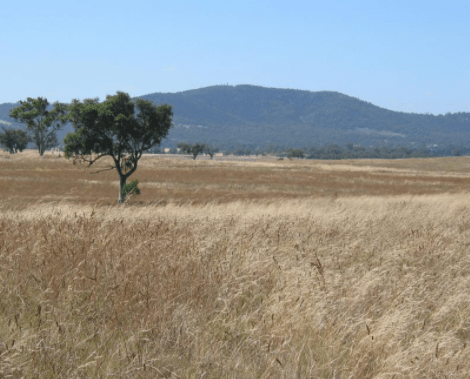
Mulanggari Nature Reserve, home to one of the largest striped legless lizard populations. Source: Michael Mulvaney [6]
Ongoing management and conservation actions
Today striped legless lizards in the ACT are largely confined to several grassland nature reserves, including various direct biodiversity offsets which were created to offset the impacts of urban development in the territory [1]. These offsets are particularly vital for the conservation of the species with some of the older sites like the Gunganderra grasslands hosting the largest populations (Thea O’Laughlin, personal communication 08/09/20; [4]. Ongoing monitoring forms a key part of management as well as ensuring there is no loss of habitat within grassland offsets, in accordance with legislative requirements [1], [7], [8].
One of the biggest challenges with threatened species monitoring is that they can be difficult to find and often monitoring can only be timed when they are most detectable. This is certainly the case with the striped legless lizard which is most easily detected during early spring to summer, yet detection rates are typically around 2% [4]. Striped legless lizards are monitored using artificial habitat (roof tiles) which are overturned to detect the species [4], an activity affectionately known as ‘flipping tiles’ which was the focus of my volunteering and detected only one individual out of >100 tiles. Threatened species with reduced populations may also be threatened by native species. This is true of striped legless lizard with accounts of predation by magpies during surveys (Thea O’Laughlin, personal communication 08/02/20).

Magpies are one of several native predators which may threaten vulnerable species with small and fragment populations, like the striped legless lizard. Source: Corey Callaghan
Management of stripped legless lizard populations is largely limited by knowledge, as relatively little is known about their preferred habitat use, susceptibility to fires or compatibility with different land management practices [1], [4]. This is evident in current ground herbage management which is based primarily on ecological niche theory due to a lack of knowledge on habitat use specific to the species, and focuses on maintaining a diverse sward structure using low intensity burns, kangaroo and cattle grazing [1]. Monitoring of striped legless lizard is also quite resource intensive, with a typical survey period requiring the monitoring of several grasslands 2-3 times each over several weeks. Each grassland site will usually have upwards of 10 plots which each plot having several sub-plots with 5 – 8 tiles which must be checked manually: this was the basis of my volunteering. The figure below illustrates a typical subplot with tiles the must be placed manually and be regularly replaced when broken.

A typical sub-plot used for monitoring striped legless lizards. Source: Thea O’Loughlin
Conclusion
There are many challenges and unknowns with the conservation of threatened species like the strip legless lizard now and in the future. It is paramount that conservation actions maintain momentum in research and policy to overcome both knowledge and legislative barriers in management.
Acknowledgements
Thanks to Thea O’Laughlin of ACT Parks and Conservation Service for providing the volunteering opportunity and sharing her valuable experience as well as all other personnel involved in the surveys.
References
[3] https://grasslands.ecolinc.vic.edu.au/fieldguide/fauna/striped-legless-lizard#details
[4] https://www.environment.act.gov.au/__data/assets/pdf_file/0010/576793/SLL_Gungahlin_Survey.pdf
[5] https://onlinelibrary.wiley.com/doi/abs/10.1111/aec.12337
[6] https://grasslands.ecolinc.vic.edu.au/grassland/mulanggari-nature-reserve
[7] https://www.environment.act.gov.au/cpr/environmental-offsets-policy/act-environmental-offsets-policy

 Biodiversity Conservation
Woops, forgot to leave my name on it! I am Harrison Dalton (U6672048)