
Caitlin Blair (U6376091)
In a world now dominated by social distancing and working from home the idea of getting outdoors and volunteering may sound like a relic of a by gone era. And this is true to some respect, the availability of opportunities for field work has diminished. But this is not the end of volunteering, like most other activities this year volunteering has moved online. There are plenty of online resources for volunteering and citizen science.
Digivol is a citizen science website developed by the Australian Museum and Atlas of Living Australia. It allows institutions to upload data sets, such as camera traps and field notes. There are a plethora of expeditions to participate in, however to keep with the theme of biodiversity I chose the Kangaroo Island Dunnart Survey run by the South Australia Department for Environment and Water. This project set up camera traps in areas unaffected by the 2019-20 summer bushfires to gather data on which species (native and feral) travel through these corridors, with a focus on the Kangaroo Island Dunnart (Sminthopsis aitkeni) the IUCN lists this mammal as critically endangered.
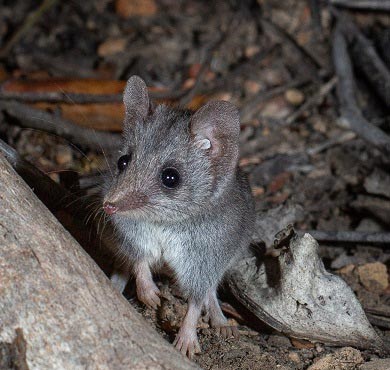
During the summer bushfires, 95% of the Island was burnt this has significantly impacted the availability of habitat for this species. With an estimated less than 500 individuals this species is particularly vulnerable to environmental stochasticity making projects such as this very important to properly understanding the impacts fire and habitat fragmentation have on critically endangered populations.
These studies help to develop a greater understanding of not only dunnart populations but also other species in the area, and how species are fairing after major environmental threats.
The project used motion sensed camera traps to photograph the species in the area. Camera traps have been assessed as the most efficient and cost effective way of detecting the dunnart. Although they do provide large amounts of data.
To ease the workload, this data can be uploaded to sites like Digivol to enlist the help of volunteers to transcribe images. For this project there was over three thousand images to transcribe. Below is an example of how this process looks on screen. You are given an image and need to identify the animal; in this case it is a kangaroo or wallaby. Options are also available to skip if you are unsure.
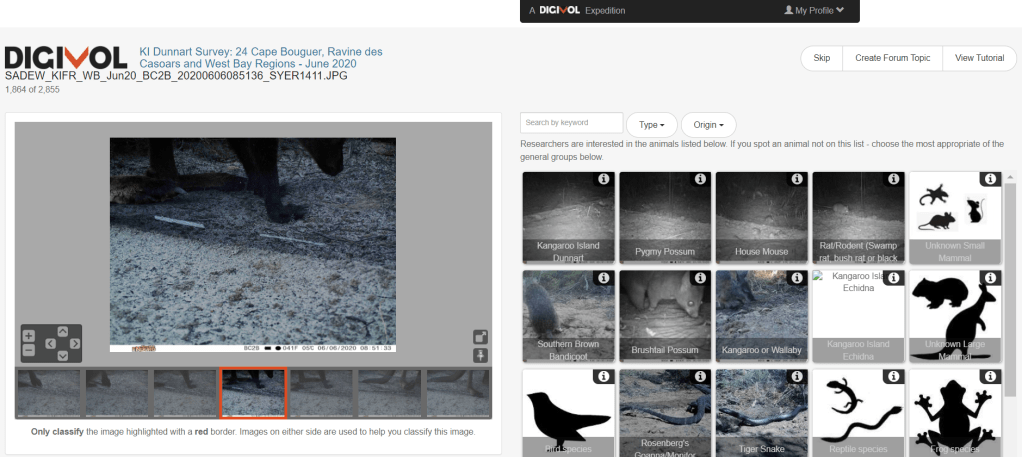
The trouble with camera traps is that quality is not always guaranteed, often images are partial or blurry which can make identification difficult. Although with time and practice these images become easier to decipher, figure 3 provides a good example of this. The project does provide a tutorial on animal identification with reference images to guide you. And Digivol provides the other images in the photo series to better aid in identification.

As far as volunteering goes, Digivol provides a meaningful yet obligation free experience to actively contribute to protection of threatened species. You can spend as much or as little time on the site which makes it more accessible to people with busy schedules who would often miss out on such opportunities.

 Biodiversity Conservation