James Benjamin Smith – u6680704
The Canberra’s Friends of Grasslands (FOG) community is dedicated to conserving the native vegetation of local grasslands.
On the 14th of August, Geoff Robertson (President of FOG) and I visited Franklin Grasslands. Despite much of the grassland being infested with weeds, Geoff explained that future programs will be aimed at restoring this area. Geoff outlined possible strategies to aid this process such as tilling and spraying of weeds and replanting of native plants.
Stirling Park, Yarralumla
On the 16th of August, I visited Stirling Park, a critically endangered Yellow Box – Blakey’s Red Gum Grassy Woodland, with members of the FOG community.
Work at Stirling park has been ongoing for over a decade and has seen great success with weed control and the replating of native vegetation.
Our task was to protect vegetation from animals such as hares, rabbits and kangaroos. We were placing barriers consisting of sticks and logs around and over the plants and grasses to cover them. Jamie Pittock stated that this would deter animals from trampling or eating them.
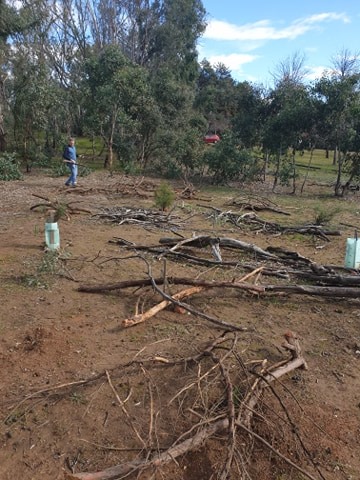
Pictured: Stick and log barriers placed over recently planted vegetation to protect them from animals
In the past, this has proven to be effective. And although it isn’t necessarily pleasing to the eye, it is important for the future protection of the vegetation.
On this day I met Jamie Pittock, a professor at the ANU who is also heavily involved in the FOG community. He invited me to aid him in a project at the Yarramundi Reach Grasslands a few weeks later.
Relocation of native vegetation
Jamie Pittock, Dr John Fitz Gerald and I relocated Kangaroo grass tussocks (Themeda triandra) from Ginninderry (a site that will soon be lost to development) to Yarramundi Reach Grasslands with the hope that they will grow and outcompete the invasive species in the area.
The relocation of Kangaroo Grass is a sort of last resort, as previous weed control measures have failed.
Jamie Pittock describes the project more precisely;
Among the native temperate grasslands (endangered ecological community), invasive weed grasses have been sprayed out by FOG volunteers over the past decade. However, there has been little or no regeneration of native species in these gaps but rather, many new weed species have colonised. Burning, past direct seeding and plant multi-species tube stock restoration efforts have failed to engender recolonisation.
– Professor James Pittock
The weeds of African Love Grass (Eragrostis curvula) and Chilean Needlegrass (Nassella neesiana) are a major pest. Both are transformative, meaning they degrade the soil and quickly outcompete native vegetation. This makes it difficult for native vegetation to recolonise these sites.
We used three methods of replanting to see which one would be the most successful.
We began our day by digging out 20 mature Themeda tussocks From the Ginninderry development site. These were to be replanted in a clustered area on Yarramundi reach.

We also planted ~80 tube stock tussocks with soil from the native Themeda site, to see if ‘seeding’ the soil biome helps.
Finally, we planted ~30 tube stock tussocks directly into the soil at Yarramundi reach.
Yarramundi Reach Grassland has been cleared of weeds quite successfully by FOG, however, there are still some bare patches of dead weeds that have been sprayed. The replanting of native tussocks will hopefully take their place.
It is expected that the tussocks taken from the Ginninderry site will have a high survival rate. For the remaining tussocks, it is optimistic, but there are still some uncertainties around what the outcome will be.
Upon completion of my work experience, it became apparent that conservation in the A.C.T region is widespread, with many volunteers donating their time. It is thanks to communities such as FOG, that Canberrans are able to enjoy parklands that are rich with native flora and fauna.
I would like to thank Geoff and Margaret Robertson for introducing me to the Friend of Grasslands Community and teaching me about the ecology and management techniques of the local grasslands.
I would also like to thank Jamie Pittock and Dr John Fitz Gerald for allowing me to join their project and for teaching me techniques for grassland and developmental management and the ecology of native vegetation.
Citations;
ACT Government, 2020, Invasive Plants, available at: https://www.environment.act.gov.au/parks-conservation/plants-and-animals/Biosecurity/invasive-plants
Greening Australia, 2003, Revegetation Techniques, available at; https://www.greeningaustralia.org.au/wp-content/uploads/2017/11/GUIDE_A-guide-for-establishing-native-vegetation-in-Victoria.pdf
Rod Taylor, 2020, Ask Fuzzy: What is a Transformational Weed?, The Canberra Times, Canberra
Sharp S., 2016. Ecological Management Plan for National Capital Authority Conservation Areas. Report to the National Capital Authority, Canberra, April 2016.

 Biodiversity Conservation