
Joe Skuse – U6376824
On the 6th of July I made the 5 hour drive from Greening Australia’s Aranda office out to the Riverina. We were headed for a sand mine 30 km north of Coleambally. When we got there, we stopped to appreciate the big Schooner.


We came all this way to establish food sources for the Superb Parrot (polytelis swainsonii) which is listed as a Vulnerable species in NSW and Federally. This is primarily driven by habitat loss.
The Superb Parrot nests in the hollows of large eucalypts along riverbanks, in our case, the mighty Murrumbidgee. These little champions don’t like to venture far from home when foraging for food, opting to forage within a 10 km radius of their nest.
Habitat Loss
The pressures of land clearing have dramatically reduced the food sources available to this little bird. Much of the native vegetation that was home to the native seeds, flowers and fruits that keep the Superb Parrot fed have been cleared away and replaced with irrigated pasture, rice and more recently, cotton crops. Furthermore, native cypress in the area has long been overharvested for its timber, accelerating habitat loss in the region.

The Site
Our office for the week was a newly operational sand mine. As part of the mine’s DA, a stand of trees had to be planted along the road to reduce the aesthetic impact of the development. To pay for this, mine site operators opted to apply for a grant offered under the Restoring Superb Parrot Flyways project run by the NSW Government through its Environmental Trust.
Our Job
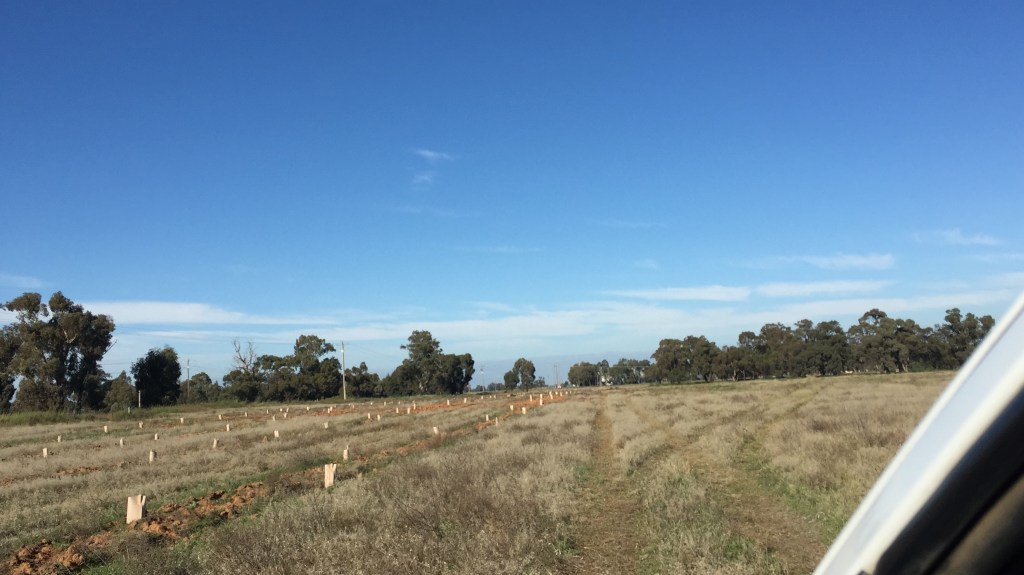
Our job was to plant and direct seed along the perimeter of the mine’s paddock.
We were to plant 3000 tubestock trees and shrubs. Species included Cypress Pine, Red River Gum, Apple Box, Silver Wattle, Gold-dust Wattle and Deane’s Wattle. This work was a repetitive process of digging, planting, guarding and watering which took the better part of 7 days. These days were long and physical days but a sunset view of the big schooner made it all worthwhile. I was a little disheartened when i heard that all of our work was simply a ‘back up’ in the event that the direct seeding did not work.
“The beauty of direct seeding is that it’s cheap. If it doesn’t work the first season, you can come back season after season after season and it’ll still be cheaper than paying you lot for the week”
Ben Hanrahan – Project Lead
I was fortunate enough to return in the coming weeks to help in the direct seeding of the paddock. Direct seeding is a pretty simple process of towing a small machine behind a 4×4. The machine (amazingly called a direct seeder) uses a plough disc to cut grass and vegetation away, exposing bare soil. Seeds (in this case a mix of acacias) are dropped into the cut and covered by a thin layer of soil. We were also spraying roundup over the cut lines to kill of other vegetation and maximise water availability for the seeds when they germinate in the spring.

What a great couple of weeks. I’m really looking forward to heading out there in years to come and seeing the transformation in the landscape.
References
https://www.lls.nsw.gov.au/regions/murray/grants-and-funding/restoring-superb-parrot-flyways
https://www.sciencedirect.com/science/article/pii/S0006320704001132
https://www.environment.nsw.gov.au/threatenedspeciesapp/profile.aspx?id=10645

 Biodiversity Conservation