
By Caitlin Coward (u6051078). Word count: 500.
My work experience involved examining the value of mature eucalypt trees for bird diversity in the Canberra region as part of long-term research under the guidance of Phillip Gibbons.
Tall and proud: Importance of mature trees
Mature trees are crucial keystone structures for the survival of many species, namely birds, as they provide shelter in the form of hollows. Hollows form when a tree limb falls off and exposes the cavity where heartwood used to occur. This process only begins to occur between 120-220 years of age for a single eucalypt tree. Cutting down these mature trees for any reason destroys the centuries long progression of hollow development and is a large threat to biodiversity
Mature and unsure: Threats to mature trees
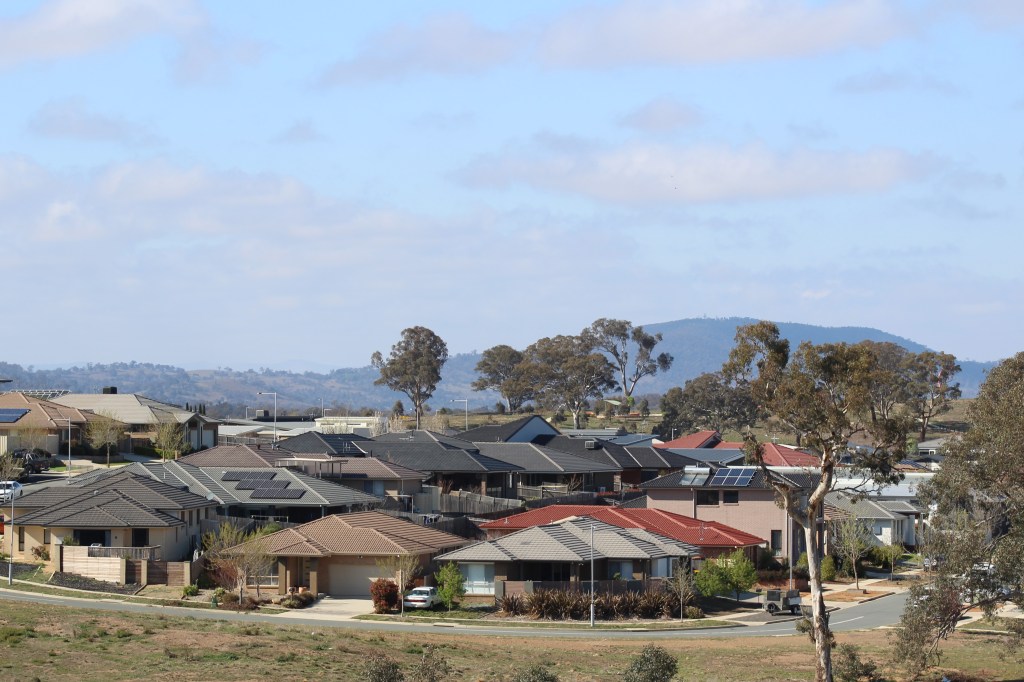
Balancing biodiversity preservation, like mature trees, with the increasing demand of urban expansion is a huge issue in conservation management. There are many anthropogenic reasons for removing mature trees: danger, inconveniently placed, roots can damage pipes, do not look nice, and to make room for urban expansion. The suburbs of Canberra are going to continue to expand with our increasing population (ref. Figure 1) and so the risk of mature tree loss will also increase as time goes by.
Leaf me to it: Independent surveying
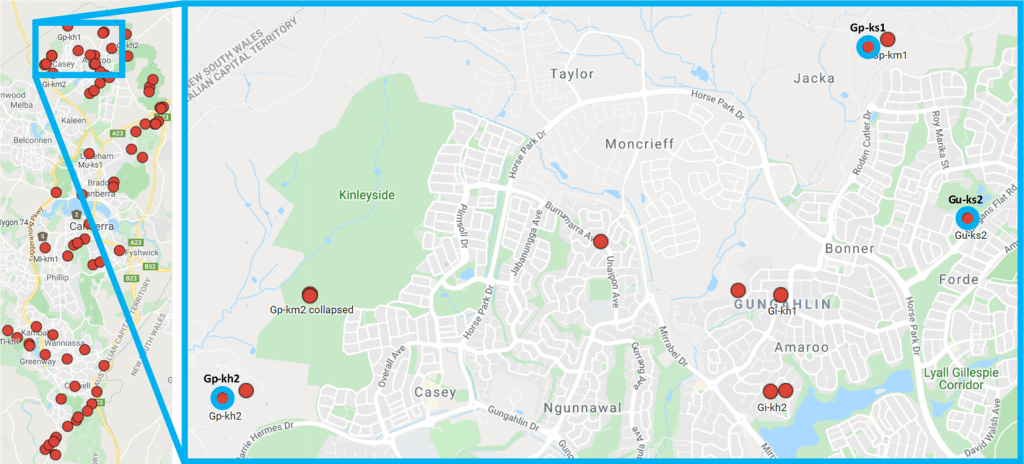
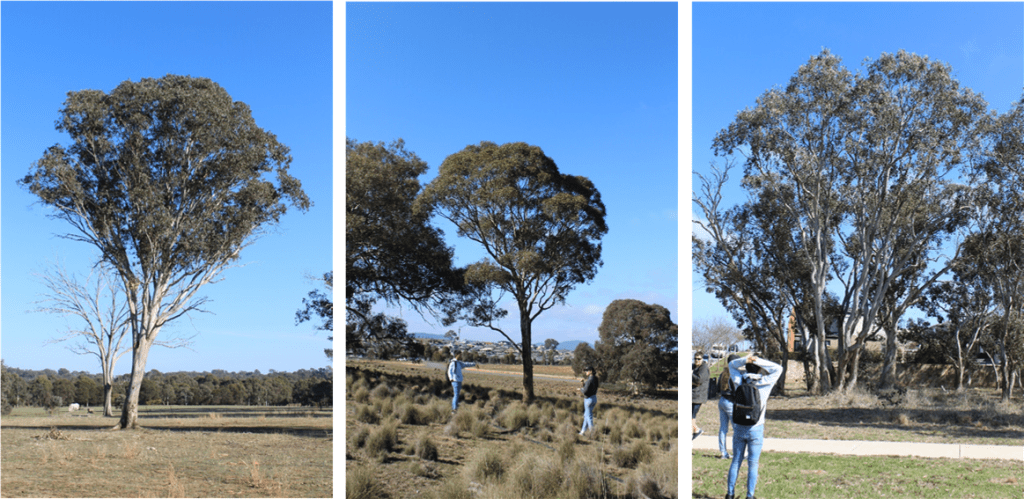
On the 4th of September I went with Phil on a training session to learn the basic skills required to undertake an independent survey. In the early hours of 20th of September I went to three sites around northern Canberra to undertake my independent survey (ref. Figure 2). I surveyed one tree in each of the following land use areas: leasehold property tree Gp-kh2 (E. blakelyi), reserve tree Gp-ks1 (E. melliodora), and urban environment tree Gu-ks2 (E. blakelyi) (ref. Figure 3). The survey duration was 20 minutes per tree, where I collected data like bird diversity, arrival and departure location, behaviours, and duration of stay (ref. Table 1). I was also given a sheet with some common Canberran birds which helped identify species (ref. Figure 4).


Turning a new leaf: Conserving mature trees
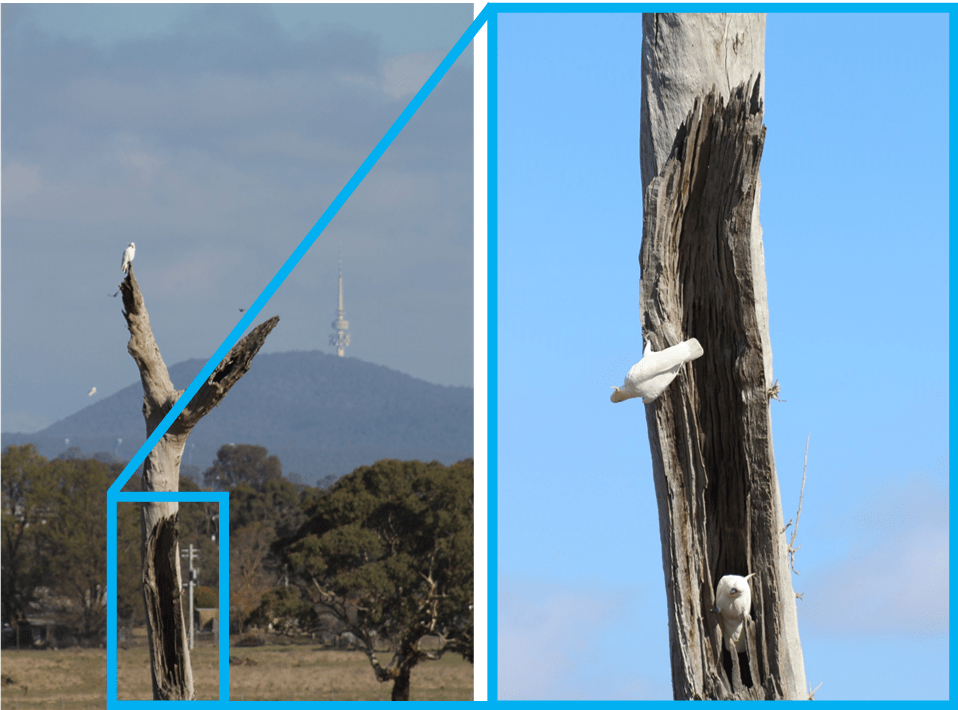
Increasing tree size positively correlates with increasing bird diversity. We must sustainably manage trees of all ages to continue the cycle where young trees replace the old and improve our management practices. Additionally, we should not cut down old or dead trees as they can still provide the service of hollows (ref. Figure 5). There is little risk of falling branches striking someone, though removing problem branches is a simple way to eliminate this issue. The preservation of these mature trees in urban landscapes is paramount for protecting biodiversity.
Growing up: Personal conclusion
I did not realise the importance of eucalypt hollows until doing this work experience. This has really opened my eyes to ecological processes I glance over every day. I now look at eucalypt trees with a new-found appreciation and am always on the lookout for birds using hollows.
Acknowledgements
Thank you to Phil for taking the time out of his busy schedule to facilitate this work experience.
References
All images: Coward, Caitlin. 2019. JPG.
Ellison, M.J. 2005. Quantified tree risk assessment used in the management of amenity trees, Journal of Arboriculture, 31(2): 57-65.
Gibbons, P. & Lindenmayer, D.B. 2002. Tree hollows and wildlife conservation in Australia. CSIRO publishing, Victoria.
Gibbons, P. 2018, ‘Smart city planning can preserve old trees and the wildlife that needs them’, The Conversation, 2 July 2018, viewed 20 October 2019, https://theconversation.com/smart-city-planning-can-preserve-old-trees-and-the-wildlife-that-needs-them-98632
Google, 2019. ‘ACT tree study’, Google Maps, viewed 25 October 2019, https://www.google.com/maps/d/u/0/viewer?mid=1wO7wqRgh2eAvSKuEYi7OWpP80_M&ll=-35.16921386746231%2C149.10879826270366&z=13
Le Roux, D.S., Ikin, K., Lindenmayer, D.B., Manning, A.D., Gibbons, P. 2014. The Future of Large Old Trees in Urban Landscapes, PLoS One, 9(6): e99403.
Le Roux, D.S., Ikin, K., Lindenmayer, D.B., Manning, A.D., Gibbons, P. 2015. Single large or several small? Applying biogeographic principles to tree-level conservation and biodiversity offsets, Biological Conservation, 191(1): 558-566.
Manning, A.D., Fischer, J., Lindenmayer, D.B. 2006. Scattered trees are keystone structures – Implications for conservation, Biological Conservation, 132(1): 311-321.
Stagoll, K., Lindenmayer, D.B., Knight, E., Fischer, J., Manning, A.D. 2012. Large trees are keystone structures in urban parks, Conservation Letters, 5(1): 115-122.

 Biodiversity Conservation