
By u6043246, Jarrod Ward
What’s the Problem?
Canberra’s ever expanding population, currently sitting around 420,000 and projected to expand to 703,000 by 2058, means we are constantly building new suburbs such as the Molonglo Valley development. This has the consequence of making old, hollow bearing trees an increasing rarity as they are often immediately removed for a number of reasons. This poses a serious problem for many of the local native bird species which rely on these structures for breeding.

The Project
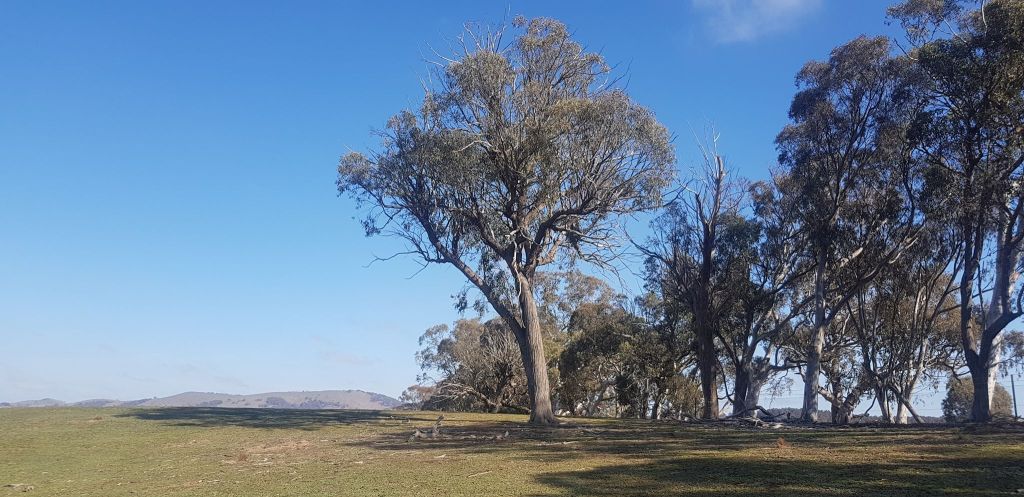
Philip Gibbons, an Associate Professor at ANU, has been surveying bird interaction with a range of trees that vary in age, species, structure and location. In doing this, it can be established which trees are most important for bird interaction so that future development policy can be influenced to preserve trees with the highest biodiversity impact. I was lucky enough to join Phil along with some other volunteers for two of these bird surveys during September, with the breeding season occurring during this month and October, bird interaction is highest at these times. One of these trees is pictured below.
Field Experience
Surveys took place early in the morning, checking multiple trees on each trip. For 20 minutes, all bird interaction with the surveyed tree was recorded. The direction they flew in from, the direction they flow out to, what they did in the tree and how long they spent there was some of the major factors that were noted for each individual bird. The most common birds that we observed during the field work included;

The Crimson Rosella (top left) photographed by Julie Clark. Sulfur Crested Cockatoo (top right) photographed by Sandra Gallienne. Pied Currawong (bottom left) photographed by Corey Callaghan. Noisy Miner (bottom right) photographed by Andrew Allan. All photographers can be found on ebird.org.
A bird species that we unfortunately didn’t get to see, likely due to the decline in breeding hollows across Canberra, is the Suberb Parrot. This parrot is currently considered vulnerable under commonwealth status with less than 5000 breeding pairs estimated to remain in the wild.
Whats the Goal?
Using quantitative surveys, Professor Gibbons aims to demonstrate the importance of older, senescent trees over younger ones. These trees can take up to 100 years to form the necessary hollows for the local native birds. If policy decision in the ACT can be changed to specifically save the older trees over younger ones in future developments than the possible breeding grounds for native wildlife will be increased, as well as the overall biodiversity of the area as the tree is used as an ecological stepping-stone.


 Biodiversity Conservation