
Goorrooyaroo Nature Reserve encompasses 1384 hectares of endangered Yellow Box-Red Gum Grassy Woodland, thus being the largest remaining area of this valuable ecosystem in the ACT. Goorrooyaroo is crucial to the natural environment of the ACT, as it is a regional stronghold for a series of endangered species, including the vulnerable Superb Parrot (Polytellis swainsonii).
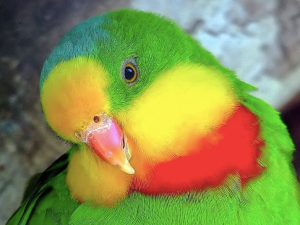
Image credit: Ian McHenry
The issue
Superb Parrots are currently listed as a vulnerable species. They are found throughout eastern inland NSW and the ACT, which is known to be their core breeding area. One of the main factors threatening the stabilisation of the Superb Parrot population, is land clearing and the associated loss of hollow bearing trees, their prime breeding ground.
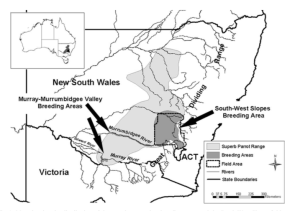
Map showing distribution of superb parrot and key breeding areas (Credit to Manning et al, 2004)
However, hollow bearing trees with the right conditions are often scattered around ‘used’ land, such as agricultural land, residential areas, etc. In most cases, these trees will thus not be protected. This is what makes the study into hollows and their characteristics so important for the protection and conservation of this species. Once we have a better understanding of which hollow-types are preferred by Superb Parrots, we can better advise on the management of these areas and ensure the protection of these trees.
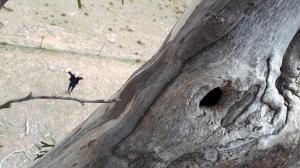
Image credit: Giselle Owens
My experience
Earlier this month I had the opportunity to assist on a superb parrot hollow study, functioning as a ground work assistant and scriber for ANU researcher, Giselle Owens. This was a very fun and enriching experience for me for many reasons. As an international student, it allowed me to learn more about Australia’s native birds, and observe magnificent species such as the superb parrot from up close.
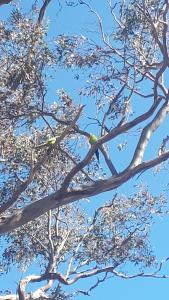
Pair of Superbs observed during study; Image credit: Giselle Owens
This experience allowed me to gain valuable fieldwork skills, such as navigating using a GPS, learning how to tie different knots and how to secure climbing equipment on a tree appropriately.
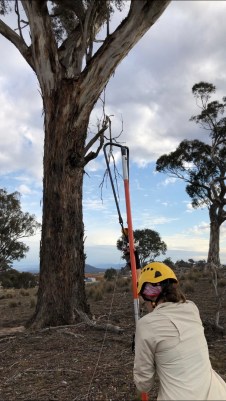
Giselle Owens shooting a line over the tree in preparation for climbing
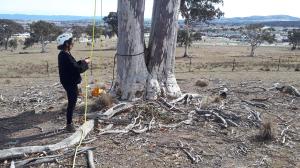
Groundwork. Image credit – Giselle Owens
As a scriber, I gained insight into the diversity of aspects which could be relevant to the potential of a hollow being as a breeding ground. This opened my eyes to how specific the needs of each bird species are, and why it is so important to protect the trees that are appropriate for nesting, if we want to protect the species as a whole.
About a year ago, I conducted similar work in the Atlantic forest biome in Brazil, where we were implanting nesting boxes on trees for the Red-tailed parrot (Amazona brasiliensis). Due to land clearing in one of their main breeding areas, Ilha Rasa, these parrots were also struggling to see their populations stabilised. It was very interesting to find the similarities of both experiences, but also the contrasts. Through conversations with Giselle Owens, I understood the reason behind researching hollow-bearing trees, against implanting nesting boxes. When it comes to conservation, it is important to tailor ones actions to the specific context. In Brazil, most nesting trees for the Red-tailed parrot where already cleared, and stabilisation of the population could not be reached without the nesting boxes. In the ACT however, we are lucky to have one of the most intact ecological communities of the Box-Gum Grassy Woodlands. Inserting nest-boxes instead of ensuring the protection of nesting trees could thus incite land clearing. The protection of superb parrots and valuable native ecosystems such as Yellow Box-Red Gum Grassy Woodlands thus go hand in hand.
By u7023409
Refereces:
https://www.environment.nsw.gov.au/threatenedSpeciesApp/profile.aspx?id=10645
The conservation implications of bird reproduction in the agricultural “matrix”: a case study of the vulnerable superb parrot of south-eastern Australia. Manning, Adrian D ; Lindenmayer, David B ; Barry, Simon Biological Conservation, 2004, Vol.120(3), pp.363-374

 Biodiversity Conservation