
by u6298107
Introduction
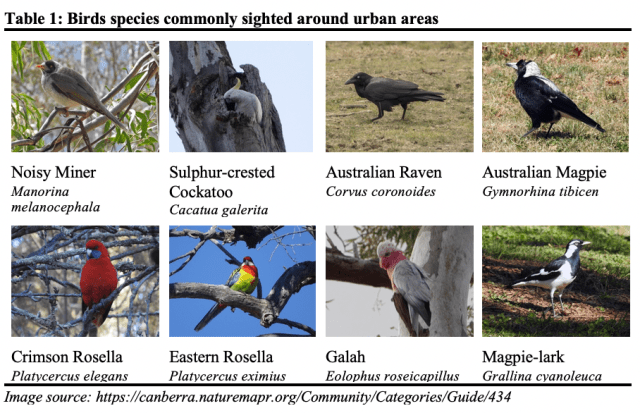
I’ve had the opportunity to join Phil and Julia (a postgrad student) on a bird survey around the urban areas of Canberra (Mount Majura Park, Hall, Bonner and Jacka). The objective of this survey is to look at the value of mature trees in urban area to wildlife, particularly to birds. There are several birds commonly sighted around these areas (table 1).
Why are mature trees under threat?
The Australian Capital Territory’s (ACT) populations are expected to reach half a million by 2022 (ACT Government, 2019a). In order to accomodate the growth in population, the critically endangered box gum grassy woodlands, including many large established trees, are becoming more susceptible to land clearing for urban area development. Large established trees are described as “keystone structures” as they provide habitat resources to a variety of wildlife (Le Roux, 2014).
The Nature Conservation Act 2014 listed the large established trees as a “key threatening process” (ACT Government, 2019b). This is significant because many of these trees contain natural hollows which provides shelter, roosting and nesting sites to many wildlife, including to some species listed in table 1 (figure 1). The formation of a hollow takes approximately 100-200 years (Gibbons and Boak, 2002). The absence of hollow bearing trees put many local biodiversity at stake. Furthermore, we observed that the larger the size of a tree, the higher the bird diversity it can support.

Figure 1: A Sulphur-crested Cockatoo in a hollow, image source: author
How should we conserve them?
In urban landscapes, large established trees are removed for safety reasons, aesthetic purposes or to accomodate more developments (Gibbons. P, 2019, pers. comm. 20 Sept). However, trees pose a threat only if they have a “target” (i.e. falling branch). Instead of being under the assumption that large old trees pose threat, we should be looking at ways to eliminate the threat. For example, planting lower shrubs around the vicinity of the trees to discourage people going near towards it.
Instead of viewing large established trees in a utilitarian view, we should be moving towards an ecocentric approach towards urban planning and redevelopment. By integrating natural ecosystems within the community, it doesn’t only benefit the biodiversity, but also help to build social capital, contributing towards sustainable development of an urban development (Steward. J, 2019, pers. comm. 18 Sept). Such progressive approach can be observed in Ginninderry, one of the newest suburb development in Canberra. 78% of trees were retained during stage 1 development, much of them were large established trees with hollow/s. Instead of removing them, the housing developments were built around the trees.
Reflections
During the surveys, I couldn’t help but to wonder, the natural environment is highly modified to make way for selfish aesthetic reasons. Our surroundings are highly regimented for gardens and because of that, these gardens are barren and doesn’t support as many species as they used to be. The beauty of nature lies within the untidiness and unaesthetic combination litter, branches, fallen logs etc. As such, it creates an environment to allow more life to thrive in. If we can truly embrace what nature in its undisturbed state, we could really change the way we see things and make decisions in life.
References
ACT Government, 2019a. ACT Population Projections: 2018 to 2058 [Online]. Treasury and Economic Development Directorate [Accessed 23 September 2019].
ACT Government, 2019b. Nature Conservation Act 2014 [Online]. Environment, Planning and Sustainable Development Directorate [Accessed 23 September 2019].
Gibbons, P. and Boak, M., 2002. The value of paddock trees for regional conservation in an agricultural landscape. Ecological Management & Restoration, 3(3), pp.205-210.
Le Roux, D.S., Ikin, K., Lindenmayer, D.B., Manning, A.D. and Gibbons, P., 2015. Single large or several small? Applying biogeographic principles to tree-level conservation and biodiversity offsets. Biological Conservation, 191, pp.558-566.

 Biodiversity Conservation