
Polytelis swainsonii (superb parrot) is a unique bird species in the Australian Capital Territory and is listed as vulnerable in the Environment Protection and Biodiversity Conservation Act. Their habitat consists of the critically endangered box-gum grassy woodlands whereof the ACT contains some of the largest and most intact ecological communities.
Volun-tree Work
I had the privilege of joining Giselle Owens, an ANU researcher working with ACT Parks and Conservation woodland ecologist Dr. Laura Rayner on a superb parrot hollow study. I assisted Giselle over the course of two days as ground support and as her scriber. The aim of the study’s field work was to collect hollow measurements of randomly sampled trees in the Throsby offset site to improve understanding of the parrots’ breeding habitat requirements. The Throsby offset site, northern Canberra is one of the core breeding sites of the superb parrot.
Our days consisted of transporting the climbing gear, searching for the indicated trees and Giselle climbing them. Once safely up in the trees Giselle examined the trunk/branches for any hollows. Once a hollow was found numerous measurements would follow and this data included the hollow type, its location on the tree, entrance diameter, depth and support/entrance aspect.
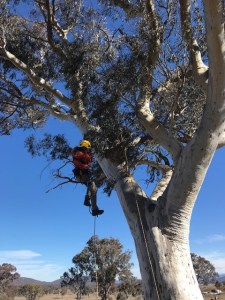
Image 1: Giselle Owens climbing a chosen tree taking measurements of hollows
The Root of the Problem
One of the largest threats on the superb parrots’ recovery is the clearing and modification of their endangered woodlands habitat. Due to urbanisation and the general loss of large, hollow-bearing trees the superb parrots are losing their key breeding habitats and are being forced to adapt to new species of trees for breeding. Alteration to their habitat and the lack of regeneration of their woodland habitats has also led to their winter-feeding grounds being unsuitable.
A further threat the parrots face is climate change and how it is forcing a change in their usual behaviour. The superb parrot usually spends its winter in the north of NSW and southern Queensland, however rising temperatures are forcing the birds south and further east for longer periods.
Finally, predation and competition for nesting hollows by crimson or eastern rosellas, the common myna and starlings poses a threat.

Image 2: 18 hollows were found and measured in this tree
Branching Out for Solutions
According to Dr. Rayner in an interview with The Canberra Times (Foden, B. 2019, January 13. Superb parrots bounce back from poor breeding years with strong result), we have around 50 years to conserve the superb parrots’ woodland habitat and old, hollow-bearing trees. It is of key importance that we especially conserve those hollows with the most optimal dimensions for the breeding success of the superb parrots.
“The habitat range of the superb parrot will contract about 90 percent, which will lead to a more concentrated population around the ACT region “
– Dr. Laura Reyner
Therefore, it is important to gain more knowledge on the parrots’ breeding biology, habitat and behaviour in order to understand the long-term viability of their populations and to identify areas critical to their persistence. Due to the super parrots being listed as vulnerable and there being numerous wild individuals left, the chance of a recovery success is high and therefore the resources should be allocated into the superb parrot conservation.
Take a leaf out of Dr. Reyner and Giselle Owens’ book and go out on a limb for the superb parrots.
-u7013737

 Biodiversity Conservation