
With Dr. David Freudenberger and a fellow member of the class we drove out to Scottsdale reserve: a 1300-hectare property 75km south of Canberra owned by Greening Australia. I grew up on a 110-acre property just north of Scottsdale which made this work experience more valuable. Scottsdale reserve does wonderful work with a large volunteer community: easily accessible from Canberra and Cooma.

Image 1: Scottsdale reserve, a room with a view
Box Gum Grassy woodland and weed management
A major task is restoring box gum grassy woodland, something that my family has been trying to achieve for over 10 years. Scottsdale was not only heavily grazed, but also cropped having long lasting effects on the land.

Image 2: African Love Grass as far as the eye can see
David used to regularly visit Scottsdale with students, in 2014 they planted hundreds of trees in paddocks where African Love Grass (Eragrostis curvula) has taken control. African love grass was introduced to feed live-stock and stabilise Australian top soil.
There is some evidence to suggests that weeds don’t like shade, and therefor by planting trees, you help to break the monoculture of love grass, as the trees get larger the weeds hopefully will die off, at the same time bringing back the box gum grassy woodland ecosystem. Greening Australia is also experiencing success with aerial spraying love grass, and then introducing plantings.
Planting success and carbon sequestration
We spent a day monitoring the success of these plantings, trees were planted along 100 metre transects. We’d walk along the transect and with David’s data sheet, checking the status of the tree: healthy (2), struggling (1) or dead (0), a dashed line if the tree was non-existent.
The trees were then measured (dead ones included) with callipers: diameter at breast height (DBH) if the trees were large enough, or a basal diameter if the trees were small, this includes all branches!

Image 4: measuring DBH of an Acacia rubida
David is researching carbon sequestration of trees, having yearly DBH data or basal diameter from the time of planting gives a more precise assessment of carbon storage. Forests are important for climate change mitigation with a gap in literature of long term data of individual trees, which David’s research is trying to close.
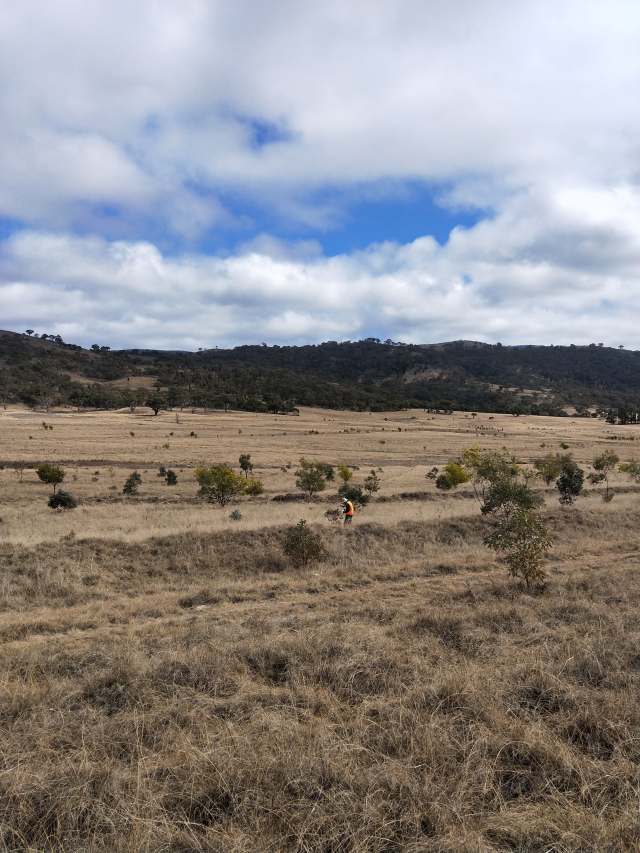
Enter a captionImage 5: Dr. David Freudenberger measuring along his transect: can’t lose anyone if you’re wearing high-vis
Not all species of plantings survive as well as others, the shrubs like Bursaria spinosa had a low success rate. However Eucalyptus melliodora, E. rubida,E. bridgesiana ,E. pauciflora were all doing well, as well as Acacia dealbata, A. rubida. There were differences in the success of trees just 100 metres from each other, this can give an indication below ground factors such as soil quality.

Image 6: Blooming Acacia dealbata
Other Projects on the Reserve
This is just one of the projects that’s being undertaken at Scottsdale reserve: platypus surveys, frog watch, top soil scraping to remove the agricultural seed bed, and many more. They also shoot about 1000 kangaroos a year which increases survival of young plantings (great for the trees, less great when you stumble across the rotting carcass). They have also eliminated almost all the rabbit warrens from the property! If you’re looking to experience a property where many hands have done some tremendous conservation work, then this is a great place to visit.

Image 7: Upgraded greenhouse, growing the seedlings before being planted on the property
References
National Environmental Science Programme, 2019. Restoring box gum grassy woodlands. [Online]
Available at: http://www.nespthreatenedspecies.edu.au/news/restoring-box-gum-grassy-woodlands
[Accessed 5 September 2019].
Bettinger, P., Boston, K., Grebne, D. & Siry, J., 2017. Valuing and Characterizing Forest Conditions. s.l.:Elsevier Inc.
Border Rivers Gwydir Catchment Management Authorit, n.d. African Love Grass. [Online]
Available at: https://www.pestsmart.org.au/wp-content/uploads/2010/11/9.Weeds_.pdf
[Accessed September 2019].
Bush Heritage Australia, 2019. Scottsdale. [Online]
Available at: https://www.bushheritage.org.au/places-we-protect/new-south-wales/scottsdale?gclid=Cj0KCQjwwb3rBRDrARIsALR3XebDBohaea3CmKwINpA8jOocBQexXsF5Z9lIvOYCrg4G44hosSCUErwaAmRJEALw_wcB
[Accessed 5 September 2019].
Kohl, M., Neupane, P. & Lotfiomram, N., 2017. The impact of tree age on biomass growth and carbon accumulation capacity: A retrospective analysis using tree ring data of three tropical tree species grown in natural forests of Suriname. PLOS ONE, 12(8).
Written by: U6080182

 Biodiversity Conservation