
u6048591
If you’re looking for one of the most critically endangered habitats in Australia, you can’t go past Box Gum Grassy Woodlands. European land-management practices have taken such a large toll on them that there’s now only 5% left . Right here in Canberra, we’re lucky enough to have the largest, most intact patch of Box Gum Grassy Woodland habitat under public ownership in all of Australia. This area is known as Mulligans Flat and Goorooyarroo Nature Reserve. The biodiversity here is a leading national example, in no small part due to the hard work of North Parks and Conservation Service. Earlier this year, I had the privilege of doing some work experience with them and gleaned some of what they do to restore and conserve biodiversity in this precious woodland.
Day 1: In the office, determining fauna population trends
On the first day I was entering fauna survey data collected from Mulligans Flat. Monitoring populations of fauna species is important in conserving biodiversity. Rangers are on-grounds daily, so they have a good idea of population abundance anyway. But for a more standardised method, they do spotlight surveys every 6 months. This involves walking along 100m transects during dusk, and tallying up what animals they see. Of particular interest to them at the moment are wallabies, possums and bettongs. Reasons being; i) bettongs play a very important role in woodland ecosystems and much effort has been put into re-introducing them into Mulligans Flat, and ii) wallabies and possums, with no natural predators, tend to be over-abundant and may out-compete other species – so need to be monitored and managed. Shown in the images below, I graphed the survey data for these three animals. This gives rangers a clearer idea of population trends and helps them make more informed management decisions.
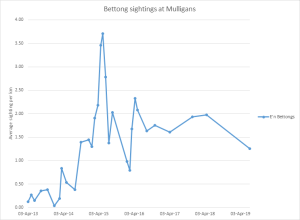
Bettongs settling down after exceedingly high numbers

Possums on the rise after a sudden decline
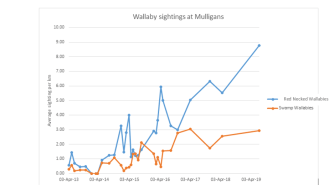
Wallabies on the up
Day 2: Out in the field, rabbit-monitoring
On the second day I swapped the computer screen for beautiful vistas of Goorooyarroo nature reserve. Here, rangers are in the process of removing invasive species like rabbits, which are highly destructive to woodland ecosystems, before they can reintroduce locally extinct species. Rangers are pretty certain they have gotten rid of all the rabbits, but just to be certain, they have a number of motion-censored cameras set up around the nature reserve. The cameras are strategically placed in hotspots for rabbits, like this area with lots of fallen logs that provide good cover:
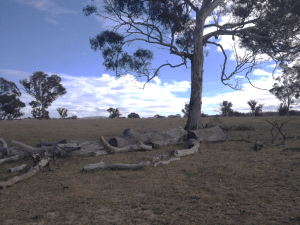
Prime real estate for rabbits at Goorooyarroo. Korda, 2019.
I had the great fun of driving around in a buggy, collecting SD cards from cameras so that the pictures could be checked back in the office for any signs of rabbits.

Our mode of transport and, in the foreground, a camera for rabbit-monitoring. Korda, 2019.
As the sun sets…
A key take-home from this experience was that monitoring fauna populations and removing invasive species are central elements of restoring and conserving biodiversity. I’m eager to see how these iconic areas of our Canberran backyard continue to flourish with biodiversity conservation.

 Biodiversity Conservation