
The Superb Parrot (Polytelis swainsonii) is listed as vulnerable under the Environment Protection and Biodiversity Conservation Act 1999 (Commonwealth of Australia, 1999). They are found in south-eastern Australia and inhabits predominately eucalypts woodlands and forests (Department of the Environment, 2018). Climatic conditions and variability have significant influences on the migration patterns of the species (Manning et al., 2007). Dr Rayner suggested that increased sightings in Canberra could be due to the shift in its geographic range induced by climate change.

Figure 1. The Superb Parrot by Bernard Spragg via https://www.flickr.com/photos/volvob12b/14253283657/in/photolist-nHvNDX-eSsLxe-diY6pH-jEYkib-27KR31s-qFXpph-qVpYQL-pUQvMj-pXoKeH-rpSuma-9d46t1-cAoUiy-obVQiU-24dSURG/ (Public Domain)
Why are hollows important?
The Superb Parrots rely heavily on hollow-bearing trees for nesting and breeding. It is predicted that the number of hollow-bearing trees will continue to decline (Gibbons et al., 2008). This phenomenon is concerning because regeneration in their habitats is limited and the generation time of new hollows is longer than 120 years (Manning et al., 2013). Therefore, conservation actions are urgently needed to conserve the population (Manning et al., 2013).
Urbanisation and interspecific competition
New residential developments are occurring throughout Canberra due to the population growth (Coleman, 2016). While urbanisation often irreversibly alter natural landscapes and reduce the quantity and quality of habitats for many species, some species thrive in urban environment (Sol et al., 2014). For instance, Sulphur-crested Cockatoos (Cacatua galerita) are benefited by urbanisation since the urban environment provides them with a constant and reliable source of food and water (Temby, 2004).

Figure 2. Two Sulphur-crested Cockatoos are meddling with the climbing equipment (Image by Tai Law)
Given that some Superb Parrots nest and breed in hollow-bearing trees near new development sites, it is expected that the Superb Parrots will face increased competition from other hollow-dependent bird species which prefer urban environment, such as Sulphur-crested Cockatoos and Crimson Rosella (Platycercus elegans).
‘If you can’t measure it, you can’t manage it.’ – Peter Drucker
During the weekend, we surveyed the tree hollows around North Canberra. With professional tree-climbing skills from Dr Rayner and Mr Jardine, we were able to measure and record the physical and biological attributes of the tree hollows in detail. Examples of attributes surveyed include hollow depth and hollow entrance dimensions.
Dr Rayner suggested that the data collected can be used to develop a model to predict the relationship between Superb Parrots and hollow-bearing trees. In other words, such model would allow for the prediction of occurrence and abundance of Superb Parrots based on environmental surrogates such as the number of hollow-bearing trees per hectare. Not only will this model provide meaningful knowledge to support conservation of the species (Davis et al., 2014), it is also useful in the policy environment because direct monitoring of the species might be costly and practically infeasible (Lindenmayer et al., 2014).
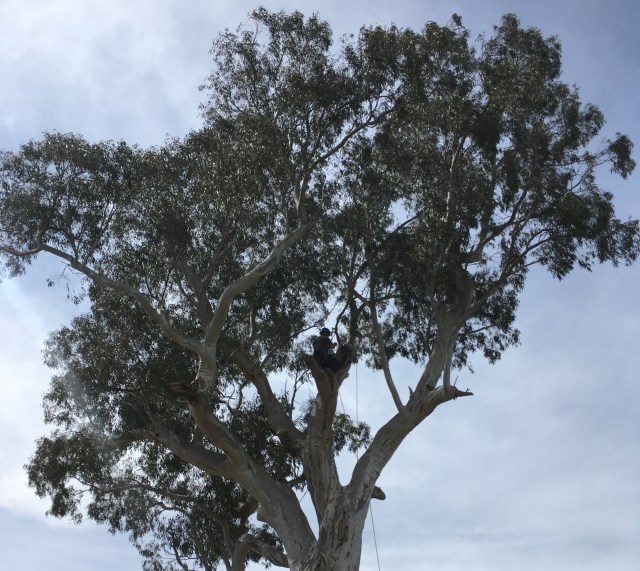
Figure 3. Alex is measuring the physical and biological attributes of a tree hollow on a hollow-bearing tree (Image by Tai Law)
The bigger picture
The situation of Superb Parrot is experienced by many species in other countries. Fundamental drivers of biodiversity loss including population growth and climate change are threatening ecological communities all over the world (Spangenberg, 2007). Conservation actions with effective environmental monitoring and adaptive management approach would be critical to the success of biodiversity conservation (Dovers and Hussey, 2013).
On 22nd and 23rd September (10 am – 5 pm), we assisted Dr Laura Rayner from the ACT Parks and Conservation Service with research on the Superb Parrot around Canberra.
I would like to thank Dr Laura Rayner and Mr Alex Jardine for the opportunity and the experience.
Written by: Tai Law (Jackson) u5782608
References
Coleman, S., 2016. Built environment: Current urban planning and management. In: Australia state of the environment 2016, Australian Government Department of the Environment and Energy, Canberra. Available at: https://soe.environment.gov.au/theme/built-environment/topic/2016/current-urban-planning-and-management (accessed 27 September 2018)
Commonwealth of Australia, 1999. Environment Protection and Biodiversity Conservation Act 1999.
Davis, A., Major, R. E. and Taylor, C. E., 2014. Distribution of tree-hollows and hollow preferences by parrots in an urban landscape, Emu – Austral Ornithology, 114(4): 295-303.
Department of the Environment, 2018. Polytelis swainsonii in Species Profile and Threats Database [webpage], Department of the Environment. Available at: http://www.environment.gov.au/cgi-bin/sprat/public/publicspecies.pl?taxon_id=738 (accessed 27 September 2018).
Dovers, S. and Hussey, K., 2013. Environment & sustainability: a policy handbook, The Federation Press, Annandale, NSW.
Gibbons, P., Lindenmayer, D., Fischer, J., Manning, A., Weinberg, A., Seddon, J., Ryan, P. and Barrett, G., 2008. The future of scattered trees in agricultural landscapes, Conservation Biology, 22(5): 1309-1319.
Lindenmayer, D. B., Barton, P. S., Lane, P. W., Westgate, M. J., McBurney, L., Blair, D., Gibbons, P. and Likens, G. E., 2014. An Empirical Assessment and Comparison of Species-Based and Habitat-Based Surrogates: A Case Study of Forest Vertebrates and Large Old Trees, PLOS ONE, 9(2): e89807.
Manning, A. D., Gibbons, P., Fischer, J., Oliver, D. L. and Lindenmayer, D. B., 2013. Hollow futures? Tree decline, lag effects and hollow-dependent species, Animal Conservation, 16(4): 395-403.
Manning, A. D., Lindenmayer, D. B., Barry, S. C. and Nix, H. A., 2007. Large-scale spatial and temporal dynamics of the vulnerable and highly mobile superb parrot, Journal of Biogeography, 34(2): 289-304.
Sol, D., González-Lagos, C., Moreira, D., Maspons, J. and Lapiedra, O., 2014. Urbanisation tolerance and the loss of avian diversity, Ecology Letters, 17(8): 942-950.
Spangenberg, J. H., 2007. Biodiversity pressure and the driving forces behind, Ecological Economics, 61(1): 146-158.
Temby, I. D., 2004. Urban wildlife issues in Australia, Proceedings of the 4th International Symposium on Urban Wildlife Conservation, Tucson, Arizona.

 Biodiversity Conservation
Fascinating blog Tai. Phil