
Monitoring Overview
On the morning of the 22nd of September 2018, Jackson Law (a fellow coursemate) and I met up in North Canberra to be picked up for Superb Parrot (Polytelis swainsonii) monitoring.
We were to be working with Dr Laura Rayner, from the ACT Parks and Conservation service, and her colleague Alex, in order to assist them in collecting data on the nesting hollows of the parrots.
The task itself was quite straightforward. Dr Rayner and Alex were to climb the trees and relay details of all hollows present, and we were to act as scribes. The information to be noted down described the main features of the hollows, including hollow and support aspect, hollow entrance size, hollow depth, and floor size.
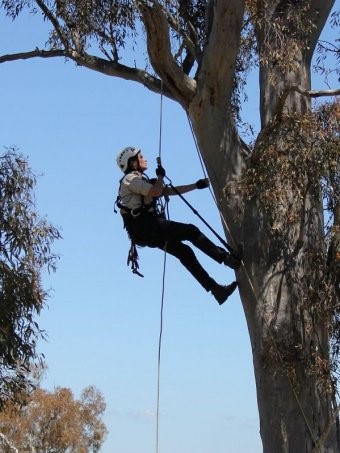
Dr Rayner climbing a tree. (ABC News: Craig Allen)
The main species of tree that we were to survey was Blakely’s Red Gum, one of the two main dominant species within that landscape, the other being Yellow Box.
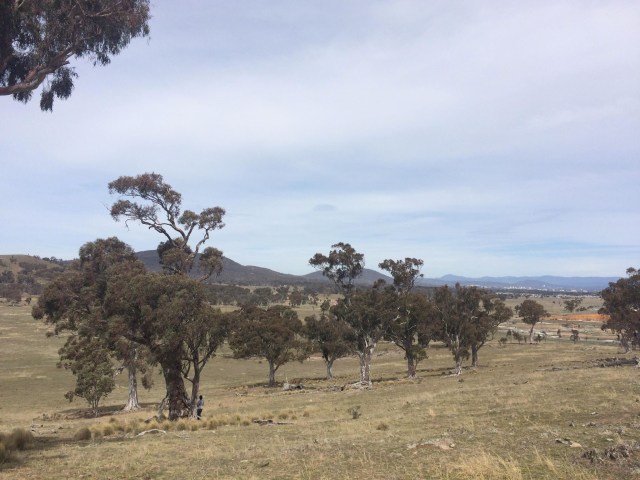
Endangered Box Gum Grassy Woodland.
Threats to Superb Parrots and their habitat
That morning, we were lucky enough to hear (click here for a recording), and even catch sight of some of them, heralding the start of the breeding season, as they migrated into the area to nest.
As we worked, we talked about the threats to Superb Parrots and the Box Gum Grassy Woodland ecological community that they nested in.
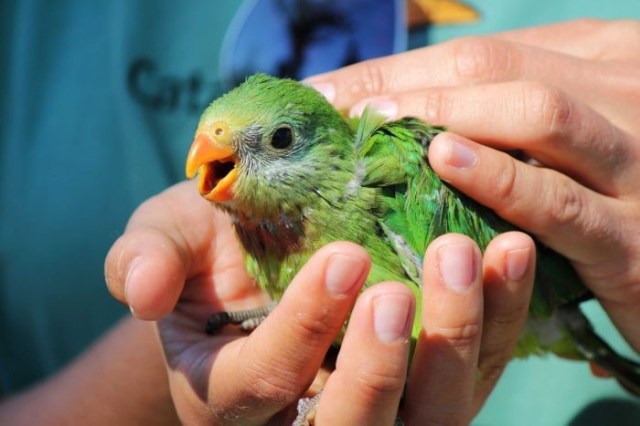
Superb Parrot chick. (ABC News: Craig Allen)
Superb Parrots are considered to be a vulnerable species, with less than 5000 breeding pairs left in the wild (NSW Office of Environment & Heritage, 2017). Dr Rayner related to us how this situation was made worse due to their selective nature with regards to nesting hollows. The hollows they preferred were in mature Scribbly Gums and Blakely’s Red Gums (Manning et al., 2004), which were also used by a range of species, most notably Crimson Rosellas (Platycercus elegans). This posed issues as these other species were observed to be more successful and dominant in human-altered landscapes, and would be able to outcompete the less aggressive Superb Parrots for nesting hollows (L. Rayner, pers. comm. 22 September 2018). This brought to mind issues regarding anthropogenic disturbance to the environment, and how species that were more capable of adapting to these changed environmental conditions were able to better establish themselves.
Dr Rayner went on to detail that the plight of the Superb Parrot was further exacerbated by the fact that numbers of such mature hollow-bearing trees were declining due to the clearing of land for housing development (Manning et al., 2012), with a 95% decline in Box Gum Grassy Woodland (Department of the Environment, 2018). Even the particular site we were working on was previously slated to have been a part of a nearby suburb, but was spared, being designated as an ecological offset.
Future Conservation Efforts
However, all hope is not yet lost for the Superb Parrot. Their numbers seem to be increasing in Canberra (Allen, 2017), although it has yet to be seen if this is due to changes to their geographical range caused by climate change (Manning et al., 2005; Manning et al., 2007). The numbers of Superb Parrots are also well above the Minimum Viable Population threshold, and a National Recovery Plan has been drawn up for the species (Baker-Gabb, 2011).
The data that we collected will also go towards the creation of a database of all Superb Parrot nesting hollows, which will allow Dr Rayner and her colleagues to be able to maintain and preserve key nesting areas.
Hopefully, the protection of keystone remnant mature hollow-bearing trees in the landscape and the recruitment of future ones (Manning and Lindenmayer, 2009), will help to conserve the species in the long run.
Darren Choo u5935818
(Monitoring was carried out from 9am to 5pm in North Canberra. Many thanks to Dr Laura Rayner for allowing us to participate in conservation efforts and for arranging transport for us.)
References:
Allen, C. (2017). Canberra becoming superb parrot central for not-so-superb reasons. ABC News. Available from: http://www.abc.net.au/news/2017-12-07/canberra-superb-parrot-changing-habitat/9207150 (Accessed 7 Oct 2018).
Baker-Gabb, D. (2011). National Recovery Plan for the Superb Parrot Polytelis swainsonii. Department of Sustainability and Environment.
Department of the Environment (2018). White Box-Yellow Box-Blakely’s Red Gum Grassy Woodland and Derived Native Grassland in Community and Species Profile and Threats Database. Available from: http://www.environment.gov.au/cgi-bin/sprat/public/publicshowcommunity.pl?id=43. (Accessed 7 Oct 2018).
Manning, A. and Lindenmayer, D. (2009). Paddock trees, parrots and agricultural production: An urgent need for large-scale, long-term restoration in south-eastern Australia. Ecological Management & Restoration, 10(2), pp.126-135.
Manning, A., Gibbons, P., Fischer, J., Oliver, D. and Lindenmayer, D. (2012). Hollow futures? Tree decline, lag effects and hollow-dependent species. Animal Conservation, 16(4), pp.395-403.
Manning, A., Lindenmayer, D. and Barry, S. (2004). The conservation implications of bird reproduction in the agricultural “matrix”: a case study of the vulnerable superb parrot of south-eastern Australia. Biological Conservation, 120(3), pp.363-374.
Manning, A., Lindenmayer, D., Barry, S. and Nix, H. (2007). Large-scale spatial and temporal dynamics of the vulnerable and highly mobile superb parrot. Journal of Biogeography, 34(2), pp.289-304.
Manning, A., Lindenmayer, D., Nix, H. and Barry, S. (2005). A bioclimatic analysis for the highly mobile Superb Parrot of south-eastern Australia. Emu – Austral Ornithology, 105(3), pp.193-201.
NSW Office of Environment & Heritage (2017). Superb Parrot Profile. Available from: https://www.environment.nsw.gov.au/threatenedspeciesapp/profile.aspx?id=10645. (Accessed 7 Oct 2018).

 Biodiversity Conservation
Really great blog Darren. That sound is becoming familiar in spring around Canberra! Cheers Phil