
Driving into the Tidbinbilla Nature Reserve I found my usually hectic speeds slowed considerably to account for the wildlife ambling across the road. Sitting on the northern edge of the Australian Alps, Tidbinbilla houses some of the last remaining breeding populations of the critically endangered Brush-tailed rock-wallaby (Petrogale penicillata). The most recent data suggests there are only 40 Brush-tails left in the wild with the population at Tidbinbilla making up 70% of the total captive breeding population (ACT Government, 2017). Out competed in their dwindling home ranges and hunted to near collapse by introduced species the Rock-wallaby is in dire straits.

Figure 1. Jed and I. Misplacing my phone in the breeding enclosure meant the day went mostly undocumented. With the exception of a few happy snaps taken by Jade (Fountain 2018).
Wildlife officers start early and at 7.30am Jade and I rolled out to the breeding enclosures where the Yellow-foot (Petrogale xanthopus) and Brush-tailed rock-wallabies were housed. As we cleaned the enclosures, Jade talked about the effective but discontinued surrogacy breeding program. This program involved the transferal of week old Brush-tail joeys into the pouches of lactating Yellow-foot mothers. This doubled the Brush-tail’s reproductive capability however, in order to do this the Yellow-foot’s joey had to be euthanized (Schultz et al 2006). Whilst this practice has been discontinued the breeding at Tidbinbilla is still heavily managed with mating pairs systematically chosen to produce the most genetically viable offspring. Since 2010 Tidbinbilla has reared 72 joeys with 26 being released into the wild to repopulate areas of Victoria (ACT Government, 2017).
Despite Tidbinbilla’s efforts, repopulation will not prevent extinction without addressing the key drivers; predation and habitat loss. Short et al (1992) found that almost all reintroductions of small macropods on mainland Australia ended in failure due to predation or poor management post reintroduction. Effective predator control is therefore essential, yet Claridge et al (2010) found that alone this did not result in a consistent increase in native populations. For example bandicoots at the Ben Boyd national park declined in response to fox baiting whilst possum numbers increased (Claridge et al 2010). These inconsistencies draw attention to the elephant in the room, habitat loss. The home range of the Brush-tails is declining and degrading due to anthropogenic influence (Australian Government, 2008). Reintroduction sites need to be carefully chosen to fall within the species original home range whilst allowing easy access to manage predators and pests (Short et al 1992). Finally the population needs to be large enough to avoid the risks associated with small populations when released (Kingsley et al 2012). Thankfully the team at Tidbinbilla are well aware of this and aim to have a population of 70 Brush-tails before attempting reintroduction.
The work being done at Tidbinbilla is tremendous and does not stop with Brush-tails. The wildlife officers work daily on a variety of species but with the same goal, conservation. I cannot thank the team enough for the opportunity to work beside them and see up close the strategies used to save these charismatic creatures.
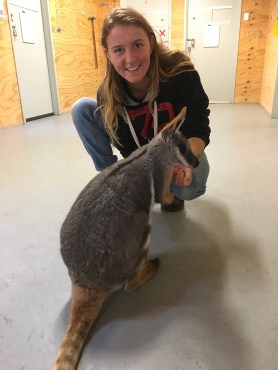
Figure 2. Lily, a Yellow-foot rock-wallaby, and I bonding over nibbles (Fountain 2018)
Verity Carscadden.
References:
ACT Government (2017). ‘Endangered Species Breeding Programs’. Viewed 02/09/2018. <https://www.tidbinbilla.act.gov.au/learn/tidbinbilla/endangered-species-breeding-programs>
Australian Government (2008). ‘Brush-tail rock-wallaby – Petrogale penicillata’, fact sheet. Viewed 02/09/2018. <http://www.environment.gov.au/biodiversity/threatened/publications/brush-tailed-rock-wallaby-petrogale-penicillata >
Claridge. A, Cunningham. R, Catling. P & Reid. A (2010). ‘Trends in the activity levels of forest-dwelling vertebrate fauna against a background of intensive baiting for foxes’, Forest Ecology and Management, vol. 260, no. 5, pp. 822- 832.
Fountain. J (2018). ‘Verity + Lily’. JPG.
Fountain. J (2018). ‘Verity + Jed’. JPG.
Kingsley. L, Goldizen. A & Fisher. D (2012). ‘Establishment of an endangered species on a private nature refuge: what can we learn from reintroductions of the bridled nail-tail wallaby Onychogalea fraenata?’Oryx Cambridge, vol. 46, no. 2, pp. 240-248.
Schultz. D, Whitehead. P & Taggart. D (2006), ‘Review of Surrogacy Program for Endangered Victorian Brush-Tailed Rock Wallaby (Petrogale penicillata) with Special Reference to Animal Husbandry and Veterinary Considerations’, Journal of Zoo and Wildlife Medicine, vol. 37, no. 1, pp. 33-39.
Short. J, Bradshaw. S, Giles. J, Prince. R & Wilson. G (1992). ‘Reintroduction of macropods (Marsupialia: Macropodoidea) in Australia – A review’, Biological Conservation, vol. 62, no. 3, pp. 189-204.

 Biodiversity Conservation
Great blog Verity. Worth the early start by the looks. Phil