
IS THERE A FUTURE FOR CORAL REEFS?
Saurabh Kataria

Coral reefs are in decline worldwide at a catastrophic rate due to effects of humans and will continue to do so in the future. Corals are affected by the same number of processes which have disrupted other human influenced ecosystem but there are some factors which are more prominent: (1) Increase in average sea level by even 1°C, can trigger the event of coral bleaching, alteration in coral communities and ultimately coral death. (2) Corals which are resilient to effects from habitat degradation are quite small and with a short life span. Effects from habitat degradation will lead to establishment of weak corals fragile to climate change. (3) Activities by people near reef sites increases both nutrient inputs and fishing pressure. Often these condition favors growth of competitors and might lead to eruption in predator population. (4) According to Fossil record, coral reefs as a group are more likely to face extinction than several other groups associated with them, whose habitat requirements are less rigorous (Knowlton, 2001).
Below I have listed various factors that affects corals and their evolutionary futures:
GROWING DISEASES
Corals and other reef dwellers are constantly being affected from the diseases. The effects on corals from pathogens are severe since high mortality rates persist [up to 2 cm of coral tissue daily (Richardson et al, 1998)] on the other hand coral growth rate are naturally low. The area of Caribbean, provide a great example for troubling situation surrounding corals. Earlier, reefs throughout the Caribbean region was dominated by a genus named Acropora. During 1990’s, Majority of Acropora were diminished to several small patches scattered across the region with a minimal recovery rate whereas the growth rates were relatively high (Richardson, 1998). The case with recent variation in coral diseases is still unknown, largely because the pathogens responsible for such diseases are still unidentified. Marine diseases are still on large as there are no records of previous diseases or any of the pathogens responsible for such consequences. Increase in the intensity of diseases in marine ecosystems could be generally a part of global climate change and terrestrial human activities have appeared to introduce at least one pathogenic agent via run-off to coral reefs (Harvell et al, 1999).
FLUCTUATING ECOLOGICAL BALANCES
Corals don’t just have to worry about pathogens as they aren’t the only enemy who challenge their survival but coral mortality are often associated with development of competitors and predators. The biggest competitor to corals today on majority of the reefs around the world are seaweeds, competition between micro-algae and corals is designed mainly due to nutrient availability and herbivory (Hughes et al, Lapointe & McCook. 1999). Anthropogenic factors like overfishing and eutrophication that affects coral competitors are also the factors that help in population explosion of some of the coral predators. The crown-of-thorns starfish, Acanthaster planci, is the most notorious of these (Bradbury et al, 1997) but explosions of predatory snails, specifically in the genus Drupella, have also been noted (Turner, 1994).
BIO-EROSION, SEA LEVEL AND STORMS
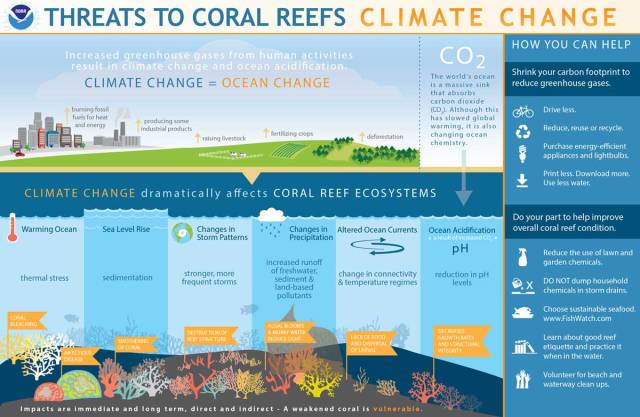
Sea level is one of the most common and prominent factor when it comes to global climate change. Sea level rise in past have been linked to coral development but in the recent scenario where sea level rise is happening at a catastrophic scale, it may result in drowning of corals (Wood, 1999). Drowning of reef would be a major and potential concern since future estimates indicates that the rise in sea level are beyond the levels to which corals would sustain. However, global climate change isn’t only limited to sea level rise but various kinds of storm activities are more than enough to wipe corals from the face of the earth. Both storm activities as well as bio-erosion are projected to rise as a response to global anthropogenic factors. The former because correlation between cyclonic storms and high temperatures while latter because of association between nutrition of bioeroders and eutrophication (Hallock, 1998). Increase in levels of storminess and bio-erosion will have evolutionary consequences on corals in addition to their common effects. These activities would support strong coral structure or skeleton which could withstand such activities. Moreover, rapid sea level rise will lead to selection for vertical growth (Knowlton, 2001) which will support selective species on expense of other species.
The above factors are major threats to the future of coral reefs and these factors are on rise with no sign of slowing down. These ecosystems are both slow in recovery and vulnerable to extinction which makes it even a bigger concern. The most appropriate guide to predicting future for corals are past mass extinction which correlates to the factors in recent scenario. Sadly, there are very little evidence in past extinction as those organisms which were vanished are different to those we wish to foresee. The combination of several factors including global warming, eutrophication and loss of top food chain members is unprecedented for more than past 65 million years. Thus, it is perhaps not surprising that many of the reef organisms that persisted and thrived during the most recent biological upheavals are those who are suffering the most now (Johnson et al, 1995). It is difficult toforesee who will be the winner in this battle but one thing is sure, we will not be happy with the outcome.
Reference
Bradbury R., Seymour R. (1997) Proc 8th International Coral Reef Symposium, 2:1357–1362.
Hallock, P (1988). Palaeogeography, Palaeoclimatology, Palaeoecology, 63:275–291.
Hughes T P, Szmant A M, Steneck R, Carpenter R, Miller S (1999). Limnol Oceanography, 44:1583–1586.
Harvell C D, Kim K, Burkholder J M, Colwell R R, Epstein P R, Grimes D J, Hofmann E E, Lipp E K, Osterhaus A D, Overstreet R M, et al. (1999). Science, 285:1505–1510.
Knowlton, N. (2001). Proceeding of National Academy of Sciences of United States of America, vol. 98, no.10.
Lapointe, B. E. (1999) Limnol Oceanography, 44:1586–1592.
McCook L J (1999) Coral Reefs, 18:357–367.
Turner S. T. (1994). Oceanography Marine Biology Annual Review, 32:461–530.
Johnson K. G., Budd A. F., Stemann T. A. (1995). Paleobiology, 21:52–73.

 Biodiversity Conservation