
Spoiler alert: we didn’t catch any
u5204437 Sarah Buchan
In April I accompanied a group of researchers from ANU led by Dave Rowell on a preliminary field trip during April to locate and catch funnel webs from Atrax robusta, Hadronyche cerberea and Hadronyche versuta within the Booderee National Park in south-east NSW.

Booderee National Park (in purple box) in relation to the south-east coast. From google maps.
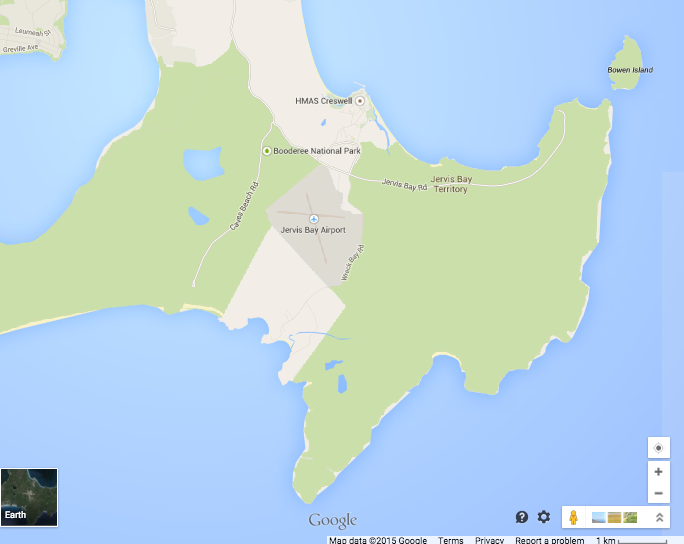
Booderee National Park from google maps.
The aim was to collect individuals on the mainland to compare morphologically and genetically to a population on Bowen Island (a small island off Jervis Bay separated for over 10,000 years) that will be collected on a future trip. Dave hypothesised that the funnel webs from the island have diverged from the mainland individuals and evolved gigantism, ie. Giant funnel Webs. I believe it is important work in exploring the biodiversity of Booderee and extend our current knowledge of Funnel Web spiders.
Along with the funnel web expedition we also worked on sampling Fergusonia fly galls (Scheffer et al. 2004 ) on Eucalyptus burgessiana trees as part of Michaela Purcells PHD work. On the drive to Jervis Bay we stopped a number of times on the side of the road to hunt for galls with some successes.
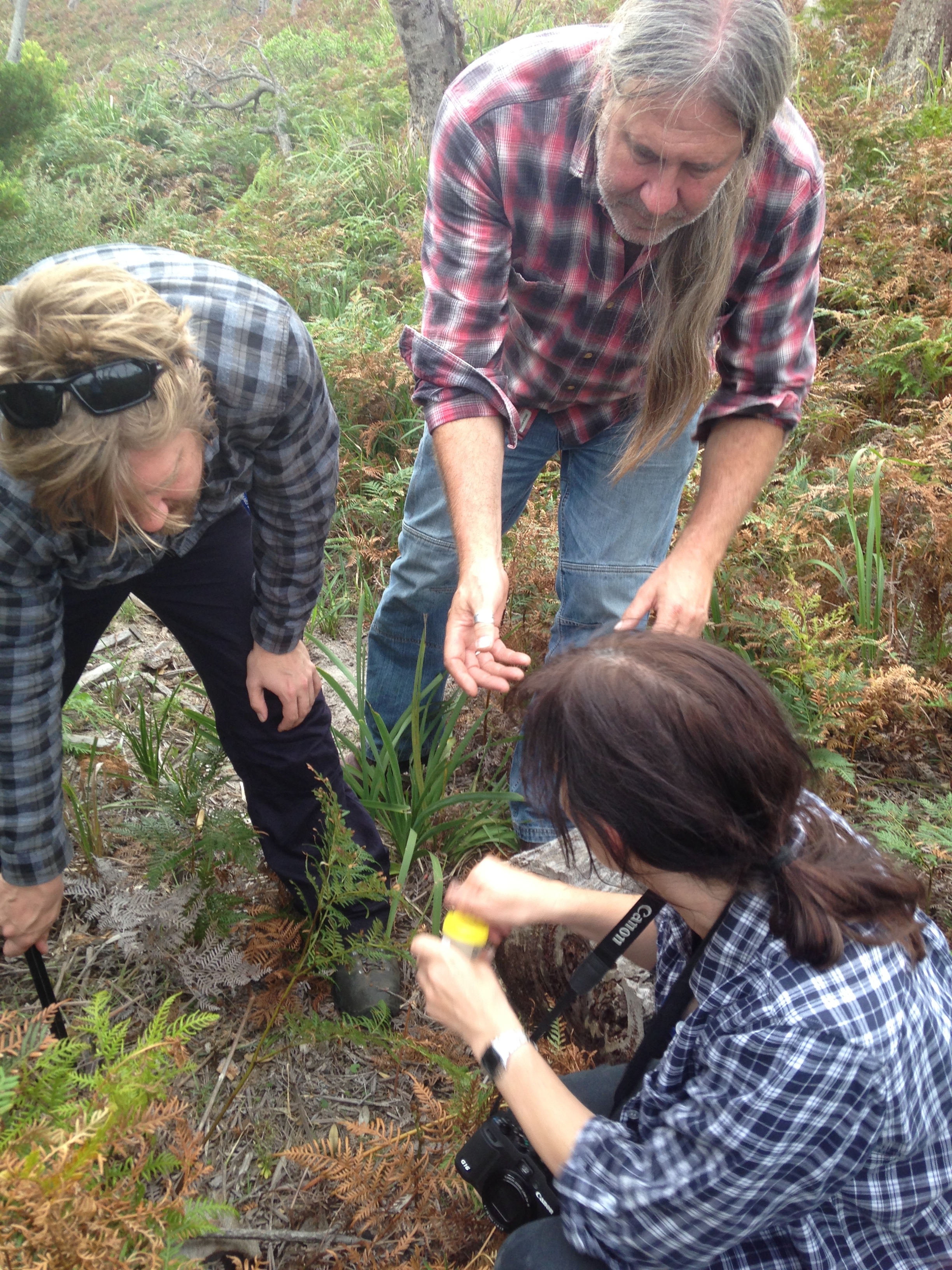
Clearly flannelette shirts are required uniform in the field (from personal photo library).
We started our search by visiting the National Parks Office and consulting their rangers for local knowledge of hotspots. From there we drove around fire trails to search a variety of vegetation types for suitable logs. Hadronyche are saproxylic meaning the build their burrows in decaying wood (Woodman et al. 2oo6). Atrax ,known to co-occur with Hadronyche (Beavis et al. 2011), usually in ground burrows underneath decaying wood or logs on the ground.
Finally, we found the opening to a female burrow in a Eucalyptus stump the car park of a beachside campground. This was a particularly interesting find as the opening was at least 4cm across indicating a female over 20 years old! As the female was potentially deep inside a large stump extraction beyond the equipment we had brought, so we left her to peacefully be. We found more web evidence of both male and females from both Hadronyche and Atrax in the botanical gardens with no successful captures. We also explored a banksia woodland and found burrows in a live Banksia tree (pictured) which is very unusual.
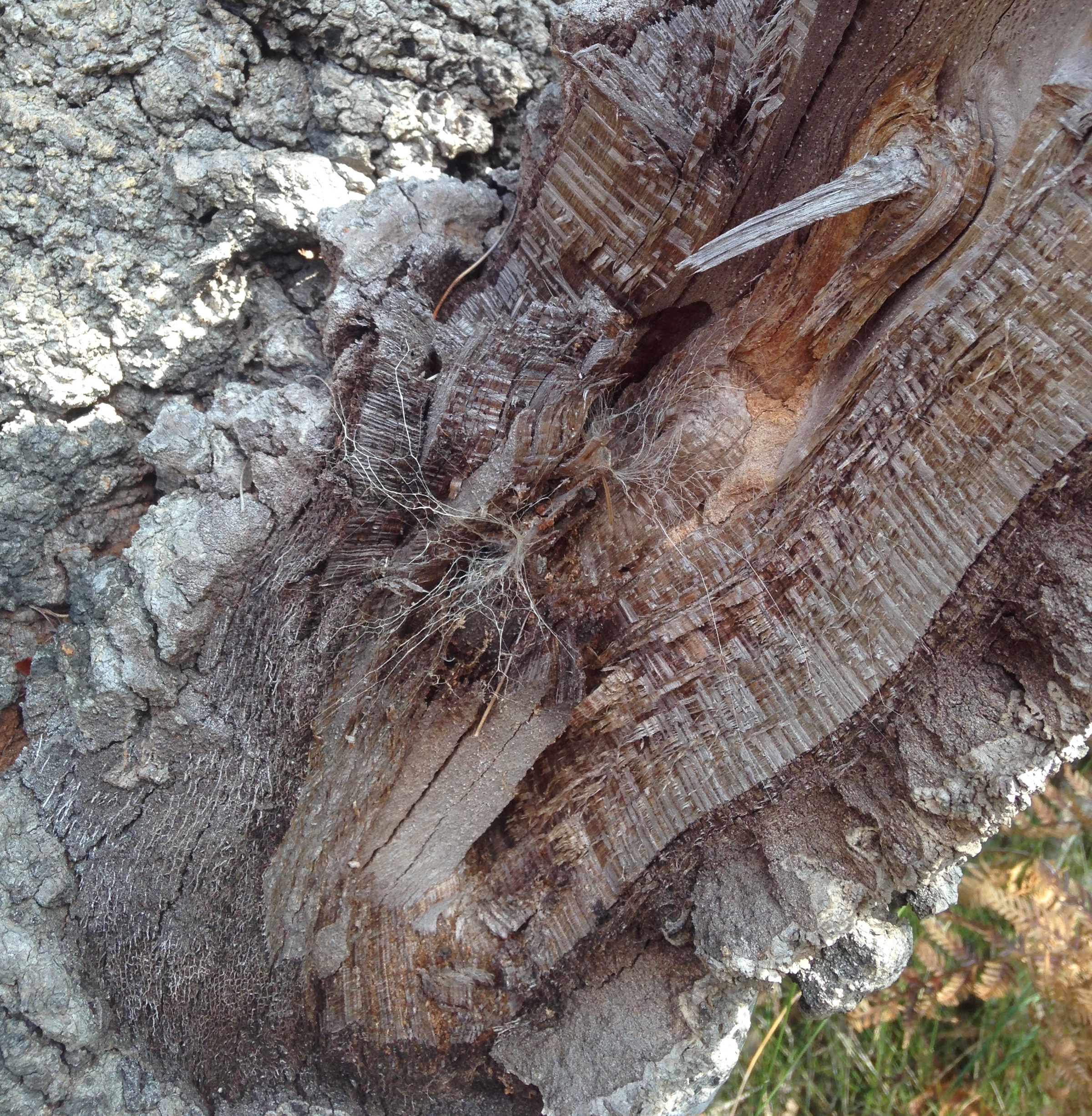
A Hadronyche burrow in a live Banksia tree (from personal photo library).
Even though we didn’t catch any live individuals on the trip we found strong evidence of the two genera co-occurring of funnel webs both males and females. However, further trips will be needed to catch individuals to compare with proposed collected individuals from Bowen Island. There was also very different and interesting habitat choice of the funnel webs, which has the potential to be an important find for the biodiversity of funnel webs.
I learnt a lot about the effort that goes into field work and searching for in new place. It was a really fun experience and I’m secretly grateful I didn’t find a big hairy spider.
I would like to thanks Dave Rowell, Michaela Purcell and Thomas Wallenius for organising an exciting and fun trip.
References
Beavis A, Sunnucks P and Rowell D, 2011. Microhabitat preferences drive phylogeographic disparities in funnel web spiders. Biological Journal of the Linnean Society. 104:4, 805-819.
http://onlinelibrary.wiley.com/doi/10.1111/j.1095-8312.2011.01753.x/full
Scheffer S, Giblin-Davis R, Taylor G, Davies K, Purcell M, Lewis L, Goolsby J and Centre T, 2004. Phylogenetic Relationships, Species Limits, and Host Specificity of Gall-Forming Fergusonina Flies (Diptera: Fergusoninidae) Feeding on Melaleuca(Myrtaceae). Annals of the Entomological Society of America. 97:6. 1216-1221.
http://aesa.oxfordjournals.org/content/aesa/97/6/1216.full.pdf
Woodman J, Ash J and Rowell D, 2006. Population structure in sproxylic funnelweb spider (Hexathelidae: Hadronyche) along a forested rainfall gradient. Journal of Zoology. 268. 325-333.
http://onlinelibrary.wiley.com/doi/10.1111/j.1469-7998.2005.00012.x/epdf

 Biodiversity Conservation
What an interesting couple of days of work experience! I’d would be great to know more about the place of evolutionary ecology in biodiversity conservation (and the consequences of genetics divergence in directing conservation), as well the role of funnel webs in the Booderee ecosystem.